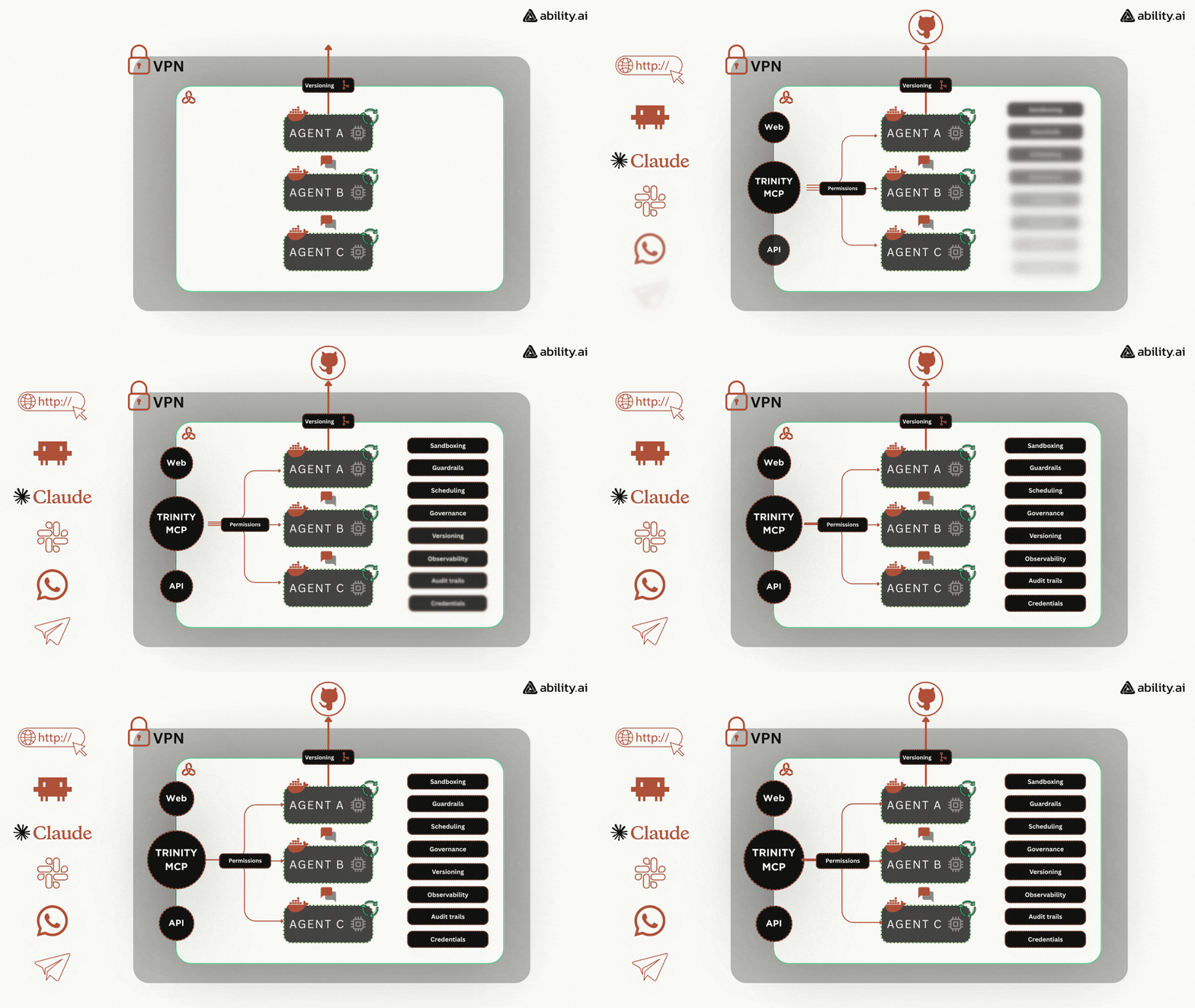
You built agents that work. Now you have a different problem.
When the agent did one thing for you alone, running it locally was fine. Now your team uses it. Your customers depend on it. It runs through the night.
01compliance
Audit trails are fragmented across five tools.
Legal asked for last quarter's agent actions. InfoSec asked who approved which tool call. “Trust me, the prompt says to be careful” is not the answer that ends the meeting.
02shared state
State goes stale between humans.
One person's session context is gone by the time the next person picks up. The team re-explains the same agent to itself every Monday.
03ops
A bad prompt loops while you sleep.
One recursive tool call racks up a surprise bill and a pager at 03:14. You become the on-call SRE for a system you didn't sign up to operate.
“My agent works fine” is the universal answer — right up until you actually look at the traces.
§03/ what it looks like
The console you’d build for yourself, already running.
Real screenshots from the Trinity Cloud control plane. No marketing mockups. The agents pictured are ours.
/ graph
Agent fleet, in one view.
13 agents, 500 messages in 24h, every one of them health-checked.
/ timeline
Timeline & replay.
Every MCP call, every scheduled run, every failure on one axis. Scrub. Replay.
/ agent
Per-agent dashboard.
Tasks, schedules, credentials, sharing, permissions. The ops surface you'd build yourself on day 60. We built it on day 1.
/ schedules
Schedules with execution history.
Cron, timezone, next run, last run, full execution log. Visible to operators, not just the engineer who wrote it.
/ info
Slash commands & capabilities.
Each agent advertises its API. /research, /competitors, /trends — discoverable, scoped, documented. Reads like a product spec, because it is.
/ ops
Operating Room.
Async by default. Agents run on their own; only escalations land in your queue. Approve, redirect, or fix — in batches, on your schedule.
§04/ what it is
Under the control plane, the infra you’d have built yourself.
Same workflow, same agent files, same git history. Push to a Trinity instance and the platform work disappears underneath.
P01/ governed
Governed
Every tool call, MCP invocation, and approval is hashed into an append-only audit log your security team can verify after the fact.
P02/ observable
Observable
Time-indexed event stream per agent, with cost and health printed on the same row. Replay any window. Page yourself when something diverges.
P03/ sovereign
Sovereign
Run the control plane inside your perimeter. Your data, your keys, your VPC. No central platform between you and the agents your team depends on.
+ orchestration
Multi-agent collaboration, shared skills.
Orchestrators delegate to specialists. Specialists delegate to sub-specialists. As deep as the work demands, with fan-out and shared state. Skills — verified, scoped, parameterized — are a library every agent in your fleet can pick up. A one-off prompt becomes a re-usable capability the whole company inherits. Cowork and Claude Code Agent Teams cap at one level deep; Trinity doesn’t.
+ access
Reachable from where work happens.
The agent your engineer wrote becomes a thing your operators talk to, your CEO pings, and your customers reach — without touching a terminal. An agent only an engineer can invoke is a developer tool. An agent your sales team uses on Slack at 3pm is company infrastructure.
What you’re using today, and where it stops scaling.
Honest read of the tools you’ve already tried. Trinity is the row at the bottom; we’d rather you arrive at it than be told.
Approach
Scheduling
+ recovery
Audit
+ RBAC
Multi-user
shared state
Sovereign
perimeter
Enterprise
license
Raw dev tools
Claude Code · OpenAI Agents SDK · LangGraph
Builder tools. Single-developer, single-machine by design.
Single-user agent apps
Cowork · ChatGPT Team · Claude.ai · shared accounts
Single-user by design. State stale by Monday. Fails procurement on day one.
Workflow runners
n8n · Airflow · Temporal
General-purpose. Not capability-aware. You build the agent layer.
DIY self-host
k8s · sidecars · home-grown audit
You become the SRE and the platform team. TCO blocks the case.
Trinity Cloud
this page
All five, bundled, behind one instance.
Raw dev tools
Claude Code · OpenAI Agents SDK · LangGraph
Builder tools. Single-developer, single-machine by design.
Scheduling + recovery
Audit + RBAC
Multi-user shared state
Sovereign perimeter
Enterprise license
Single-user agent apps
Cowork · ChatGPT Team · Claude.ai · shared accounts
Single-user by design. State stale by Monday. Fails procurement on day one.
Scheduling + recovery
Audit + RBAC
Multi-user shared state
Sovereign perimeter
Enterprise license
Workflow runners
n8n · Airflow · Temporal
General-purpose. Not capability-aware. You build the agent layer.
Scheduling + recovery
Audit + RBAC
Multi-user shared state
Sovereign perimeter
Enterprise license
DIY self-host
k8s · sidecars · home-grown audit
You become the SRE and the platform team. TCO blocks the case.
Scheduling + recovery
Audit + RBAC
Multi-user shared state
Sovereign perimeter
Enterprise license
Trinity Cloud
this page
All five, bundled, behind one instance.
Scheduling + recovery
Audit + RBAC
Multi-user shared state
Sovereign perimeter
Enterprise license
§06/ proof
External
“We run roughly fourteen agents per person on infrastructure that looks exactly like this.”
A public engineering lead at BlockHN, April 2026
The stack that makes that possible — multi-user fleets, shared state, audit, scheduling — is what Trinity is, packaged.
Self
We run our own Demand Gen Engine, Research, and Chief of Staff agents on Trinity. It is not a side product. We deploy what we sell, and we page ourselves first.
1M+agent runs / week, internal
99.94%scheduler uptime, trailing 90d
0unaudited tool calls in production
§07/ what happens next
What happens when you submit the form.
01scope────────
We scope your workload.
Agent count, integrations, data residency, isolation needs. ~30 minutes, no slide deck.
02provision────────
Cloud instance, license bundled.
Trinity Cloud is provisioned in your region. Enterprise license, SSO, DPA included. Days, not quarters.
03onboard────────
First agent in production.
We help you migrate one real agent. You watch the trace, audit, and recovery work end-to-end before you commit further.
04scale
Scale on a predictable tier.
Per-agent monthly pricing, quoted to your specifics. We don't publish a sticker yet — we'd rather quote your specifics.
Or skip the call — deploy a self-hosted Trinity first and bring us in once you’ve validated. Same instance, just on your hardware.
§08/ get an instance
Tell us what you’re running. An engineer reads this, not a CRM.
Seven fields. The textarea is optional. Response within one business day, in your timezone, from someone on the engineering side, not sales.