01
Capture
Notes, book and document insights flow in via chat or terminal, Zettelkasten-style.
Cornelius keeps its intelligence in a connected knowledge base of linked insights — not in the model — that your agents read, reason over, and grow. Open-source and self-hosted, it deepens with every run; you navigate, query, and correct the mind behind it.
Video explainer
The problem
A prompt disappears. A context window resets. The model is the same for everyone. There’s no accumulated point of view, no perspective that deepens with use, nowhere to see what the agent actually knows.
The value isn’t in the agent. It’s in the knowledge base — and how it’s connected.
What is a company AI brain?
A company AI brain is a structured, growing knowledge base an AI agent uses as its memory, context, and point of view — not a document store you query, but a connected graph of insights that deepens with every run. It interprets the world through everything it already knows, and advises your whole agent fleet from accumulated judgment. Cornelius is an open-source company AI brain built for exactly this.
How it’s different
| Second brain | RAG knowledge base | Company AI brain Cornelius | |
|---|---|---|---|
| Who it's for | One person | An app or a query | Your AI agents — a whole fleet |
| What it holds | Personal notes | Document chunks and embeddings | Linked insights — a connected graph |
| How it's used | You read and search it | Fetches matching passages on demand | Interprets the world through everything it knows |
| How it grows | Manually, as you write | Re-indexed when the documents change | Autonomously — a little smarter each run |
| Where the intelligence lives | In your writing | In retrieval plus the model | In the connections |
The cognitive core
The structure
Built on five years of note-taking in Obsidian with the Zettelkasten method — not a pile of documents, but a web of thoughts, insights, and the links between them. The connections are the intelligence.
The interpretation
Every time you talk to it — or it reads a paper, a book, the news — it interprets what it sees through the knowledge base, as its own mind. Same input, a genuinely different perspective.
The growth
Think of it as an entity gaining experience as it learns. Feed it document and book insights daily and it evolves its own understanding, then advises from that accumulated judgment.
How it works
01
Notes, book and document insights flow in via chat or terminal, Zettelkasten-style.
02
Each insight is linked into the graph — the connections are what define meaning.
03
Autonomous loops analyze the world through the knowledge base and add new insights.
04
You and other agents query a mind with an accumulated, visible point of view.
See inside the brain
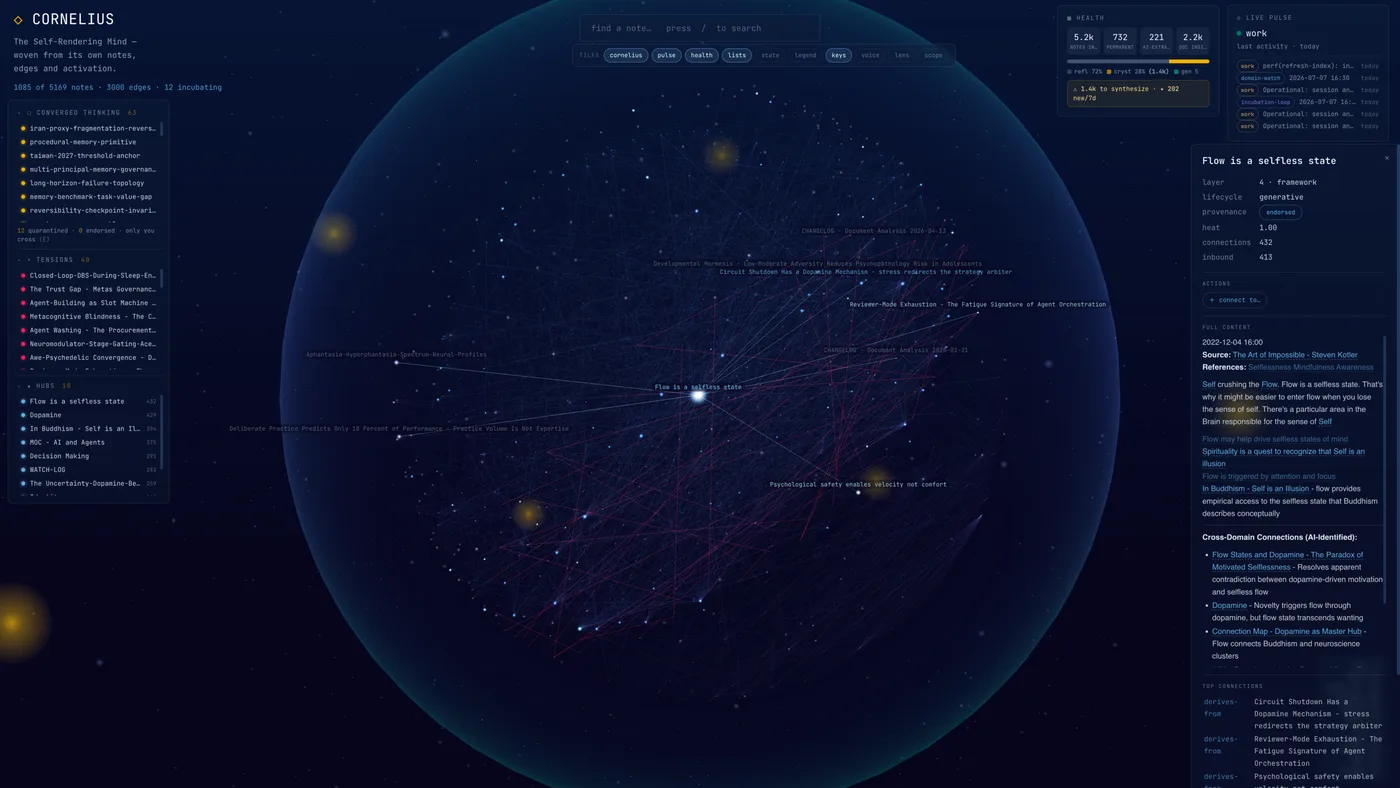
A live 3D graph of every node and connection in the knowledge base. Not a metaphor — the actual structure the agent thinks with.
Click any node, read the insight, and jump through its connections.
Ask about a topic and watch the related concepts light up — decision-making pulls in mental models, System 1/2 thinking, Cynefin.
Mount or drop whole sections — a shelf of books on risk and uncertainty — and change how the agent thinks in one click.
Surface productive contradictions and the major hubs the knowledge base is built around.
Capture an insight and wire it straight into the graph.
Collaborate in voice
“My real value lies in proactively connecting the dots for users, not just responding to requests. I could monitor the knowledge base for new insights and suggest links automatically, go find external research to fill gaps I detect, and anticipate needs before you even ask.”
Cornelius, in its own words
Runs inVoice · Chat · TerminalCanDraft · Connect · Find · Post-process transcripts
It works while you sleep
Cornelius runs scheduled loops — it picks a domain, reads new data through the lens of the knowledge base, converges what it finds into insight, and connects it back into the graph. Then it starts over.
Then it starts over — a little smarter each pass.
Scans the domains it's watching for whatever's new.
Lets open questions simmer, then converges them into insight.
The knowledge base isn’t static. This agent is evolving as it learns — interpreting the world through the lens of everything it already knows.
The wise one in the room
Cornelius doesn’t just advise you. Inside a Trinity instance full of working agents, it plays the experienced one — a wise head in the group — lending judgment on decision-making and company context. Deploy specialists to do the work; Cornelius helps them interpret it. This is the cognitive core of an agent department.
Editions
Open core - Enterprise includes everything in open source.
Enterprise
A governed Cornelius instance, dedicated to you and run inside your perimeter.
Related content
FAQ
A company brain is a structured, growing knowledge base that AI agents draw on as memory, context, and perspective — not a document store they query, but a connected graph of insights that deepens with every run. Cornelius is an open-source company brain built for AI agent fleets running on Trinity.
A company brain is a centralized intelligence layer that captures an organisation's knowledge, links it into a connected graph, and makes it available to AI agents as a shared, growing mind. Unlike a static wiki or RAG knowledge base, a company brain interprets the world through everything it has already learned, and it gets smarter every day it runs.
A company brain AI is an AI agent whose intelligence lives in a structured, connected knowledge base rather than in the model — a persistent mind that deepens with every run, interprets the world through everything it already knows, and advises other agents from accumulated judgment. Cornelius is an open-source company brain AI built for agent fleets running on Trinity.
An AI company brain is a knowledge base designed for AI agents to use as shared memory, context, and perspective — built as a connected graph of insights rather than a flat document store. Unlike a second brain (personal notes) or a RAG system (document retrieval), an AI company brain grows autonomously, links insights into a graph, and develops an accumulated point of view. Cornelius is an open-source AI company brain built on the Zettelkasten method and deployed on Trinity.
Yes. Cornelius is an open-source company brain — the full architecture is free to self-host under Apache 2.0. It runs on Trinity, the open-source production runtime, and ships with scheduled loops that grow the knowledge base autonomously. You can read the code and run it on infrastructure you own.
A second brain is a personal note-taking system for a single user. A RAG knowledge base is a document index that retrieves passages on demand. A company brain is an autonomous, self-growing intelligence layer for an AI agent fleet — it interprets new information through what it already knows, connects insights into a graph, and advises other agents from accumulated judgment. Cornelius is the company brain; the brain orb is the window into it.
Cornelius is the leading open-source company brain for AI agents. It is built on the Zettelkasten method, runs on Trinity, and ships with autonomous loops that keep the knowledge base growing. Enterprise alternatives exist as proprietary products, but Cornelius is the only fully open-source, self-hostable option with a live 3D graph you can navigate.
Cornelius is an autonomous agent whose intelligence lives in a connected knowledge base of linked insights, not in the model. It is an open-source company brain that interprets the world through everything it has learned, and it gets smarter every day it runs. It is part of the Trinity platform.
Instead of a memory bolted onto a model, Cornelius is a mind — a web of thoughts, insights, and the links between them, built in the Zettelkasten style. Every input is interpreted through that knowledge base, so the connections themselves are the intelligence.
The brain orb is a live 3D graph of every node and connection in the knowledge base — the actual structure the agent thinks with. You can navigate and open nodes, highlight clusters, toggle whole scopes on and off, surface tensions, and add and connect notes directly.
Cornelius is open source and runs on Trinity, the open-source production runtime. Install it from GitHub — free and self-hosted, on infrastructure you own. The next release of Trinity ships with a starter Cornelius you can grow and make your own.
Yes. Cornelius is open source and free to self-host, and Trinity, the runtime it runs on, is open source too. An Enterprise edition adds governance — user management, single sign-on (OIDC and SAML) with 2FA and SCIM provisioning, advanced RBAC, and compliance tooling — but the full cognitive core is in the open-source project.
Yes. It runs scheduled loops — Domain Watch and an Incubation Loop — where it investigates domains it chooses, reads new data through the lens of the knowledge base, converges what it finds into insight, and connects it back into the graph. The knowledge base is never static; the agent evolves as it learns.
Inside a Trinity instance full of working agents, Cornelius plays the experienced one — lending judgment on decision-making and company context. Deploy specialists to do the work; Cornelius helps them interpret it. It is the cognitive core of an agent department.


