The applied AI lab behind AI-native companies
Managed
For teams.
We build your agents, run them for you, and what they build up stays with you.
Open source & Enterprise
For builders.
We provide the open-source operating system for AI agents: Trinity, with Cornelius, its cognitive architecture, built in.
Partner program
For agencies.
You keep the client. We give you the platform, the training and a share of the license.
 Cloudflare
Our approach
Compounding intelligence your company owns.
Most software loses value from the day it ships. Our systems work inside your real operations, and the knowledge they build there stays with your organization, so they are worth more next year than they are today.
From Demos that never survive the first real week
To Operated as production infrastructure - scheduled, audited, recoverable
From Configured once, degrading from day one
To Turns operational experience into knowledge the company keeps
From Tied to one model: switch it and the agents start over
To Switch models and keep what the agents know - it lives in your knowledge base, not the model
From Built on the same models as everyone else
To Differentiated by the knowledge they accumulate in operation
Inside the lab
We build the technology, and stay ahead of it.
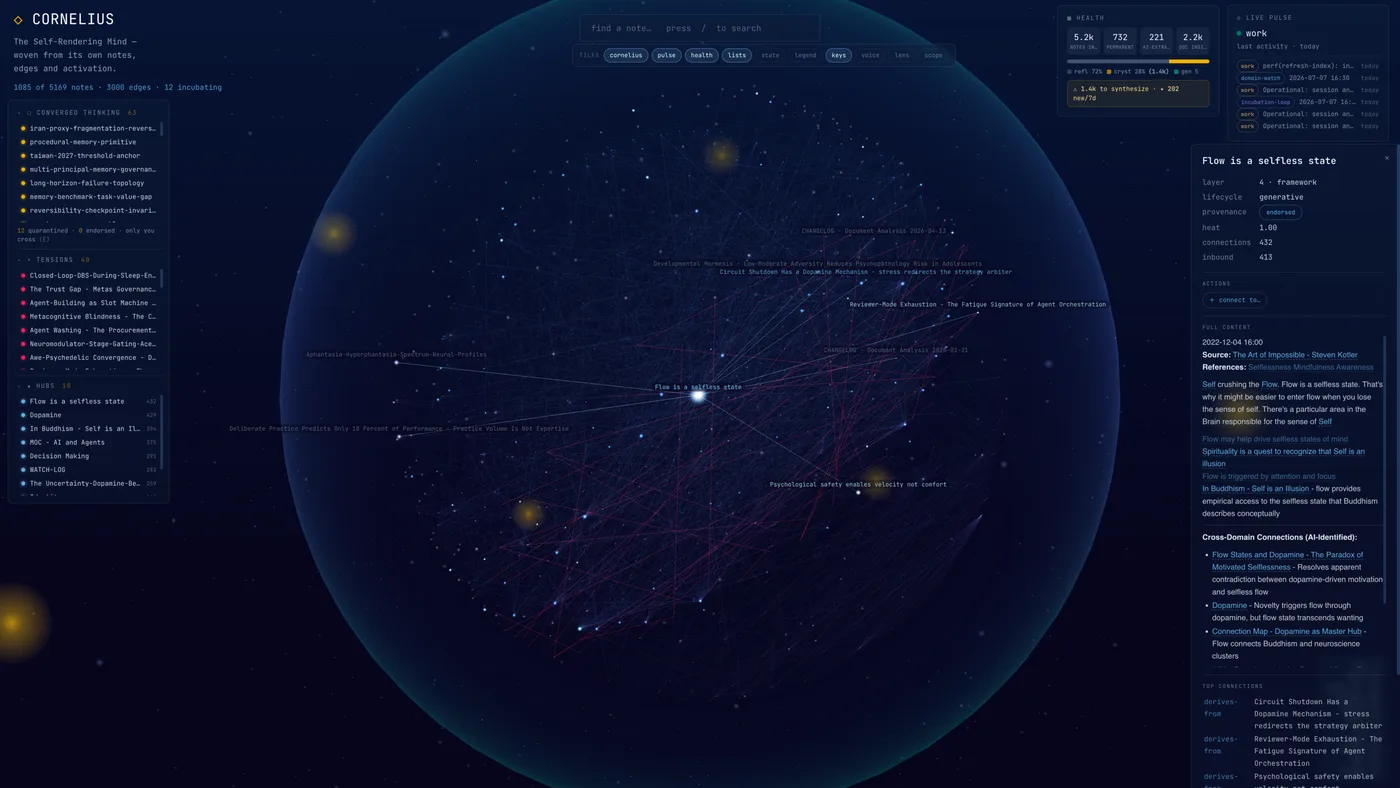
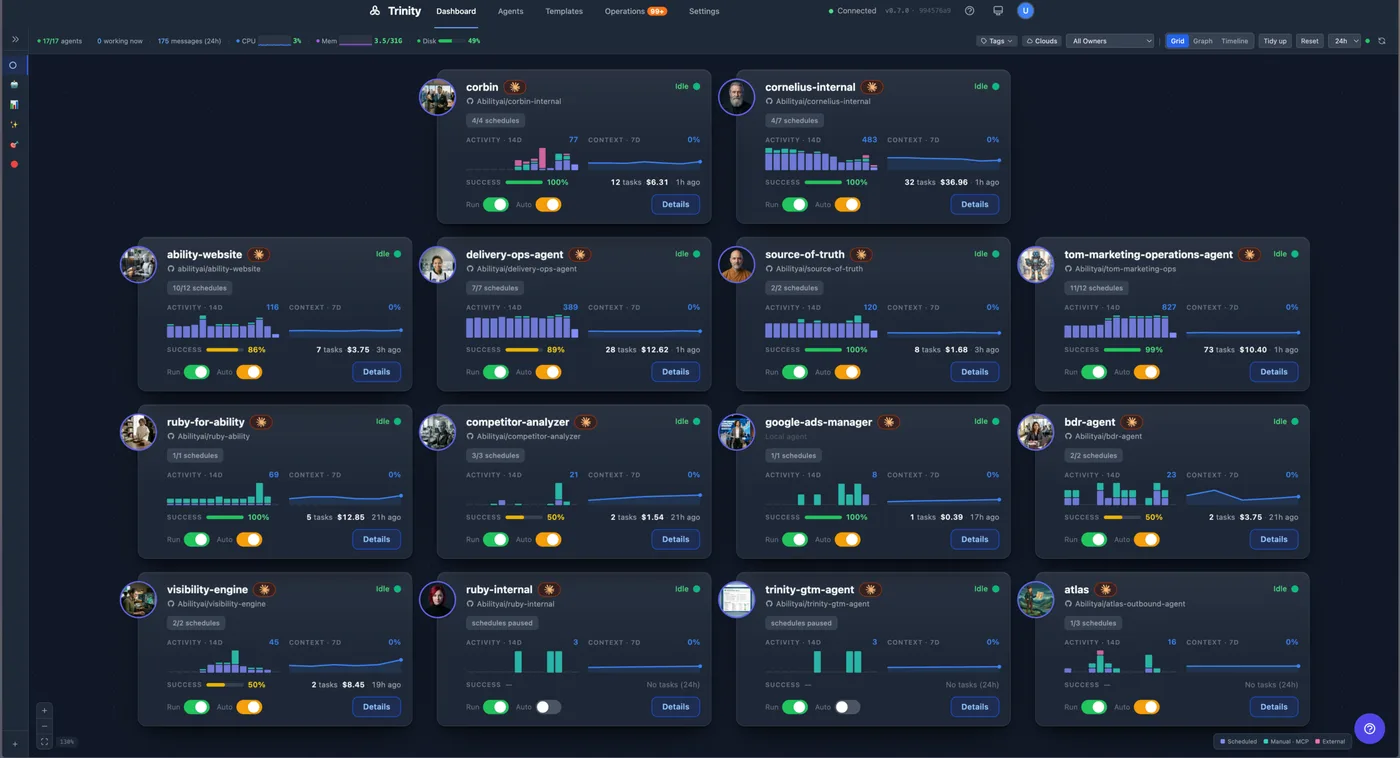 Pictured: the agents we run Ability AI on. Nine people, 45 agents.The operating systemTrinity.Where a company’s agents and workflows run with permissions, state, governance and receipts. Open source, Apache 2.0.★ 708 on GitHub ↗v1.0.0 · Oct 20 ↗Explore Trinity →
As featured in





Shaped to your company
Your organization, run by agents.
Departments, roles and reporting lines in one system: every agent answers to its people and works with them in one shared workspace.
- One agent
- A department
- The company
Sales · 2 agents
Sales leadMarketing · 1 agent
Marketing leadSupport · 1 agent
Support leadPeople · 1 agent
People leadOperations · 1 agent
Operations leadIn your control
Yours, and on the record.
Adaptive improvement inside strict governance: every piece of work an agent does leaves a receipt your people can read, check and undo, on infrastructure you own.
- Logged. Every action lands in an append-only audit trail.
- Approved. Decisions you choose wait for the person in that role.
- Owned. It runs inside your perimeter, on any model, and what it builds up is yours to keep or export.
- Reversible. Every change is a commit you can roll back.
Renewal offer sent to Northwind
Sales department · outbound agent
- What happened
- Drafted the renewal offer and queued the email to the client.
- Why
- The client asked for 15%. Pricing policy allows 12% on this plan.
- Who signed off
- Sales lead, in the Inbox Approved at 12%
- What the company kept
- Pricing-objection playbook, updated. Read by every agent.
a3f19c · roll back any timeWritten to the append-only audit trail
In production
AI at work inside real companies.
Agents we built, running inside our clients’ own operations, and what changed for them.
 Customer SupportSupport answers in minutes, not a business day
 OperationsCompany knowledge, found in minutes not an hour
 Business Operations6,500 members matched with 95% coverage
 Marketing ContentTechnical content at scale, accuracy intact
 Knowledge ManagementA governed AI mind on stage in under 9 weeks

“We run our entire production agent fleet on Trinity - multi-user, scheduled, and audited, all inside our own perimeter. It just runs.”
“They quickly understood our goals, proposed pragmatic solutions, and moved implementation forward with minimal friction. Their responsiveness and domain expertise have improved both our team’s efficiency and the impact of our campaigns.”




 Tapestry
Next step
Three ways to work with us.
We set it up for you, give you the technology, or equip you to deliver it. One system underneath.
- Agents built around your processes
- Trinity operated for you, on infrastructure you own
- Monitored, maintained and improved in production
- Start from GitHub, DigitalOcean or AWS
- Run it on your own infrastructure
- Add Enterprise for governance at scale
- You own the client; we share every license
- Our methodology and blueprint library
- Training and a supervised first install
From the lab
We share what we build.
Webinars for leaders, workshops for builders - knowledge, findings, and work, live and on the record.
AI adoption for business leaders — strategy, governance, and what it takes to put agents into production across an enterprise. Built for executives and partners.
Upcoming
Latest recordings


What does Ability AI actually do?
We are the applied AI lab behind AI-native companies. We build Trinity, our operating system, and Cornelius, our cognitive architecture, and release both as open source, so the intelligence your company builds compounds and stays yours.
You can run the foundation yourself, have us build and run your agents on it, or deliver it to your own clients as a partner.
What are Trinity and Cornelius?
Trinity is the open-source operating system for your company's AI: your agents and workflows run on it with permissions, state, and receipts - governed, audited, scheduled, multi-user, and recoverable, inside your own perimeter.
Cornelius is the cognitive architecture: it turns operational experience into knowledge the company keeps and builds on - adaptive improvement inside strict governance.
Is it really open source? What's the catch?
The whole platform is Apache 2.0 - self-host it, inspect it, extend it, free forever. There is no gated core.
Enterprise is the same foundation plus the governance an organization needs: org management, single sign-on (OIDC and SAML) with 2FA and SCIM provisioning, advanced RBAC, compliance tooling (an audit dashboard and SIEM export), managed data retention, and offline license management.
Do we own the platform, or are we renting it?
Yes. It's your instance, and your agents live in your GitHub.
Run it yourself, or let us run it and take it back whenever you want.
Can we run it ourselves, or does Ability AI run it?
Both. Self-host the open-source platform inside your own infrastructure, or have us build your agents, run them in production, and maintain them as your business changes.
Because you own the platform either way, switching from managed to in-house is a decision, not a migration.
Can we deliver this to our own clients?
Yes - that is the partner program. Agencies and integrators deliver Trinity-based agents to their clients: you own the client and the services, your client owns the install, and we pay you a share of every license you bring.
Behind every install you get the platform, our methodology and blueprint library, training with a supervised first install, and last-line support.
How is this different from agents that are built once?
Conventional agents are built once and decay. Our systems turn operational experience into knowledge the company keeps.
Cornelius compounds knowledge and ships its own improvements, with receipts - under your control, behind human gates, never on its own.
Won't Claude or OpenAI just do this?
Most of the value is in how the agents are set up and run, not in the model. And your agents should belong to you, not to an AI vendor.
Why not n8n or Zapier?
Those run workflows. Trinity runs agents that hold what your company knows. If you need a fixed workflow, an agent can run one.
What happens if an agent makes a mistake?
Every agent follows business rules you approve before deployment, with deterministic guardrails that keep it on your playbook.
All actions are logged with full chain-of-thought transparency - you can see exactly why a decision was made, and review, override, or adjust any action.
How fast do we see value?
Weeks, not quarters. We start with one focused process, put the agent that runs it into production, and grow from there.
Across our production deployments we have documented 70-95% time savings on the work we automate - and outcomes like EV Energy's first response time dropping from a business day to seven minutes.
Articles
Latest from the lab.
 AI interpretability: ending the black box for safer agents
 Insurance claims AI data: why your foundation is broken
 Corporate knowledge base: solving context rot with AI
 AI agent swarms: a new governance reality
 Declarative AI agents: from prompting to contracts
 AI business outcomes: why shipping code is no longer enough