
AI automation quick wins are high-impact, low-effort workflows that deliver measurable ROI — often within weeks of deployment. The most successful AI adopters begin by targeting these "quick wins" — automations in the "high impact, low effort" quadrant of a prioritization matrix. These early successes demonstrate tangible value, generate excitement within your team, and provide the learnings needed to tackle more complex projects. Here are three key areas to find your first quick wins:
Finding quick wins: automating the repetitive
Every entrepreneur and marketer has a list of tasks they wish they could delegate. This is your "anti-to-do list," and it's a goldmine for automation opportunities.
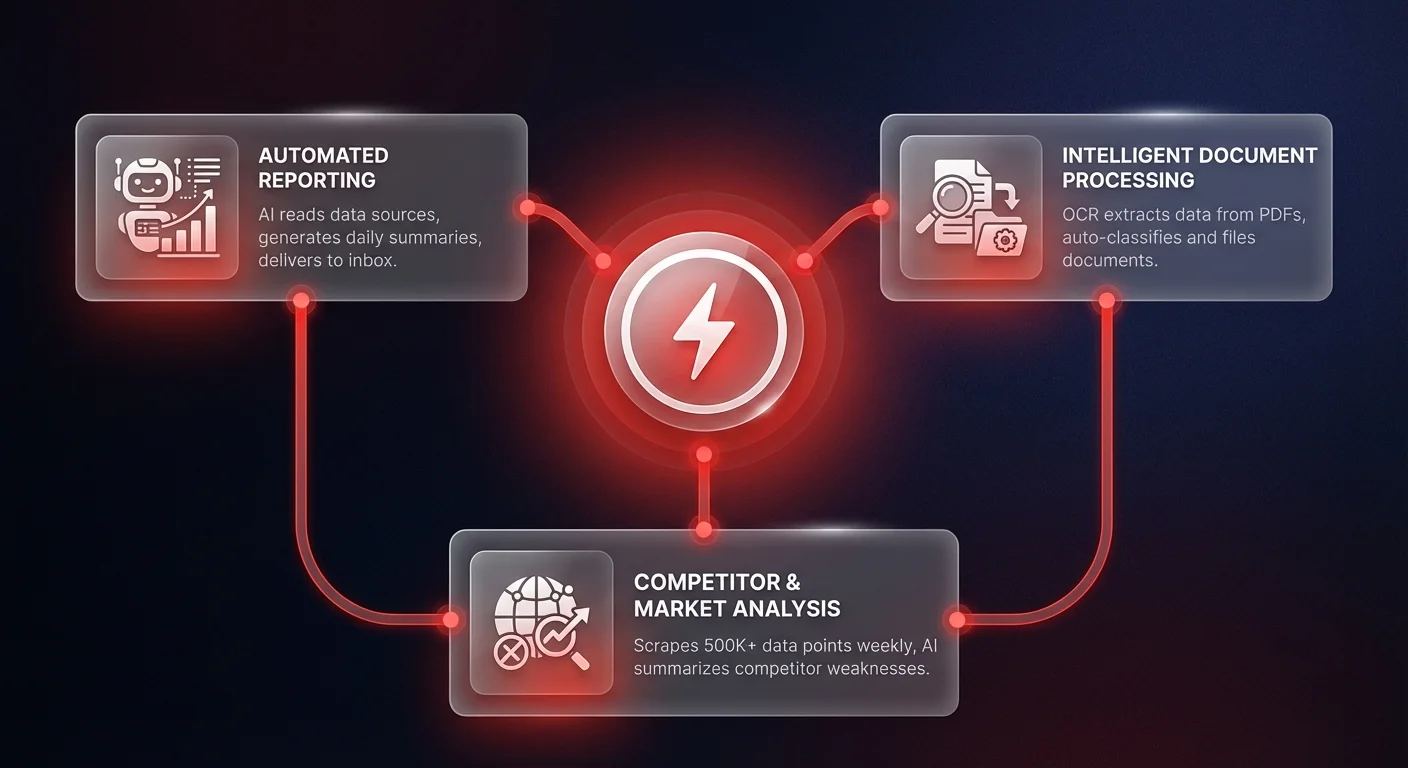
Automated Reporting: Instead of manually compiling sales figures, task updates, and meeting notes each day, you can use tools like Zapier, Make.com, or n8n to connect to your data sources. An AI can then read this data, generate a concise summary, and deliver it to your inbox every morning.
Intelligent Document Processing: Businesses are constantly dealing with PDFs that need to be converted to spreadsheets, classified, and filed. AI-powered Optical Character Recognition (OCR) tools can now intelligently extract data from both electronic and image-based PDFs, automating a process that is both tedious and prone to error.
Competitor and Market Analysis: One founder shared how they built a no-code system using n8n and Bright Data to scrape over 500,000 data points weekly from Amazon reviews and social media comments. An AI model (GPT-4o mini) then analyzes this firehose of information to summarize competitor weaknesses and customer pain points, providing invaluable insights for their marketing messages.
Using AI to democratize skills
AI is a powerful force for democratizing skills. It can serve as an expert assistant, helping your team overcome bottlenecks without the need for extensive training or new hires.
Personalized Knowledge Bases: Imagine having an AI assistant trained on all your company's documents, PDFs, and internal wikis. Tools like Elephas or custom-built "Super Brains" allow you to do just that. Instead of searching through folders, you can simply ask your personalized AI a question - "What were our Q2 sales goals?" or "Summarize the key findings from the Johnson case file" - and get an instant, context-aware answer. This is particularly powerful for legal research, sales enablement, and customer support.
Coding and Technical Assistance: For teams needing to automate processes but facing limitations with legacy software that lacks an API, AI can be a game-changer. One Reddit user, a non-programmer, taught themselves C# to automate a manual reporting process, saving their company hundreds of hours annually. Today, AI coding assistants can accelerate this process, helping marketers and operations staff write simple scripts to bridge technology gaps.
Unleashing creativity with AI
Contrary to the fear that AI will replace creativity, it's proving to be an incredible partner in the creative process. It can help brainstorm ideas, structure complex thoughts, and handle the heavy lifting of content production.
Content Generation and Repurposing: One of the most effective and high-ROI automations is content repurposing. A popular workflow involves taking a single piece of pillar content, like a YouTube video, and using an AI like Claude or ChatGPT to automatically transform it into a series of optimized Twitter threads, LinkedIn posts, and newsletter excerpts. With carefully crafted prompts, the AI can analyze the source material and generate multiple platform-specific variations, complete with hooks and calls-to-action, turning one hour of video production into a week's worth of marketing content.
Brainstorming and Ideation: When facing a blank page, AI can act as an inexhaustible brainstorming partner. Use it to generate blog topic ideas, potential ad copy variations, or different angles for a marketing campaign. This "clarifying" function helps teams move from ambiguity to action much faster.
Sales and marketing: the biggest ROI opportunity
Nowhere is the potential for rapid ROI more apparent than in sales and marketing. By integrating AI-powered tools — including AI sales intelligence systems — you can build a lead generation and nurturing machine that operates 24/7, ensuring no opportunity is missed.
The entire customer acquisition journey can be supercharged with AI. Predictive analytics can help create more effective ads, data analysis can intelligently score and prioritize incoming leads, and automated follow-ups via chatbots and email sequences can ensure persistent, timely communication.
A fully automated lead follow-up system
A powerful and simple example of this is a fully automated lead follow-up system. The workflow is straightforward:
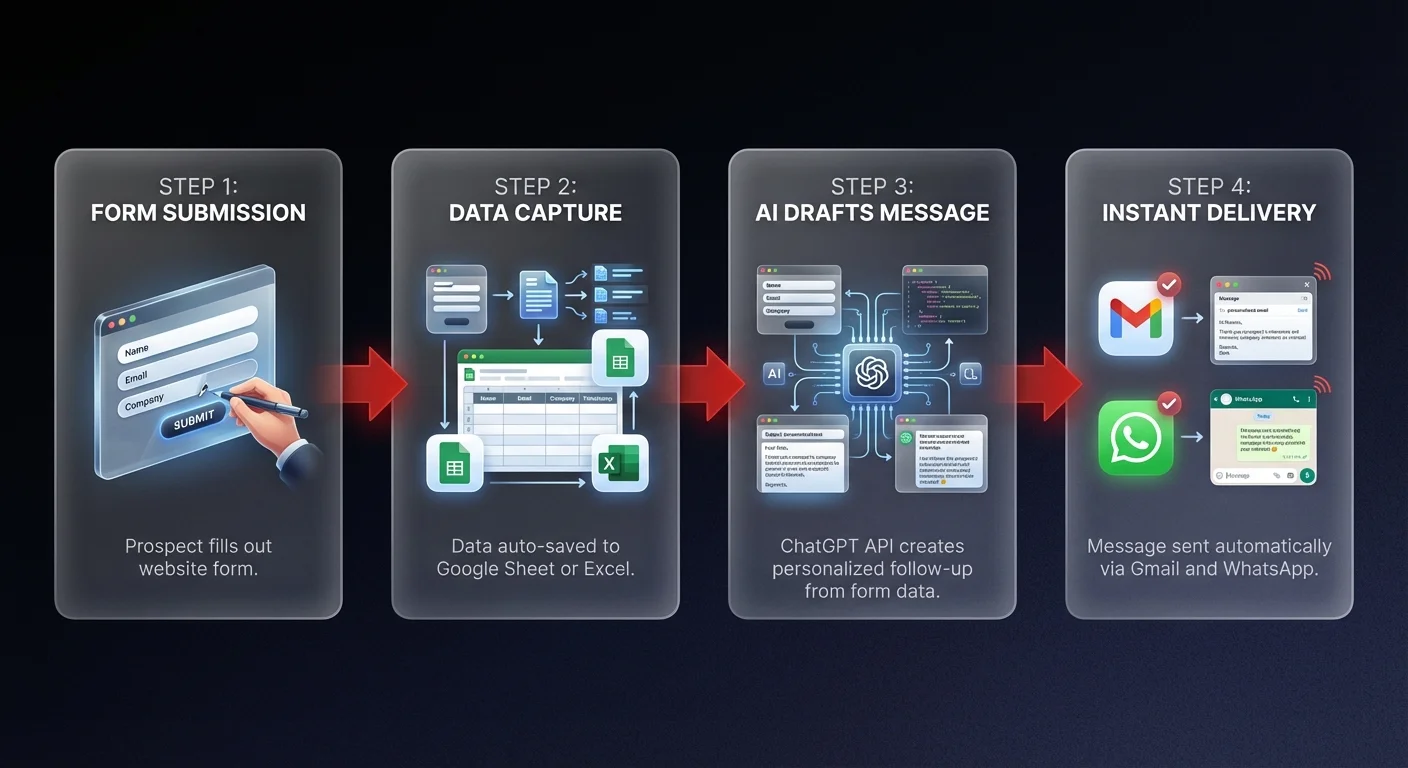
- A potential customer fills out a form on your website.
- The data is automatically saved to a Google Sheet or Excel file.
- This triggers the ChatGPT API to draft a personalized follow-up message based on the form data.
- The message is then automatically sent to the lead via both Gmail and WhatsApp.
This simple, low-cost automation ensures every lead receives an immediate, personalized response, dramatically increasing the chances of conversion.
Scaling: avoiding vendor lock-in
As your business grows, your AI strategy will evolve. While large enterprises debate complex multicloud strategies involving AWS, GCP, and Azure, the core lesson is universal: avoid vendor lock-in and build for flexibility.
Even for a small business, this means choosing platforms and tools that can easily integrate with others. You may find that one LLM is best for content creation, while another excels at data analysis. Your business shouldn't be trapped in a single ecosystem — which is why sovereign operations automation matters as you scale. Consider using workflow orchestration platforms like n8n as your foundation.
The path forward
Lasting success begins with practical, achievable steps. By identifying and implementing "quick wins" in areas like repetitive task automation and content repurposing, you can build immediate momentum and demonstrate tangible value. From there, you can scale your efforts to build sophisticated AI engines.