
Documentation-as-cognitive-model is the practice of structuring project files to give AI agents a coherent understanding of time, purpose, and system state — rather than feeding them raw context. Most developers feed agents unstructured information and hope for the best, which limits AI to text generation rather than true orchestration. To get real results, you need four structured documents — changelog, architecture, requirements, and roadmap — that map directly to an agent's cognitive functions.
The four pillars of cognitive architecture
Here's the hard truth - an AI agent without a structured understanding of time is just a text generator flailing in the dark. The most effective way to orchestrate agents is to map your documentation directly to cognitive functions. You need to give the agent a clear framework for reasoning about the project's state.
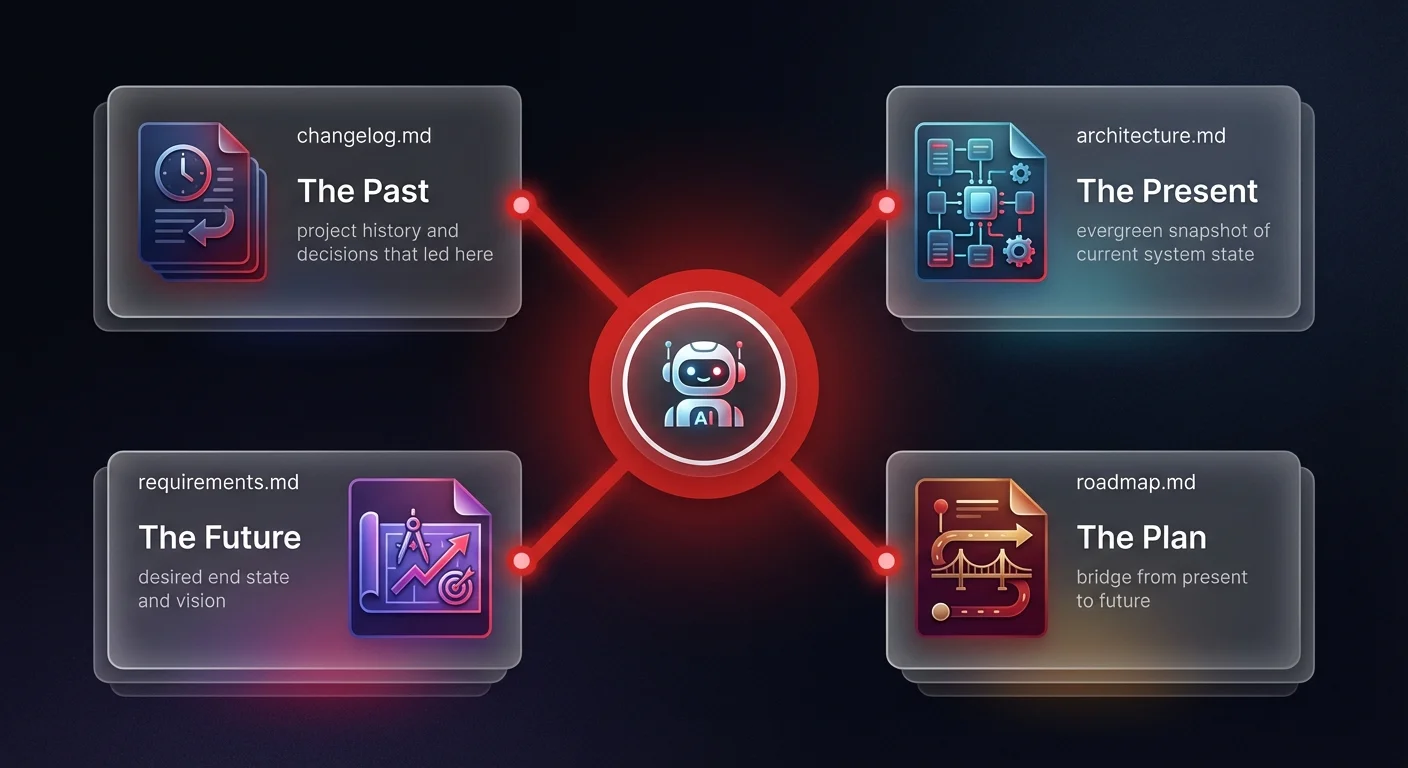
The Past (changelog.md): This is the history of the project's evolution. It tells the agent where we've been and what decisions led us here.
The Present (architecture.md): This file needs to be an evergreen representation of your current reality. Instruct the agent to analyze existing code and update this document constantly. It is the absolute truth of 'now'.
The Future (requirements.md): This shouldn't be a static list of MVP features. It needs to be a living snapshot of the future state - a vision of what the system looks like when the work is done.
The Plan (roadmap.md): This connects the present to the future. It's the bridge. When you change the requirements, it must trickle down to the roadmap.
The workflow in practice
Implementing this structure requires a radical shift in how you work. You stop being a coder and start being an architect of intent. Instead of writing code, you manage the state of these documents.
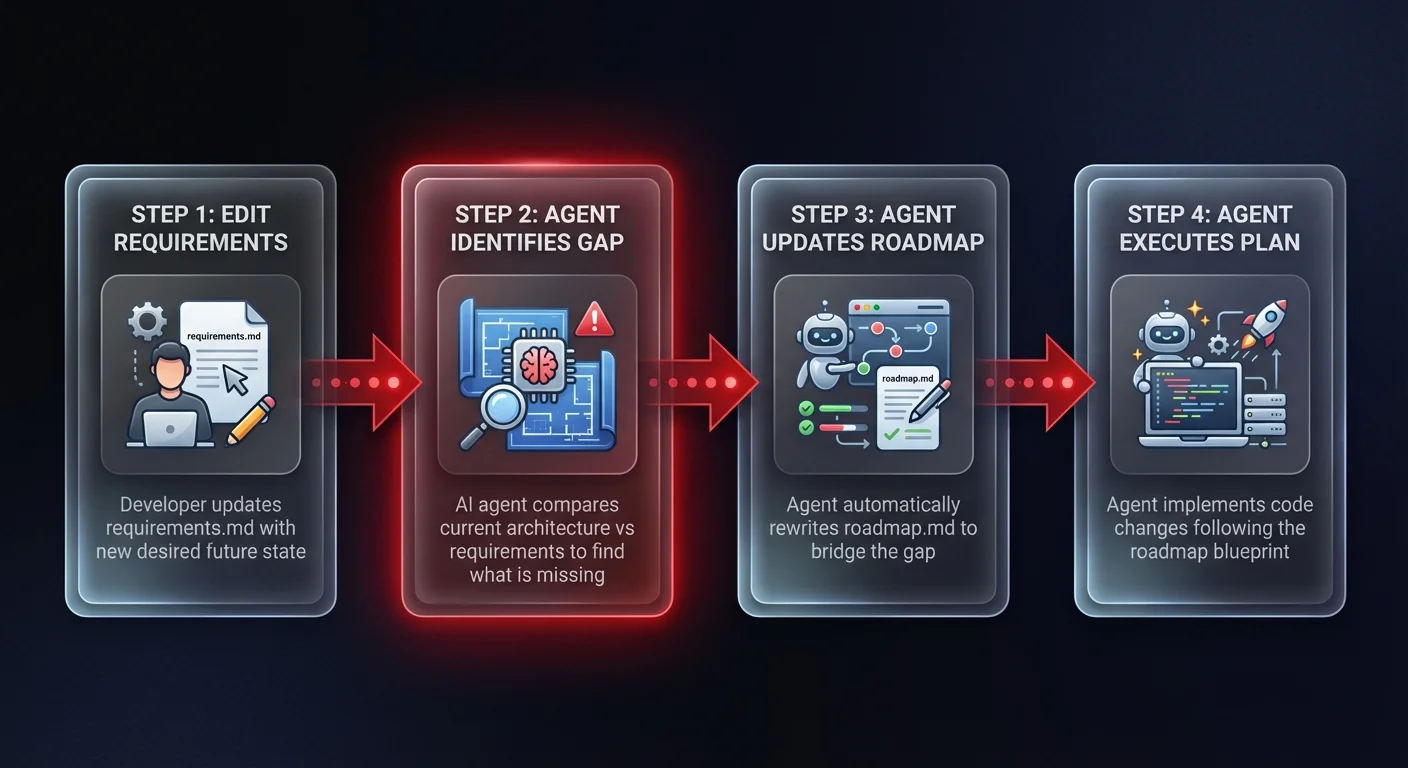
When you want to change the system, don't touch the code. Edit the 'requirements.md' to reflect the new desired future state. Because the agent understands the relationship between these files, it automatically identifies the gap between the present and the future.
The agent then updates the roadmap to bridge that gap. It creates a plan. This is high signal work. You aren't micromanaging lines of code; you are orchestrating the project's evolution — the kind of AI-driven software development that separates high-leverage teams from everyone else.
Reframing prompt engineering
This approach reframes prompt engineering entirely. We aren't just writing clever prompts anymore. We are building a cognitive architecture for agents. We are defining their understanding of time and purpose.
If you want ownership over complex AI systems, you have to treat documentation as the interface for reasoning. The files are the brain. You are simply guiding the thoughts — a principle that drives how we design autonomous AI agents for complex, multi-step business processes.