
RAG with a knowledge graph is a hybrid retrieval architecture that combines vector database semantic search with structured graph traversal to give AI agents contextually rich, relationship-aware knowledge. Standard vector-only RAG finds documents that sound alike but misses the structural logic of how ideas actually connect. The systems we're building at Ability AI go beyond simple retrieval — orchestrating a 'layered cake of context' that's the difference between an agent that parrots information and one that actually thinks.
The hybrid model
Let's break it down. Standard vector search is great at finding things that sound alike. If you ask about 'revenue', it finds 'sales'. But real insight often comes from connecting concepts that don't sound alike at all but are deeply linked structurally. That's where the knowledge graph comes in.
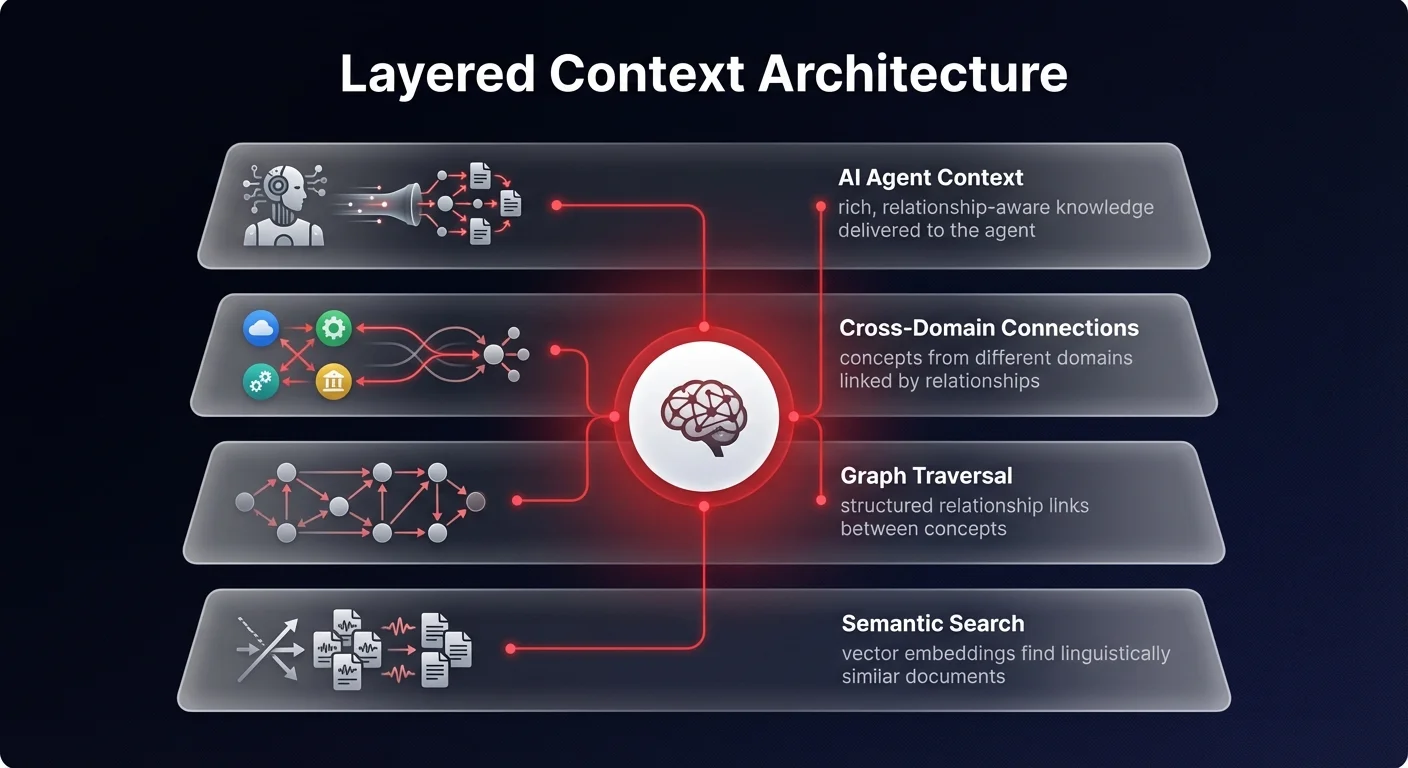
We are flipping the script on standard RAG architectures. Instead of relying solely on vector databases, we're orchestrating a hybrid model. We use embeddings for the initial semantic sweep, but then we combine that with rigorous knowledge graph traversal.
Think of it like a layered cake. The base layer is your semantic match - the raw ingredients found via embeddings. But the layers on top? That's the structural context pulled from the graph. When we query a specific node, we don't just look at its vector neighbors. We traverse the graph to find connected ideas, sometimes three levels deep.
This allows us to pull in concepts from completely different domains that a vector search would miss entirely. It gives the agent a context that is specific, rich, and historically accurate, rather than just linguistically similar. You're not just feeding the AI data; you're feeding it the relationships between the data.
Graph traversal magic
The execution is where the magic happens. We're not just retrieving; we're traversing.
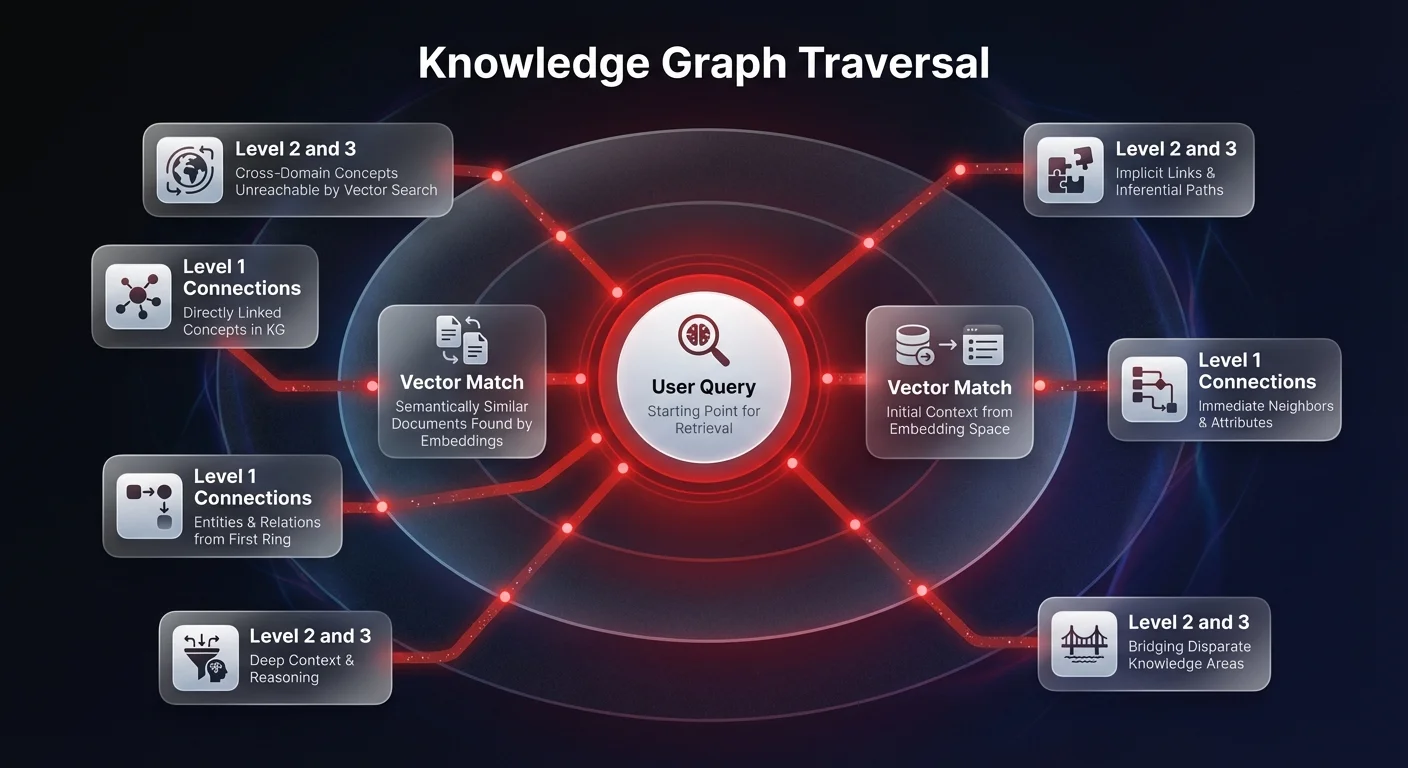
Here is the technical reality. We use a vector database to find semantically relevant notes - that's standard. But then, for those specific results, we traverse the knowledge graph. We might go three layers deep. This pulls in the 'family tree' of the concept.
Why does this matter? Because in a complex business, the answer to a question in sales is often hidden in a product document from six months ago — a particularly critical pattern for AI sales intelligence systems where revenue insights are scattered across disconnected documentation. A vector search won't find that connection if the vocabulary is different. But a graph search will find it instantly if the link exists.
You create a situation where the agent understands context not just by 'domain specific knowledge that we found semantically, but also all of the connected concepts.' It mimics human associative thinking. When you think about a project, you recall the people, the meetings, and the constraints associated with it - not just files with similar names.
This hybrid approach - the layered cake - creates a critical mass of context. It reduces hallucinations because the model is grounded in structured relationships, not just statistical likelihood. It amplifies the signal and cuts the noise. If you want autonomous AI agents that can own complex tasks, you have to give them this depth of context. Anything less is just a glorified search bar.
Building intelligent systems
This is the level of engineering required to build truly agentic workflows. It's not about slapping an API on a database; it's about architecting a second brain. At Ability AI, we build systems that understand the structure of your business, not just your keywords. Ready to build agents that actually understand context? Let's talk.