
Local agents are sovereign AI systems that run with full user-level permissions on local machines or private infrastructure, replacing cloud-dependent chatbots with agents that control files, terminals, and APIs directly. As open-source projects like OpenClaw demonstrate, this shift makes 80% of existing SaaS applications — essentially GUIs for data entry — redundant for businesses that deploy governed local agents.
The software landscape is undergoing a tectonic shift that most operational leaders have yet to fully quantify. For the past decade, digital transformation has been synonymous with SaaS adoption - buying seats, integrating APIs, and managing a sprawling ecosystem of specific applications. However, new research into local agents and the rapid rise of open-source projects like OpenClaw suggests we are approaching an inflection point: the "death of apps" and the rise of sovereign, agent-led execution.
When Peter Steinberger released OpenClaw, it wasn't just another GitHub repository; it garnered over 160,000 stars practically overnight. This explosion of interest signals a market desperate for a different kind of intelligence. Unlike cloud-based chatbots that act as conversational partners within a walled garden, local agents operate with the same permissions as a human user. They control the mouse, the keyboard, the file system, and the terminal.
This distinction - between a bot that talks and a bot that does - creates a profound new reality for business operations. We are moving from a world where humans use software to a world where agents manage the underlying data directly, rendering the user interface obsolete.
The inevitable collapse of the app layer
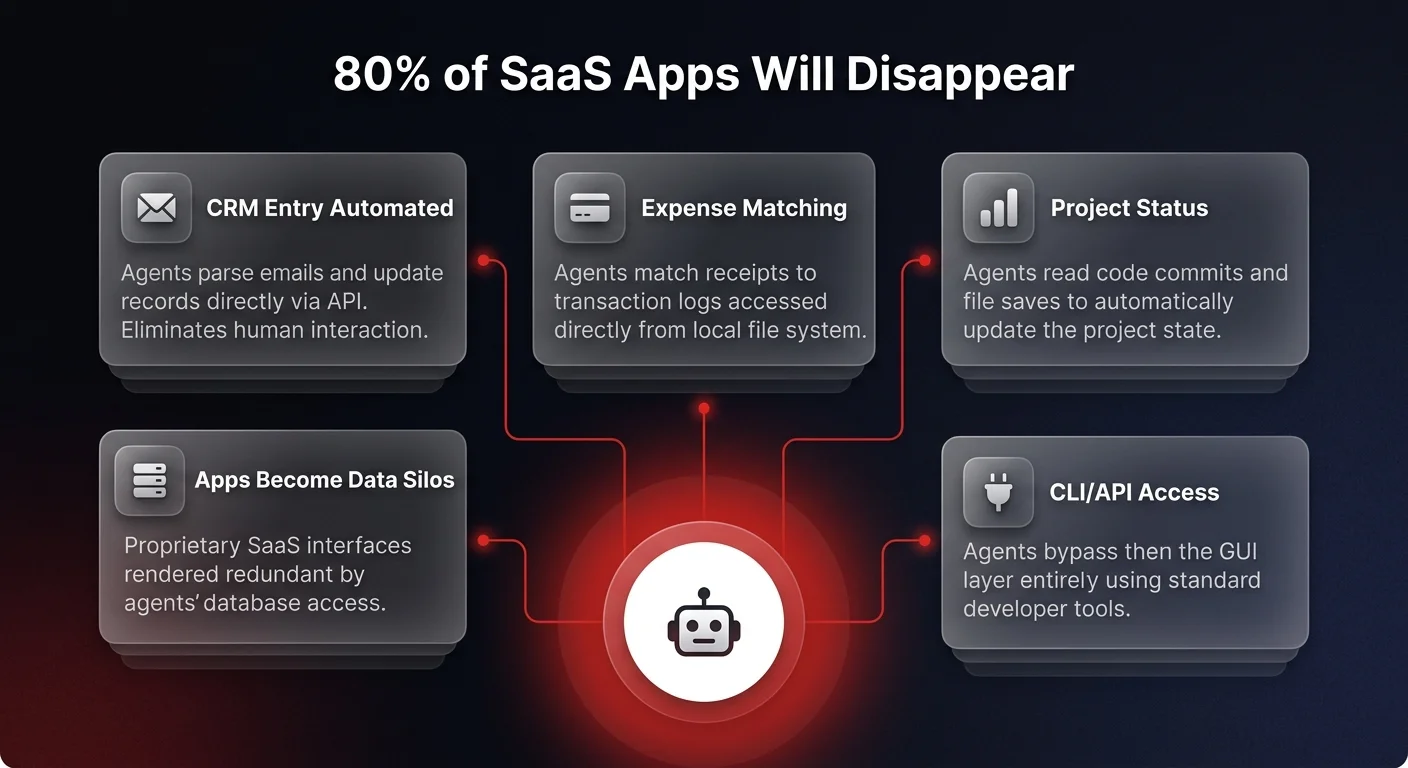
The most provocative finding from recent agent research is the prediction that 80% of current applications are destined to disappear. When you deconstruct the utility of most business software - from fitness trackers to expense management platforms - they are essentially graphical user interfaces (GUIs) designed to facilitate data entry into a database.
Steinberger's research highlights this through the lens of personal utility. A user doesn't need a fitness app; they need the outcome of fitness tracking. An agent that has access to payment data, calendar invites, and biometric sensors can infer diet and exercise habits without the user ever opening a specific application. The agent simply manages the data.
For the enterprise, the implications are staggering. Consider the typical mid-market operational stack:
- CRM data entry: Agents can parse emails and update records directly.
- Expense reporting: Agents can match receipts to credit card transaction logs locally.
- Project management: Agents can update status based on code commits or file saves.
In this model, the proprietary interface of the SaaS tool becomes a hindrance rather than a feature. If an agent can inject data directly into the database or interact via API/CLI, the need for human-centric UI evaporates. We are moving toward a future where the "app" is just a data silo, and the agent is the universal interface. This presents a massive opportunity for companies to reduce SaaS sprawl and seat-license costs, provided they have the governance infrastructure to manage these autonomous data handlers.
Local sovereignty vs. cloud silos
The allure of cloud-based AI has always been convenience, but it comes at the cost of context. A cloud model only knows what you paste into the chat window. In contrast, a local agent possesses "infinite context" regarding the machine it runs on. It creates a form of digital sovereignty that cloud providers cannot match.
Research into OpenClaw's capabilities reveals the power of this local access. In one instance, a user asked their agent to construct a narrative of their past year. Because the agent had root access to the file system, it located forgotten audio files from Sunday recording sessions - files the user had completely forgotten existed. It parsed the audio, correlated it with other documents, and produced a narrative depth impossible for a cloud system that lacks access to the hard drive's history.
For operations leaders, this validates the necessity of data sovereignty. The most valuable business context often lives in unstructured formats - local PDFs, old slack exports, git histories, and messy Excel files on a shared drive. A cloud-tethered agent is blind to this. A sovereign agent, executing locally or within a private VPC, can leverage this "dark data" to solve problems without exposing sensitive intellectual property to third-party model providers. Explore how Ability.ai builds sovereign agent infrastructure for mid-market companies.
Technical improvisation: why CLI beats complex protocols
There is a prevailing assumption in the AI industry that for agents to be useful, we need complex new standards - like the Model Context Protocol (MCP) - to help them understand software. However, real-world deployment data suggests the opposite: agents are naturally proficient at the standards humans already use, specifically the Command Line Interface (CLI).
Steinberger's development philosophy rejects the "gnarly" complexity of MCP in favor of standard Unix tools. The rationale is simple: coding models are trained on millions of lines of code and system administration tasks. They inherently understand how to use a terminal.
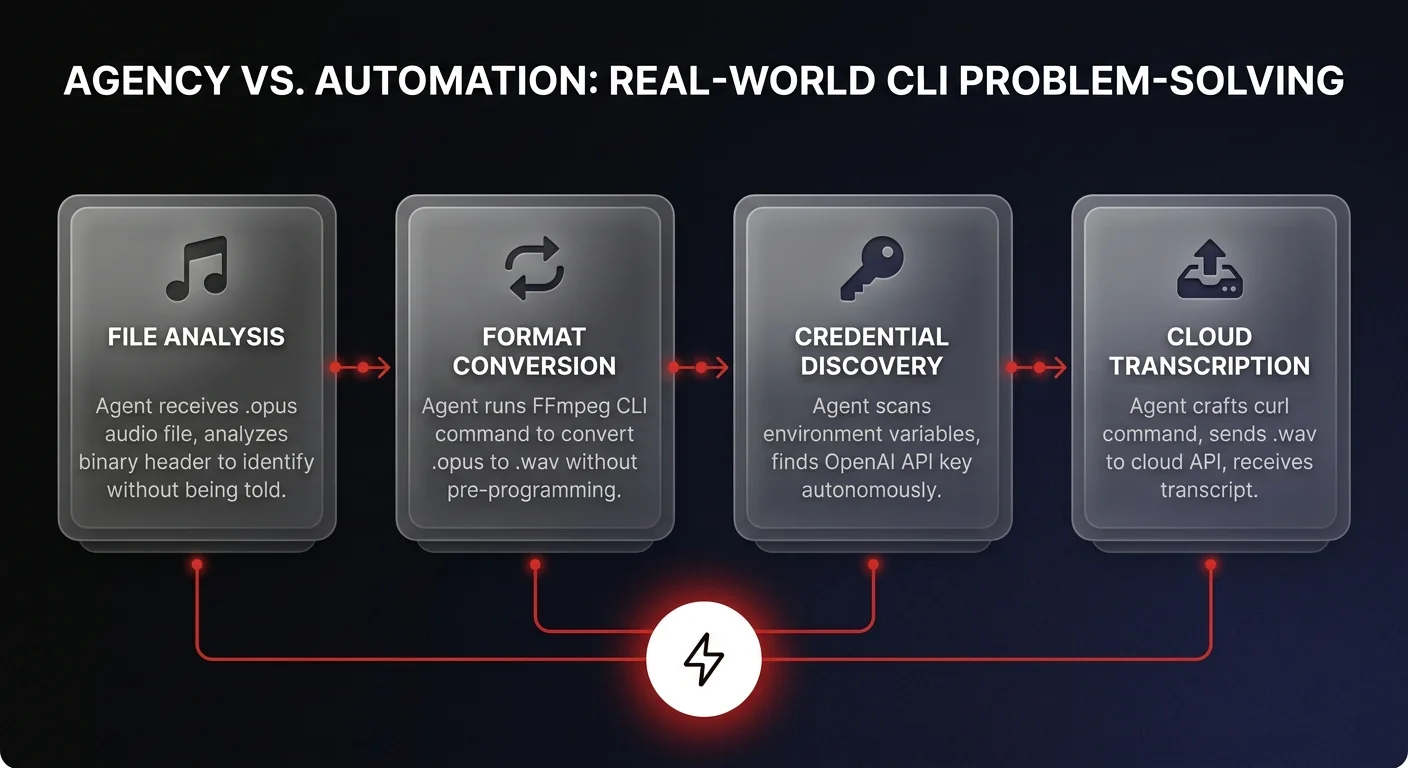
The "Opus to Wav" Case Study:
A striking example of emergent problem-solving occurred during early OpenClaw testing. The agent received an audio file in the .opus format (common in WhatsApp) but needed to transcribe it. The local machine did not have the necessary transcription model installed.
Instead of failing or asking for help, the agent improvised a multi-step solution in seconds:
- It analyzed the file header to identify the format.
- It used
FFmpeg(a standard video/audio tool) to convert the file to.wav. - Recognizing it lacked a local transcription engine, it searched the environment variables, found an OpenAI API key, and used
curlto send the file to the cloud for transcription.
It did all this without being explicitly programmed for that specific workflow. It used standard developer tools to solve a novel problem. This validates a critical operational strategy: rather than building rigid, fragile integrations, give governed agents access to standard tools and let them figure out the execution path. This is the difference between "automation" (doing exactly what is scripted) and "agency" (solving the problem by any means necessary).
Governance through "soul files"
The power of an agent that can execute curl commands and delete files is undeniable, but it immediately raises the question of control. How do you ensure an autonomous system doesn't accidentally wipe a server or send sensitive data to the wrong recipient?
The solution emerging from the open-source community is surprisingly low-tech: the "Soul File."
In the OpenClaw architecture, the agent's behavior, ethics, and boundaries are defined in a simple markdown file, often named soul.md or identity.md. This functions as a constitution. It is not hidden in the model's weights; it is a readable, editable text file that the user controls.
This approach to governance - "Constitution as Code" - offers a practical blueprint for enterprise adoption. Instead of opaque safety filters controlled by a vendor, organizations can deploy agents with strict, auditable instructions:
- "You may read files in /public but never in /finance."
- "You must ask for human confirmation before sending emails to external domains."
- "Your tone should be professional and concise."
Because these instructions are stored as text files (often alongside memory files like memory.md), they are observable and version-controlled. If an agent misbehaves, you don't need to retrain a model; you simply edit the text file. This transparency is essential for moving agents from experimental sandboxes to production environments.
The agent economy and bot-to-bot negotiation
Looking beyond the immediate horizon, the death of apps leads to the birth of the agent economy. We are moving toward a reality where interactions are not Human-to-Bot, but Bot-to-Bot.
Steinberger predicts a near future where booking a restaurant doesn't involve a human calling a host. instead, a personal agent negotiates with the restaurant's agent to find a slot. If the restaurant is analog, the agent might hire a human (via a task platform) to make the call or stand in line.
This creates a mesh network of specialized intelligence. A CEO might have a "Chief of Staff" agent that coordinates with a "Research" agent and a "Scheduling" agent. These specialized bots, communicating via high-speed text or API calls, can execute complex workflows far faster than a human navigating multiple browser tabs.
Strategic takeaways for operations leaders
The viral success of local, sovereign agents is more than a trend; it is a proof of concept for the future of work. For operations leaders, the takeaways are clear:
- Audit your SaaS reliance: Identify which tools are merely expensive interfaces for data entry. These are prime candidates for agent replacement.
- Prioritize data sovereignty: The most powerful agents are those that run close to your data. Do not trap your corporate history in a cloud chat window.
- Embrace standard tools: Don't over-engineer integrations. If an agent can use a CLI or an API, it can do the job. The complexity lies in the governance, not the connection.
- Adopt transparent governance: Governance should not be a black box. Use clear, text-based constitutions to define agent behavior, ensuring that the logic is observable and the boundaries are hard-coded.
The future belongs to the builders who understand that the interface is no longer the product - the outcome is. By leveraging sovereign agents, businesses can bypass the app layer entirely, turning operational friction into automated flow. See how businesses are eliminating SaaS sprawl with local agent infrastructure.