
Enterprise AI agents are sophisticated multi-agent systems that autonomously execute complex back-office functions — moving beyond chat to active operational roles. According to OpenAI CFO Sarah Friar and investor Vinod Khosla, 2026 is the inflection year where these systems shift from experimentation to real impact, with leading organizations already operating at a 1:5 human-to-agent workforce ratio.
For operations leaders and mid-market executives, this shift signals a move away from asking AI questions and toward assigning AI specific jobs. The technology is no longer just about generating text; it is about closing the "capability gap" between possessing intelligence and executing tasks. As businesses look to scale without linearly increasing headcount, the emergence of the 1:5 human-to-agent ratio represents a new benchmark for operational efficiency.
Closing the capability gap
For the past few years, we have handed employees "the keys to the Ferrari," as Friar puts it, but most are still learning how to drive. The vast majority of AI usage has been "call and response" - a human types a prompt, and the AI generates an answer. While useful for drafting emails or summarizing text, this interaction model barely scratches the surface of what the technology can do.
Vinod Khosla notes that we are entering a phase where agents - specifically multi-agent systems - will mature to the point of having a visible impact on enterprise resource planning (ERP) and daily operations. The goal is to move from "ChatGPT is a chatbot" to "ChatGPT is a task worker."
In this new paradigm, an agent doesn't just answer a question about a contract; it performs the reconciliation, manages accruals, and tracks the contract lifecycle every single day without human intervention. This is the difference between an AI assistant and an AI operator. The capability gap is closing, allowing systems to handle multi-step workflows that previously required constant human hand-holding.
The emergence of the 1:5 workforce ratio
One of the most striking insights for operations leaders is the shifting ratio of humans to digital workers. Friar shared an anecdote from a leader at a major consulting firm who now describes their back-end organization not in terms of headcount alone, but as "people plus agents."
This leader is currently operating with a ratio of one human to five agents.
This metric - the 1:5 ratio - provides a tangible goal for scaling companies. It suggests a future where a single employee acts as a manager for a team of specialized software agents. This doesn't necessarily mean reducing staff; rather, it allows companies to decouple revenue growth from headcount growth.
In this model, the human employee shifts from doing the "drudgery" of data processing to supervising the outputs of agents. This creates a force multiplier effect where a small team can handle the volume of work that would typically require a massive department. For mid-market companies, this agility is a critical competitive advantage.
Real-world automation: inside OpenAI's finance team
While theoretical discussions about agents are common, concrete examples of implementation are rare. Friar provided a detailed look at how OpenAI uses its own technology to automate complex finance workflows - specifically revenue recognition and contract review.
In a traditional pre-AI setup, as a company's contract volume grows exponentially, the finance team must hire more people linearly just to read those contracts. It is mundane, repetitive work that burns out talented professionals.
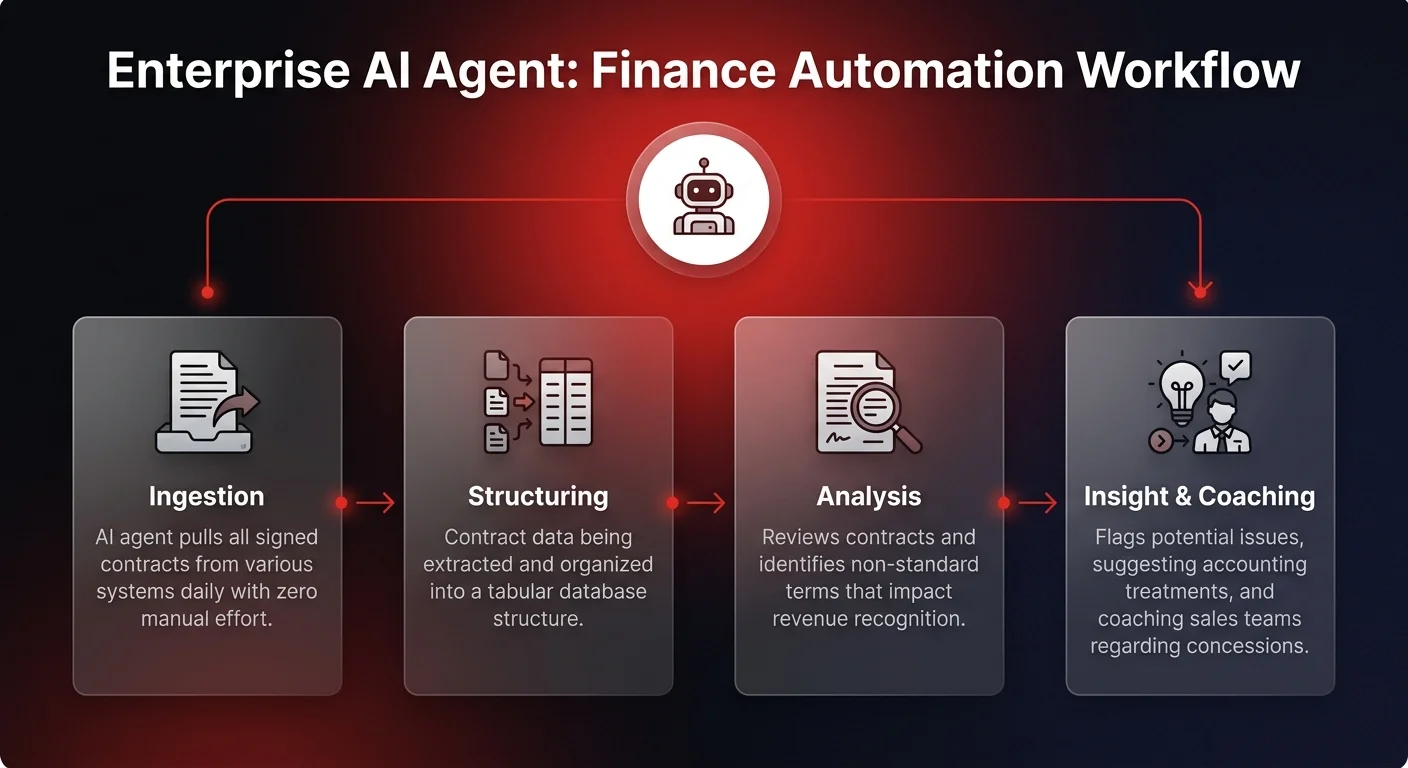
OpenAI has deployed an agentic workflow to handle this:
- Ingestion: The agent pulls all signed contracts from the previous day directly out of the system.
- Structuring: The data is extracted and organized into a tabular database (specifically Databricks).
- Analysis: The agent reviews the contracts to identify non-standard terms that could impact revenue recognition.
- Insight & Coaching: The agent flags why a term is non-standard and suggests the correct accounting treatment. It even identifies if a salesperson gave away a concession they shouldn't have, allowing the CFO to provide targeted coaching to the sales team.
This workflow transforms the role of entry-level finance staff. Instead of reading legal text for eight hours a day, they are reviewing the agent's analysis, confirming the revenue recognition logic, and focusing on strategic business shifts. The "drudgery" is offloaded to the agent, while the human retains the decision-making authority — the same model at the core of structured finance and procurement automation.
Infrastructure and the demand signal
There is often talk in the market about an "AI bubble," but Khosla argues that looking at stock prices is the wrong metric. The real metric of value is the number of API calls - the actual demand for intelligence.
OpenAI's own growth trajectory suggests that demand is limited only by compute availability. Friar noted a direct correlation between their infrastructure deployment and revenue:
- 200 Megawatts of compute correlated with $2 billion in ARR.
- 2 Gigawatts of compute correlated with $20 billion in ARR.
This "infrastructure as revenue" dynamic implies that for enterprises, AI should be viewed similarly to electricity or cloud computing. It is a utility that powers the business. Khosla predicts that demand for this intelligence is effectively infinite because it makes every human hour more effective.
For operations leaders, this reinforces the need to build scalable infrastructure now. If demand for intelligence is infinite, the companies that build the "wiring" to deliver that intelligence to their teams will win.
The governance challenge: identity and permissioning
As companies move toward that 1:5 ratio, a new challenge emerges: governance. Friar highlighted that we are just beginning to understand the risks associated with "agents talking to agents."
In a multi-agent system, questions of identity and permission become critical.
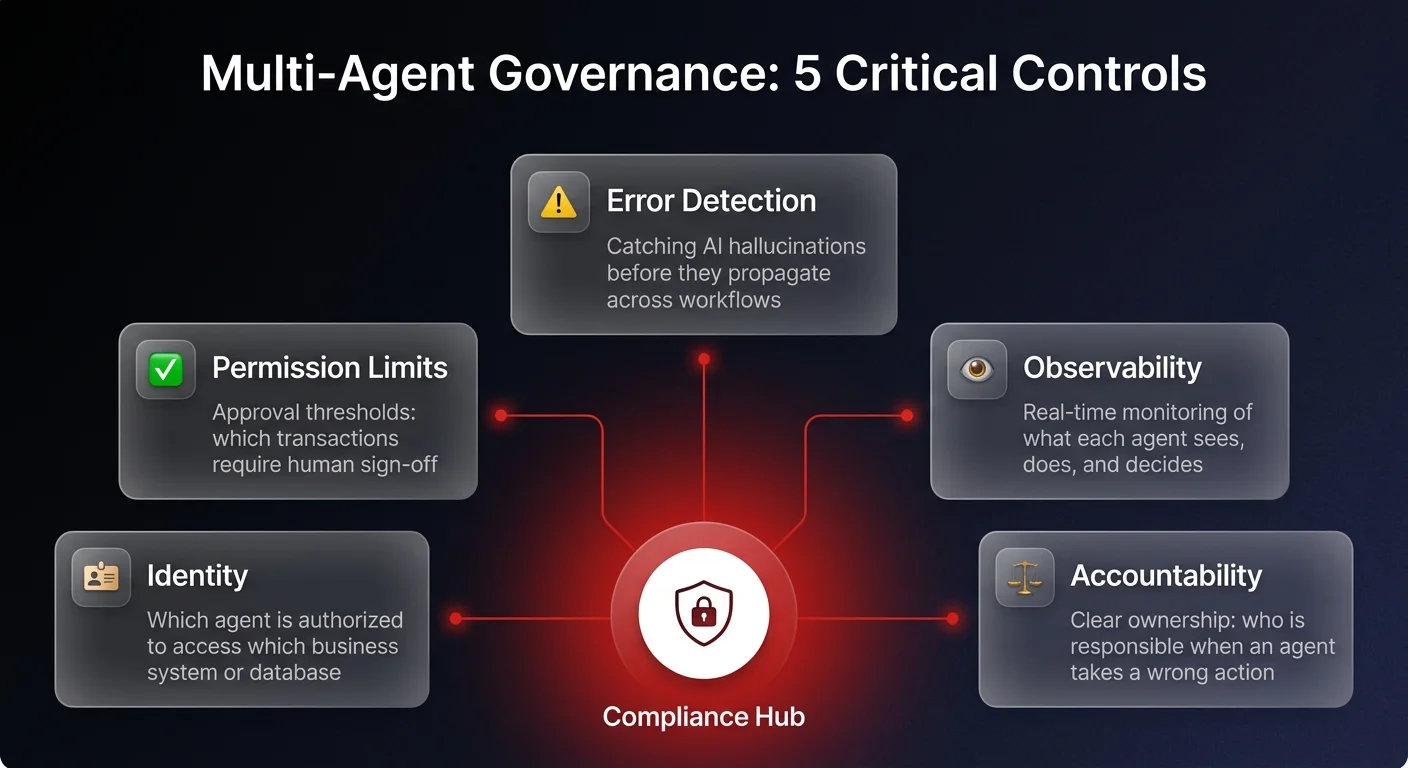
- Which agent is allowed to access the HR database?
- Can the procurement agent authorize a payment without human sign-off?
- If an agent hallucinates a non-standard term, who catches it?
Friar pointed to "identity and permissioning" as a massive unsolved opportunity. In the procurement example she cited, a system needs to know that a specific agent is acting on behalf of a VP with a specific approval limit. It needs to check the HR system to verify authority before executing a transaction.
This connects directly to the need for governed agent infrastructure. You cannot have five agents running loose for every employee without a strict observability framework. There must be a layer of logic that defines what an agent can see, what it can do, and who is responsible for its actions.
Preparing for the agentic enterprise
The transition to 2026 will be defined by how well companies can integrate agents into their core workflows. The technology is moving fast - effectively closing the gap between "chatting" and "doing."
To prepare, operations leaders should start looking for high-volume, rules-based processes - like contract review or data reconciliation - that are currently consuming valuable human capital. By adopting a governed approach to operations automation, businesses can begin to realize the efficiency of the 1:5 ratio, turning their operations into a scalable engine for growth rather than a bottleneck of administrative tasks.