
The agency AI automation trap is the "Spaghetti Stack"—a fragile web of single-purpose tools connected via webhooks that creates more operational chaos than it solves. A typical ad campaign workflow requires six separate vendors (orchestrator, database, context engine, image generator, scraper, storage), six API keys, and six billing accounts. If any single vendor changes an endpoint or deprecates a model, production stops. For agencies managing millions in client ad spend, this architecture is not an asset—it is a liability.
For agencies scaling between $5M and $250M in revenue, this architectural fragility is not just a technical nuisance; it is a strategic risk. When your core delivery mechanisms rely on fragile connections between six different vendors, you aren't building an asset. You are building a liability.
This post explores the anatomy of these fragile stacks, the specific risks they pose to agency stability, and why the future of enterprise-grade automation lies in consolidated, sovereign systems.
The anatomy of a spaghetti stack
To understand the magnitude of the problem, we must look beyond the glossy promises of "one-click automation" and examine the plumbing required to make these tools work in a real-world scenario. Let's analyze a specific, common use case in modern agencies: a Meta Ads automation system designed to handle creative generation and campaign deployment.
On the surface, this sounds like a singular capability. However, a deep dive into the architecture of a typical DIY or "low-code" implementation reveals a labyrinth of dependencies. To execute this single campaign workflow, an agency often has to stitch together a precarious chain of vendors:
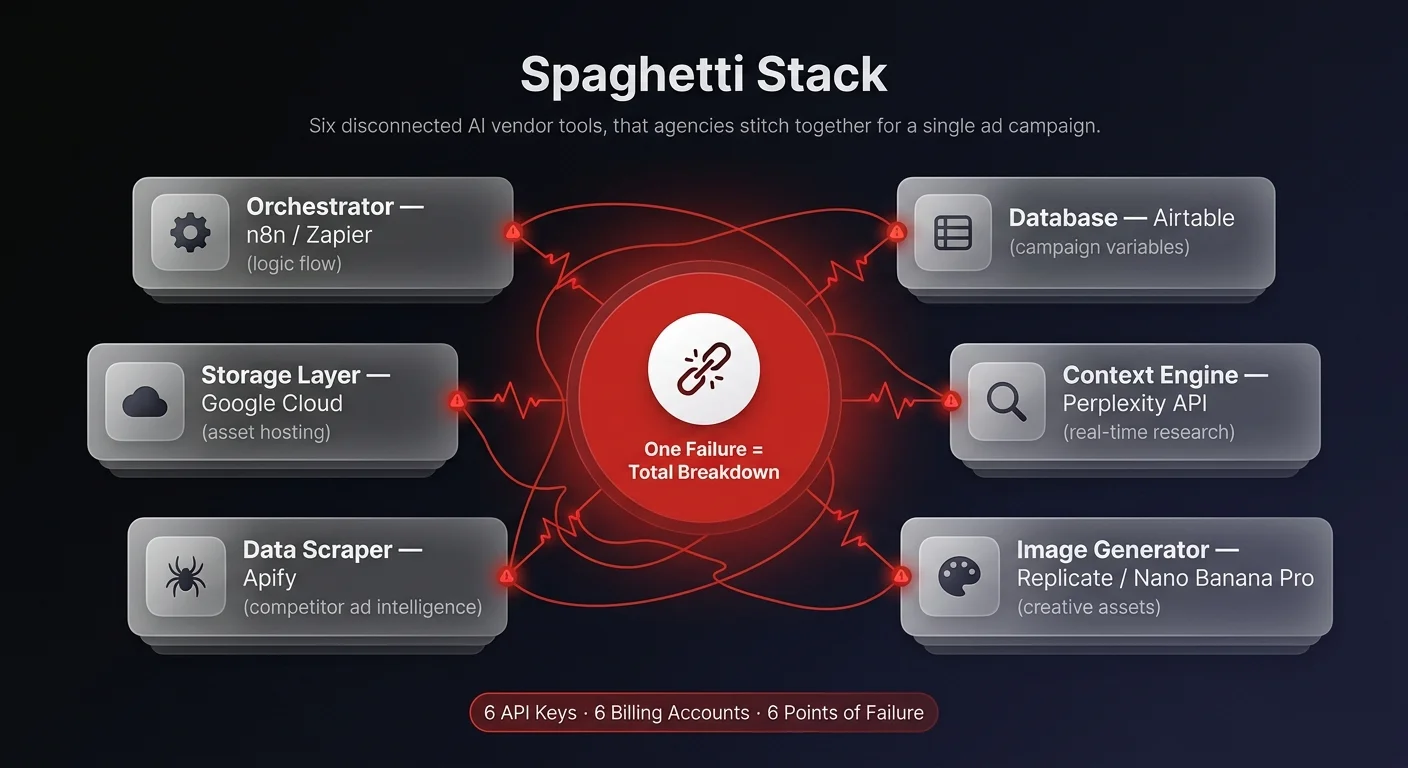
- The Orchestrator: Tools like n8n or Zapier are used to handle the logic flow.
- The Database: Airtable is required to store campaign variables and status updates.
- The Context Engine: Perplexity or a similar search API is plugged in to gather real-time context.
- The Image Generator: A specific platform like Replicate is needed, often calling a niche model like 'Nano Banana Pro' to achieve the desired aesthetic.
- The Data Scraper: Apify is integrated to scrape Ad Libraries for competitor insights.
- The Storage Layer: Google Cloud is necessary for hosting assets.
This is the Spaghetti Stack. To run one process, the agency must manage six separate billing accounts, six distinct API keys, and six different service level agreements. If Apify changes an API endpoint, the workflow breaks. If the specific image model on Replicate is deprecated, production stops. If the credit card on the n8n account expires, the entire operation grinds to a halt.
For a freelancer, this might be acceptable. For a mid-market agency responsible for millions of dollars in client ad spend, relying on this "science fair project" architecture is a governance nightmare.
The hidden costs of disconnected workflows
The allure of the Spaghetti Stack is low barrier to entry. It feels easy to connect a few webhooks and claim you have automated your operations. However, the long-term costs of this approach manifest in three critical areas: maintenance burden, data sovereignty risks, and operational fragility.
1. The "science fair" maintenance burden
In the example above, we see a workflow that requires constant monitoring. One analyzed workflow for "Competitor Spying" required a user to manually configure Apify to scrape Facebook Ad Library URLs, extract headlines and media types, and then pass them to a Large Language Model (LLM) for analysis. This is not automation; this is tech-enabled manual labor.
Furthermore, many of these stacks require a "Human in the Loop" step simply to approve prompts before incurring image generation costs. Instead of freeing up human capital for strategic thinking, the agency has turned its creative strategists into systems integrators who spend their days debugging JSON templates and checking error logs.
2. Shadow AI and data sovereignty
When you distribute your client's data across half a dozen vendors - sending strategy documents to Perplexity, creative assets to Replicate, and performance data to Airtable - you lose control over that data. This is the definition of Shadow AI sprawl.
Mid-market agencies are increasingly subject to strict enterprise security requirements from their own clients. Explaining to a Fortune 500 client that their proprietary campaign data is bouncing between servers owned by six different startups is a difficult conversation. Data sovereignty requires that intelligence lives within a governed boundary, not scattered across the internet via fragile API calls.
3. Reporting drag and operational friction
Ideally, automation should handle the "boring stuff." A classic pain point for agencies is "Reporting Drag" - the tedious process of moving data from the Meta Graph API into client-facing Google Slides. In a Spaghetti Stack, automating this requires yet another set of connectors and scripts. Often, the effort to maintain the automation exceeds the time it would take to do the work manually, leading teams to abandon the tools entirely and revert to old habits.
Why agencies need sovereign systems, not webhooks
The fundamental issue is that mid-market agencies are trying to build enterprise-grade capabilities using hobbyist-grade tools. Agencies scaling toward $250M revenue cannot rely on cloning JSON templates from YouTube tutorials to run their core operations.
The solution is a shift from fragmented tools to Sovereign Systems. A Sovereign System is a consolidated, governed infrastructure that lives inside the client's company. It replaces the fragility of the Spaghetti Stack with the robustness of a unified operations infrastructure.
The growth operations agent
At Ability AI, we address this by deploying pre-packaged Sovereign Systems designed for specific outcomes, such as the Growth Ops Agent. Instead of forcing the agency to act as a systems integrator, the Growth Ops Agent consolidates the necessary capabilities into a single, cohesive module.
Here is how this shifts the paradigm:
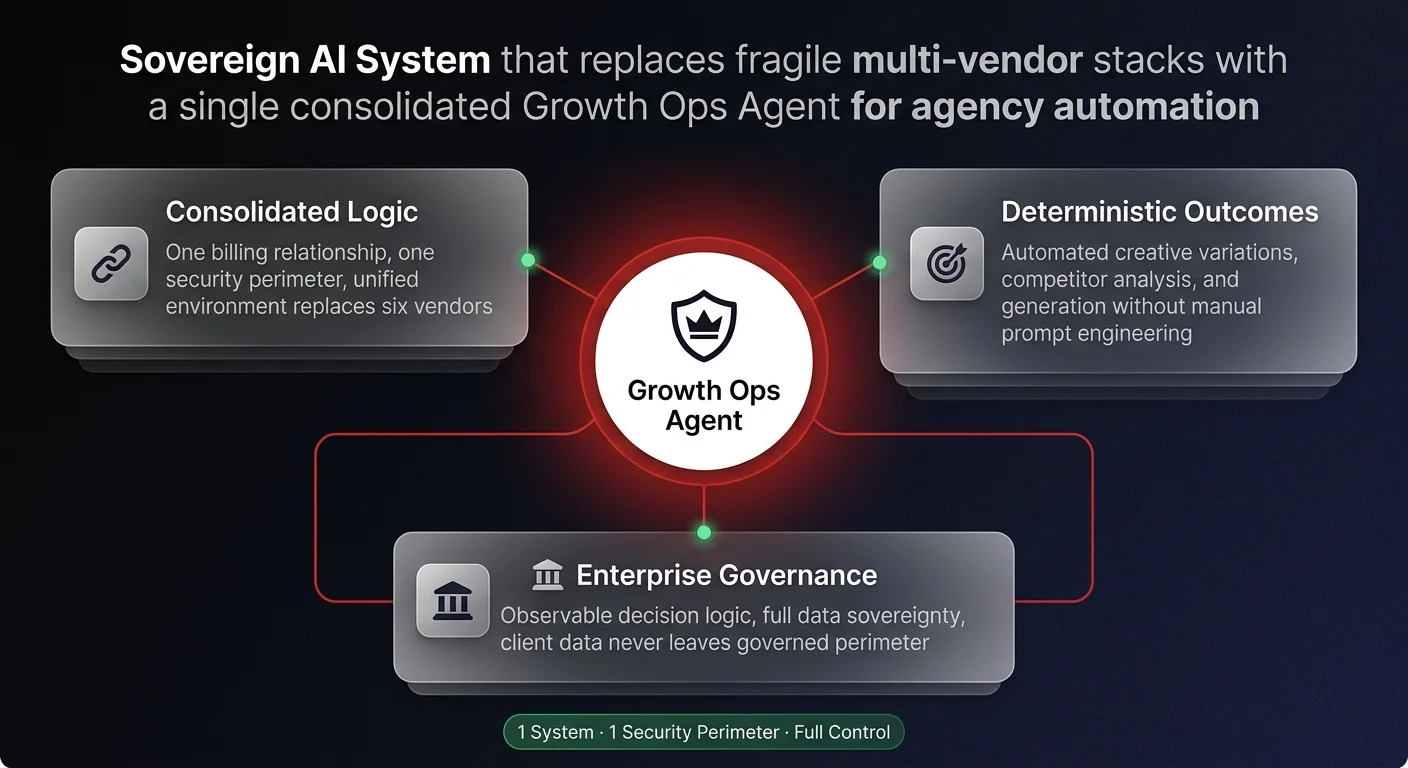
- Consolidated Logic: Instead of n8n talking to Replicate talking to Airtable, the agent handles logic, generation, and storage within a unified environment. There is one billing relationship and one security perimeter.
- Deterministic Outcomes: The agent is engineered to handle specific tasks like "Creative Fatigue" (automating variations) without requiring manual prompt engineering for every single asset. It integrates the scraping, analysis, and generation steps that previously required three different vendors.
- Enterprise Governance: Because the system is deployed as a sovereign asset, the agency retains full control over the data. Logic is observable, meaning you can see exactly why the AI made a specific decision, rather than staring at a black box.
Breaking the cycle of fragility
The transition from manual work to AI automation is inevitable, but the method of transition matters. The Spaghetti Stack represents the "experimental phase" of the industry - a time when connecting tools was novel and exciting. We are now entering the "deployment phase," where reliability, security, and scalability are paramount.
Agencies must ask themselves: Do we want to build a tech stack that requires constant vigilance and debugging, or do we want to deploy infrastructure that works out of the box?
If your team is spending more time managing API keys than managing client strategy, you are caught in the trap. The goal of AI in the agency world should be to eliminate the friction of low-value tasks - automated reporting, resizing variations, initial competitor research - so that human talent can focus on high-value strategy and creative direction.
Conclusion
The era of the "science fair project" is over. For mid-market agencies to compete effectively, they must move beyond the Spaghetti Stack and adopt professional, governed AI infrastructure. By consolidating fragmented tools into Sovereign Systems, leaders can ensure their automation is as reliable as their human talent.
Ability AI provides the infrastructure to make this transition possible, replacing chaotic vendor lists with streamlined, effective Growth Ops Agents. It is time to stop debugging webhooks and start delivering results.