Marketing Ops - time for an AI overhaul?

Marketing Ops - time for an AI overhaul?

Topic:

AI Operations

The world of marketing is undergoing a seismic shift. For years, Marketing Operations (MOPs) managed complex MarTech stacks, but AI is now rewriting the rules, ushering in a profound career reckoning. This isn't merely about adding another tool; AI is exposing fundamental flaws in traditional, rules-based marketing and challenging the very foundation of MOPs. A new discipline, AI Ops, is emerging as the future, transforming the role from tactical system manager to strategic architect of an intelligent, AI-powered go-to-market engine. While leaders hype AI's efficiency, practitioners fear job obsolescence and struggle with its complexity. This article will reveal why the old MOPs model is failing, how AI is forcing a strategic evolution, and provide a clear roadmap for your critical transition to AI Ops.

The world of marketing is undergoing a seismic shift. For years, Marketing Operations (MOPs) managed complex MarTech stacks, but AI is now rewriting the rules, ushering in a profound career reckoning. This isn't merely about adding another tool; AI is exposing fundamental flaws in traditional, rules-based marketing and challenging the very foundation of MOPs. A new discipline, AI Ops, is emerging as the future, transforming the role from tactical system manager to strategic architect of an intelligent, AI-powered go-to-market engine. While leaders hype AI's efficiency, practitioners fear job obsolescence and struggle with its complexity. This article will reveal why the old MOPs model is failing, how AI is forcing a strategic evolution, and provide a clear roadmap for your critical transition to AI Ops.

For decades, Marketing Ops aimed to create order from chaos by stitching together systems like Salesforce and Marketo to build rules-based campaigns. This model is now failing, buckling under its own complexity and rising consumer expectations. Siloed, rules-based automation can no longer deliver the sophisticated, one-to-one personalization businesses need to compete. This failure manifests in several critical ways:
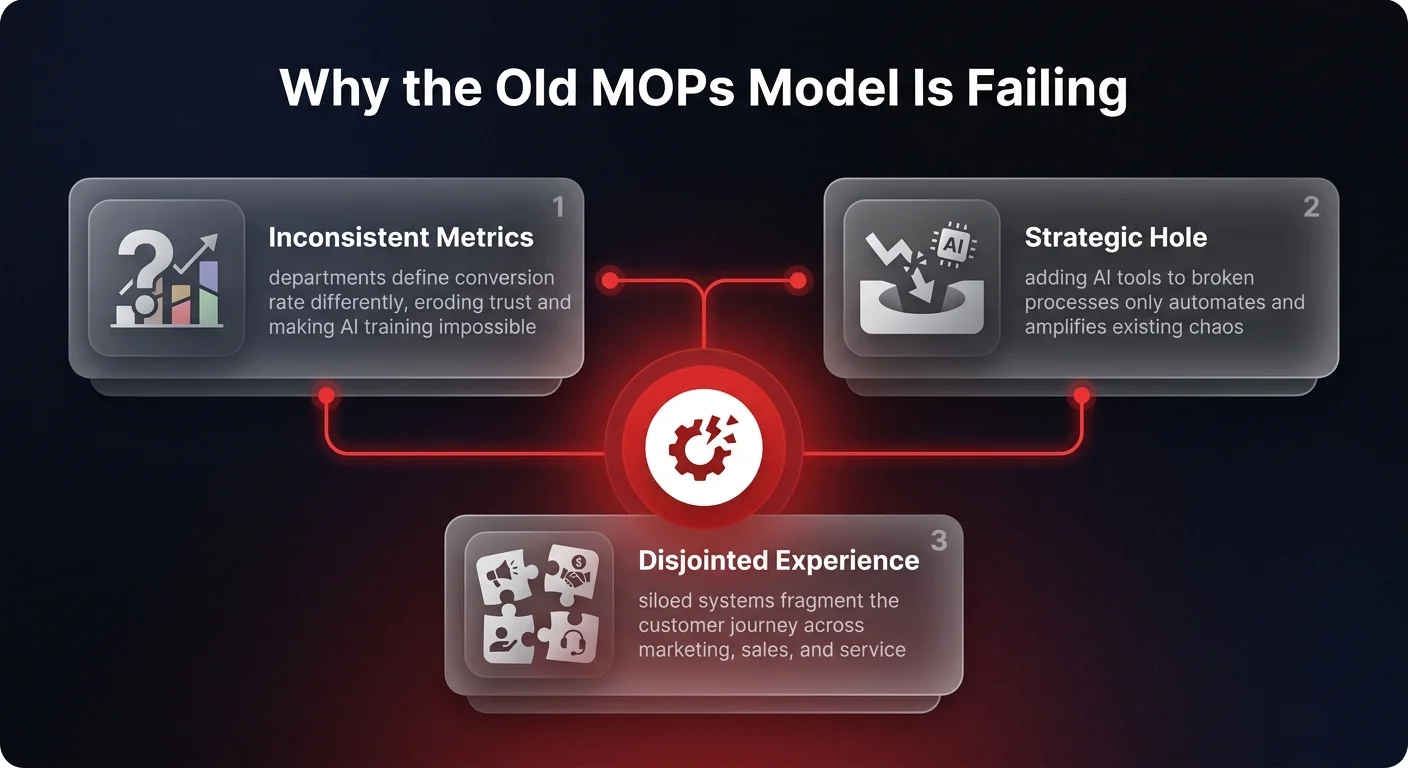
  • Inconsistent Metrics and a Broken Data Language: Departments often define "conversion rate" differently, eroding trust in reporting and wasting time on arguments instead of decisions. This data discord makes training reliable AI models impossible, as they are fed conflicting signals.

  • The Strategic Hole: Many organizations try to patch fundamental business problems with more tools and tactics. As one viral TikTok insight bluntly states, "Most businesses that feel stuck are... trying to use operational marketing to fix a strategic hole." Simply adding an AI tool to a broken process only automates and amplifies existing chaos.

  • A Disjointed Customer Experience: In siloed organizations, the customer journey is fragmented. Prospects receive different messages from marketing automation, sales reps, and customer service. This disjointed experience results from an operational model built around internal departments rather than the customer. A modern Go-To-Market (GTM) engine aims to deliver the "next best conversation" for each customer, a task impossible for a rigid, rules-based system.

This operational breakdown urgently demands a new approach - one that is customer-centric, data-fluent, and built for the age of AI. For MOPs professionals, AI presents a stark paradox. It is simultaneously the most powerful tool for solving their biggest challenges and the single greatest threat to their career stability. This duality creates powerful excitement and anxiety. On one hand, AI is a massive force multiplier, automating tedious tasks like cleaning data, drafting email copy, and optimizing complex workflows. TikTok influencers promote AI tools as "your AI employee that runs your influencer campaigns from the start to the end," promising appealing hands-off execution.

On the other hand, this very efficiency fuels a deep-seated fear of replacement. A major complaint in community forums is the disconnect between the C-suite's perception of AI and the practitioner's reality. Executives often view AI as a direct replacement for human roles, leading to talks of replacing content writers or reducing analytics teams. This creates a contradiction between "Automation Hype" and "Strategic Reality." While some suggest AI can fully automate marketing, the nuanced view is that these tools only handle operational execution. They cannot fix a flawed strategy, conduct meaningful customer interviews, or apply critical thinking to ambiguous data. The true value remains in human skills, but professionals rightly fear their execution-focused roles are being devalued.

>>>

The limitations of old-school MOPs and the disruptive power of AI are forcing a necessary evolution. The role is shifting from managing known systems to architecting unknown intelligence - this is the transition to AI Ops. It's a discipline that bridges high-level marketing strategy with the technical implementation of intelligent systems. This new role resembles a product manager, a go-to-market (GTM) engineer, and a data scientist, focusing on building the engine of growth. Key characteristics include:

  • Architecting the Customer Experience: The AI Ops leader is a "customer-centric architect" designing the entire GTM journey, orchestrating how all channels work together to deliver a coherent, AI-powered personalized experience.

  • Managing AI Models, Not Just Workflows: The focus shifts from static "if-then" rules to managing dynamic AI models. This involves building data feedback loops to train personalization engines, creating custom AI agents, and monitoring model performance to align with business goals.

  • Building Intelligent Systems, Not Just Using Software: The most significant shift is from consuming software to building systems. The AI Ops professional actively constructs the company's intelligent core, creating systems that learn and adapt.

This technological and strategic shift also requires a corresponding human and cultural change. As one expert noted, "AI will not reshape an organization until its people feel ready to move with it." The Ops function becomes a critical agent of change, addressing skills and culture. The skills gap is real, but also a massive opportunity. The ability to blend marketing strategy with technical AI implementation is becoming a highly lucrative skillset, with specialized roles showing significant earning potential. The value is no longer in just operating a tool, but in leveraging it to solve core business problems and demonstrate tangible ROI.

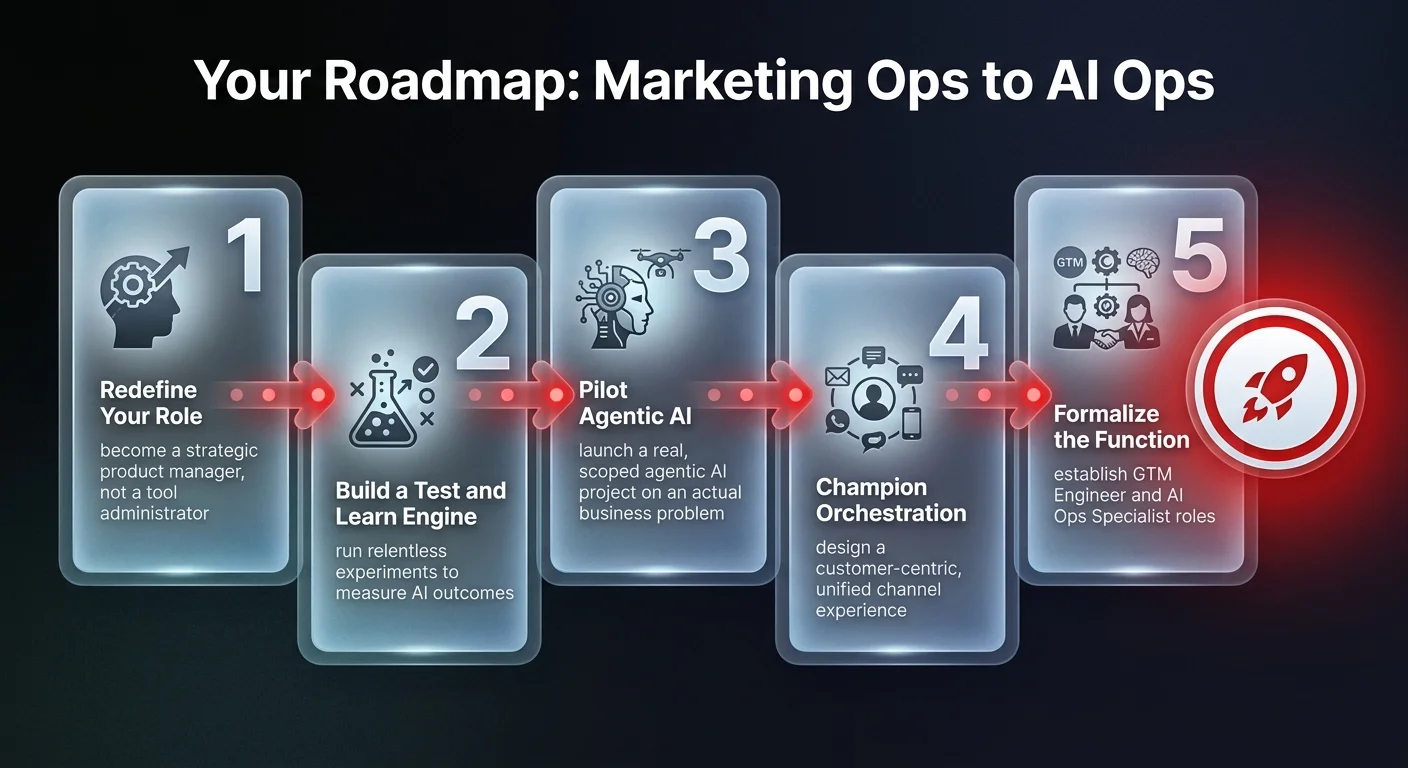
The journey from traditional, reactive MOPs to a strategic, proactive AI Ops function is deliberate. Here is a practical roadmap for this transition:

  1. Redefine Your Role as a Strategic Product Manager: Reframe your mission as owning the entire go-to-market customer experience; your product is the customer's journey.

  2. Build a Relentless 'Test and Learn' Engine: Implement a rapid-cycle, multivariate testing engine that constantly generates rich behavioral data to fuel and improve your personalization AI.

  3. Pilot Agentic AI to Solve Real Problems: Identify specific, high-friction marketing and sales workflows and pilot agentic solutions to build practical experience and demonstrate value quickly.

  4. Champion a Customer-Centric, Orchestrated System: Break down silos between Marketing, Sales, and Customer Service to create an orchestrated system delivering the "next best conversation" for each customer.

  5. Formalize the New Role: Advocate for dedicated roles like "GTM Engineer" or "AI Ops Specialist" with hybrid skill sets combining marketing strategy and technical AI acumen.

The era of Marketing Operations as a purely technical function is over. AI has thrust Ops teams into the spotlight, making them the strategic nervous system of modern, data-driven enterprises. The transition to AI Ops isn't just new technology; it's embracing a mindset focused on architecture, intelligence, and relentless customer-centricity. Successfully navigating this evolution means leading the AI revolution, building intelligent, personalized go-to-market engines. This challenging but essential transition requires expert guidance. Schedule a consultation to architect your operations' future and unlock AI's full potential.