
Platform-specific AI voice profiles are the solution to robotic AI content — each channel requires distinct tone, structure, and formatting instructions rather than a single generic 'brand voice' document. Feeding AI one catch-all brand voice is why AI-generated content screams 'ChatGPT wrote this.' A LinkedIn post and a Twitter thread demand fundamentally different linguistic contexts, and scaling authentic thought leadership means building separate, constrained voice profiles for each platform.
Platform-specific voice profiles
Here's what I mean. I recently reviewed a piece of content generated by our internal agents. It was a LinkedIn post discussing why 75% of in-house agent projects fail. It included the phrase 'I have this firsthand.' It sounded authentic. It sounded like me. Why? Because the agent wasn't just told to 'write like Eugene.' It was restricted specifically to my LinkedIn tone of voice profile.
If we had used my Twitter profile, that same insight would have been a punchy, one-line hook or a threaded list. If we used a generic 'professional' voice, it would have sounded like a corporate whitepaper.
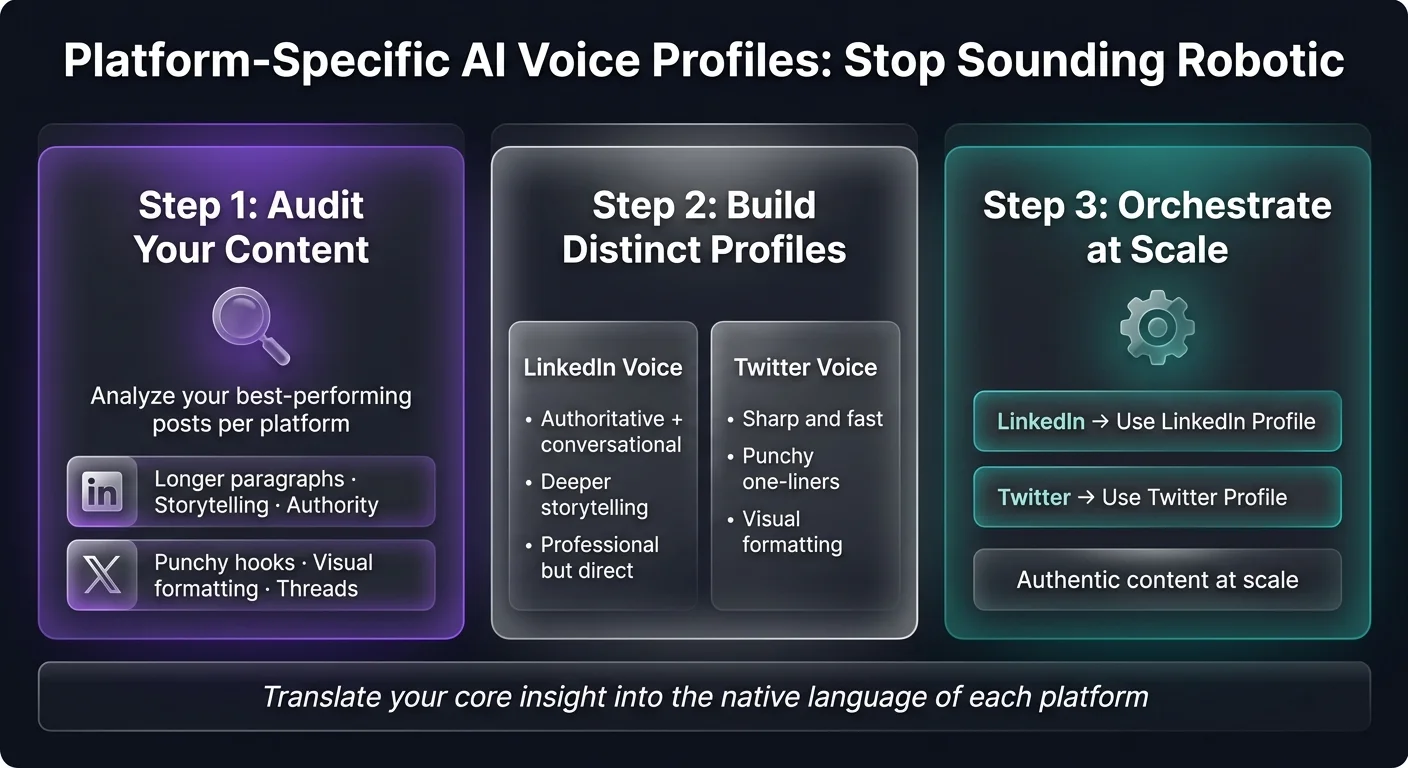
The mistake most companies make is treating AI automation as a blunt instrument. They look for a one-size-fits-all solution. But in reality, linguistic context matters. We don't think that more complicated is necessarily better, but distinct is non-negotiable. You have to define the constraints. My LinkedIn voice is authoritative but conversational - it allows for longer paragraphs and deeper storytelling. My Twitter voice is sharper, faster, and relies on visual formatting. When you try to average these out into a single 'Brand Voice,' you get the worst of both worlds - bland, structureless text that engages no one.
Orchestrating effective content
So how do you orchestrate this effectively? You need to take ownership of the inputs. Stop treating your AI as a magic box and start treating it as a junior writer who needs specific instructions.
First, audit your own content. Look at your top-performing LinkedIn posts versus your best Tweets. Identify the structural differences. Do you use rhetorical questions on one but not the other? Do you use bullet points or emojis differently?
Second, build distinct profiles. In our system, we use defined visual styles and platform-specific voice prompts. We tell the agent: 'This is for LinkedIn. Use the LinkedIn profile. Keep it professional but direct.' Or 'This is for Twitter. Use the Twitter profile. Optimize for threads.'
This approach amplifies your ability to produce content without sacrificing quality — it's the architecture behind AI-powered marketing content systems that scale without losing brand fidelity. It allows you to maintain consistency across channels automatically, but it's a nuanced consistency. It's not about repeating the same words everywhere; it's about translating your core insight into the native language of each platform. The game has changed. You can't just broadcast anymore. You have to communicate. And communication requires fitting the room you're in.
Amplify your unique perspective
Ready to stop sounding like a robot and start scaling your actual thoughts? At Ability AI, we orchestrate AI agents that understand the nuance of your voice across every channel — see how this approach works in our AI content system case study. Don't let generic tools dilute your message. Let's build a system that amplifies your unique perspective with precision.