
Conversational business intelligence is the shift from static dashboards to AI agents that answer data questions in natural language — eliminating the friction between your data and your decisions. Most companies waste countless hours building Looker or Tableau dashboards that nobody reads. Instead of filtering through ten different views to find your CPA, you ask your Slack bot and get the raw answer in seconds. That is the radical shift from reactive viewing to conversational intelligence.
From viewing to communicating
Let's break it down. We have spent the last decade building visual abstractions - bars, pies, lines - to make sense of our businesses. But looking for a specific metric in a complex dashboard is low-leverage work. It kills momentum and creates bottlenecks.
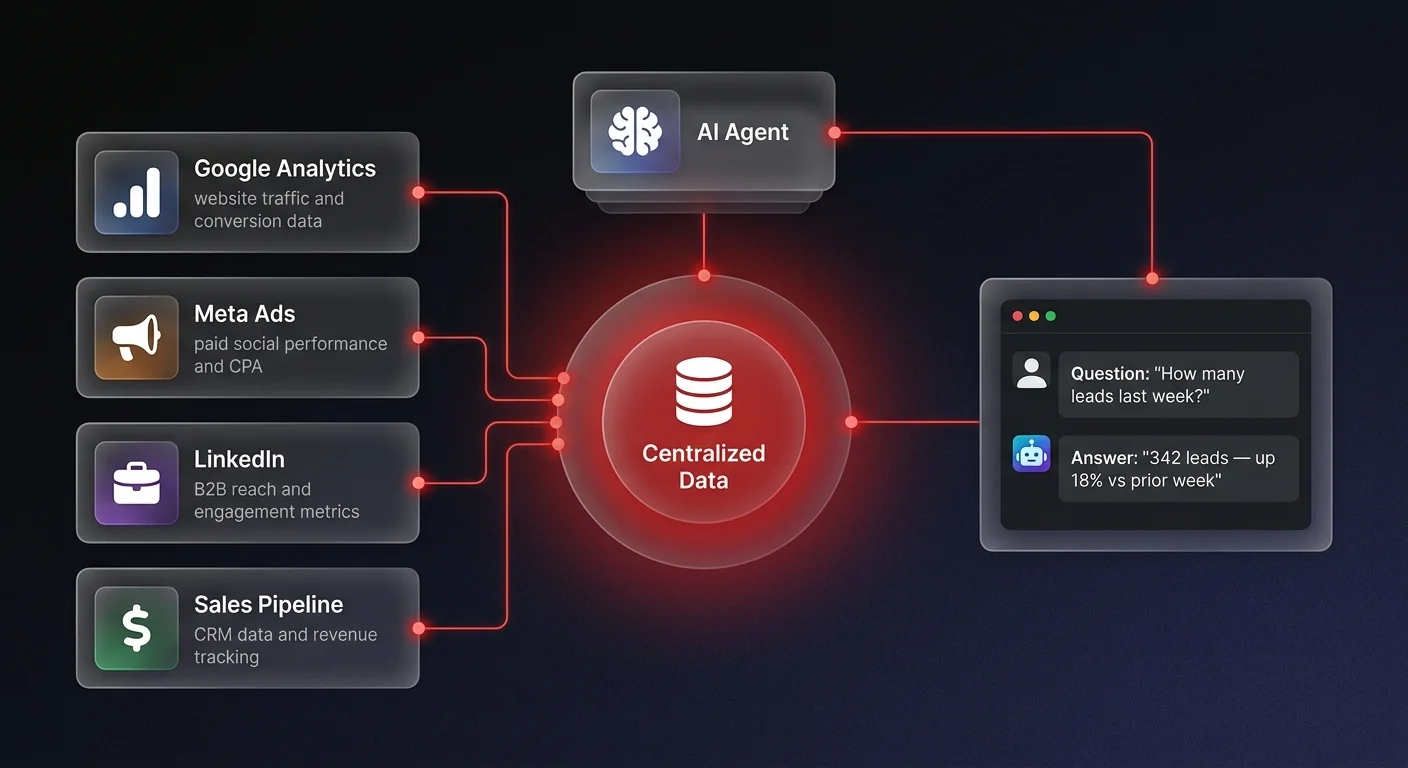
Here is what I mean. Instead of relying on siloed reporting tools, you need to aggregate your raw data - Google Analytics, Meta Ads, LinkedIn performance, sales pipelines - into a single, centralized database. Then, you orchestrate an AI agent on top of it. This is not just about search; it is about accessibility.
We implemented this internally, connecting our agent to Slack. Now, anyone on the team can simply ask, 'How many leads did we generate last week?' or 'Compare LinkedIn CPA versus Meta for Q3.'
The result? You get the raw truth immediately. No login, no filters, no waiting for the data analyst to run a SQL query. This amplifies your team's ability to make decisions because you are removing the friction between the question and the insight. You are flipping the script from 'viewing' data to communicating with it.
From retrieval to strategic partnership
But here is the thing - retrieval is just step one. If you stop at 'get me the data,' you are missing the point. The real power comes when you orchestrate the agent to interpret the data and offer solutions.
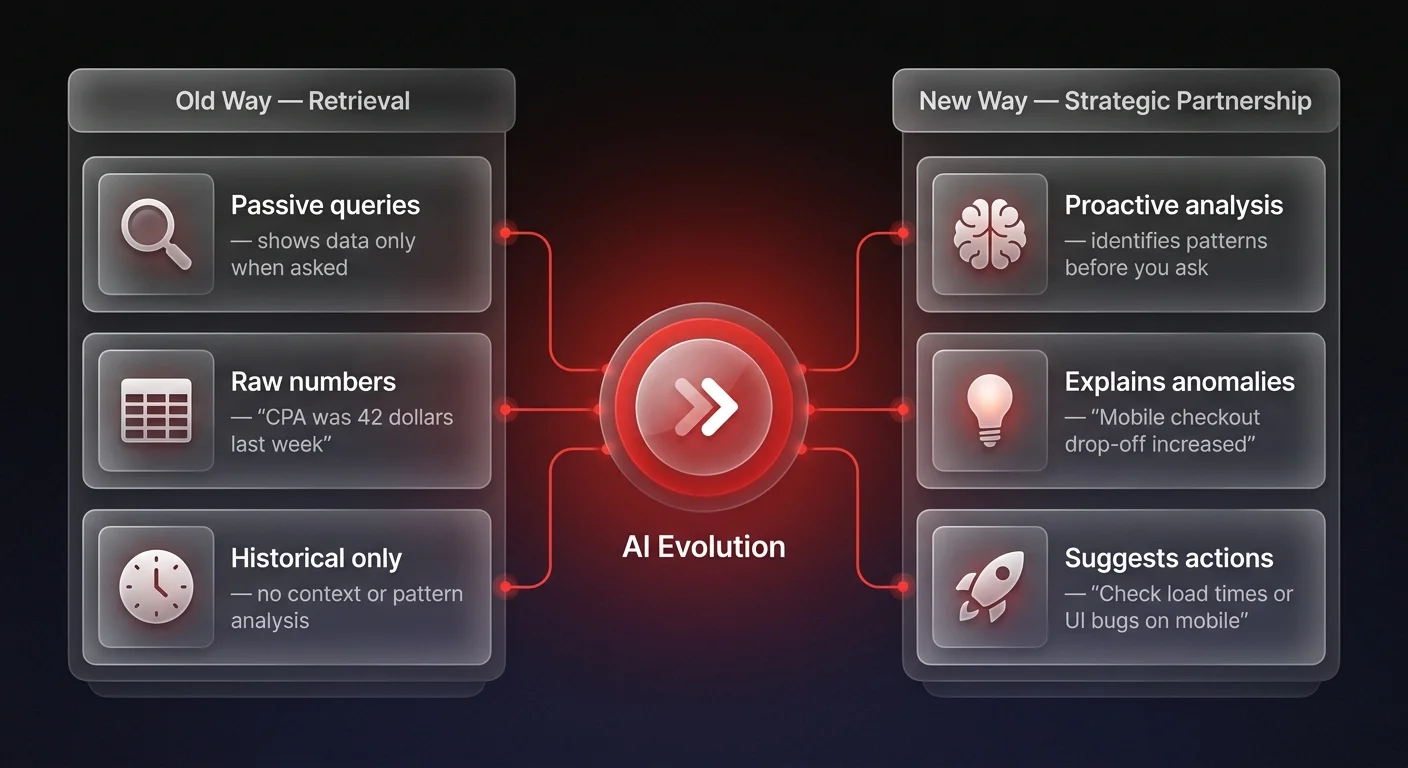
Because the agent has access to the raw context and the system instructions we have designed, it can analyze patterns that might be invisible to the human eye in a spreadsheet. It moves from being a librarian to a consultant.
You can ask, 'Why is our conversion rate dropping?' and the agent does not just show you a graph. It analyzes the funnel and says, 'Drop-off increased at the checkout page on mobile devices - suggest checking load times or UI bugs.'
It gives you suggestions. It becomes a strategic partner. That is the difference between a tool and a teammate.
To get here, you need to own your data. Stop relying on platform-native analytics that trap your insights. Centralize it. Then, orchestrate an agent that understands your business logic — a capability that AI operations automation is making increasingly accessible. The goal isn't just to see what happened; it is to know exactly what to do next.
Start getting answers
Ready to stop staring at charts and start getting answers? At Ability AI, we help you orchestrate AI agents that turn your raw data into actionable intelligence. Let's talk about how to make your business intelligence conversational and proactive.