

Modular AI agent architecture is the practice of breaking complex workflows into specialized sub-agents — each with a single, well-defined job — rather than relying on one monolithic agent to handle everything. Most people think a more powerful model is the answer to complexity, but a single agent given too many responsibilities loses context, produces average results, and hits a reliability ceiling fast. Specialization is what separates systems that actually execute complex business operations from those that just chat.
The problem with single agents
When you ask a single agent to handle a complex workflow - say, analyzing a knowledge base, extracting insights, and managing files - you're setting it up to fail. It loses context, gets confused, and produces average results. It's like hiring one person to be your CFO, CTO, and janitor all at once.
The modular architecture solution
The solution is modular architecture. Instead of one massive prompt, architect a system of specialized sub-agents. Each one has a distinct definition of success.
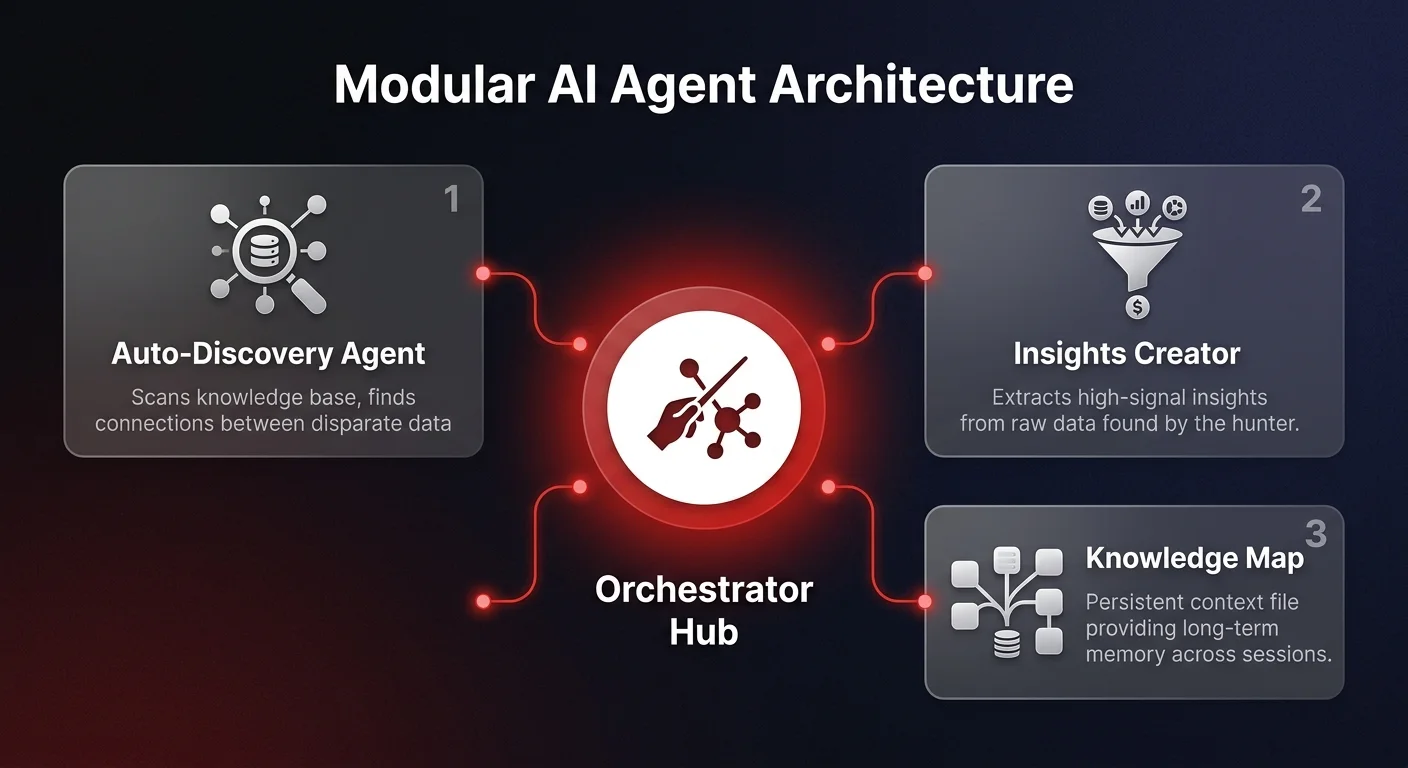
The auto-discovery agent: Its sole job is to be a hunter. It scans the knowledge base, looking strictly for connections between disparate pieces of information. It ignores everything else. Because its scope is limited, its accuracy is incredibly high.
The insights creator: It doesn't look for files; it takes the raw data found by the hunter and extracts unique, high-signal insights. By decoupling these functions, each agent becomes exponentially more effective at its specific job.
Orchestrating the system
You can't just have a bunch of loose agents running around. You need a conductor. Use a master file that defines the overall workflow and calls up specific sub-agents when needed — a pattern central to how we build AI-powered operations automation for clients handling complex, multi-stage workflows.
To make this truly powerful, you need persistent context. One of the biggest issues with LLMs is they have no memory of what they did five minutes ago. Solve this by generating and maintaining a knowledge base analysis file - think of this as long-term memory or a map of the territory.
The AI updates this file to keep a high-level understanding of what's in the entire database. When the master prompt runs, it references this map. It knows where to look and which specialist to deploy without having to re-read every single file from scratch.
This is the shift from 'chatting with AI' to 'building AI architecture.' The result is a system that doesn't just answer questions but actually executes complex, multi-step business processes with reliability — the foundation of every autonomous AI agent we design for production environments.