
A 20x company is an organization that competes against incumbents many times its size by deploying internal AI automation instead of proportional hiring. Coined by GigaML after their five-person team beat 500-person competitors for a Fortune 500 contract in 2025, the model works by restructuring operations so one human manages the output of dozens of autonomous agents — breaking the traditional link between revenue growth and headcount through internal automation.
Recent industry research highlights a startling trend: small, lean teams are successfully competing against incumbents twenty times their size - and winning. They aren't doing this by working harder or outsourcing to cheaper labor markets. They are achieving this leverage by deploying internal automation systems built on sovereign AI agents that automate entire functions rather than just individual tasks.
This isn't about giving employees a chatbot helper. It is about restructuring the organization so that one human employee can manage the output of dozens of autonomous agents. For operations leaders and CEOs, understanding the mechanics of a 20x company is no longer just an academic exercise - it is a survival requirement in a market where your competitors might be moving twenty times faster than you.
The arithmetic of the 20x company
The term "20x company" was coined by the founders of GigaML to describe their experience closing DoorDash as a customer. At the time, GigaML was a team of approximately five engineers. They were competing against incumbent vendors with hundreds of engineers and vast resources. Despite the resource disparity, they won the contract.
How does a five-person team outmaneuver an organization with 100x the engineering talent? They built an internal agent named Atlas. Atlas wasn't the product they sold; it was the infrastructure they used to build the product. Atlas could access browsers, edit policies, write code, and execute complex workflows within their own product environment.
The result was a dramatic expansion of scope for every human engineer. Before Atlas, an engineer might handle four or five problems simultaneously, bottlenecked by integration boilerplate and customer-specific configurations. With the agent handling the boilerplate, each engineer's capacity doubled or tripled. This leverage allowed them to beat a competitor literally twenty times their size - hence the name.
The 1:N management ratio
The defining characteristic of these high-leverage organizations is a shift in the human-to-work ratio. In traditional operations, one employee executes one workflow at a time. In a 20x company, one employee manages multiple AI instances simultaneously.
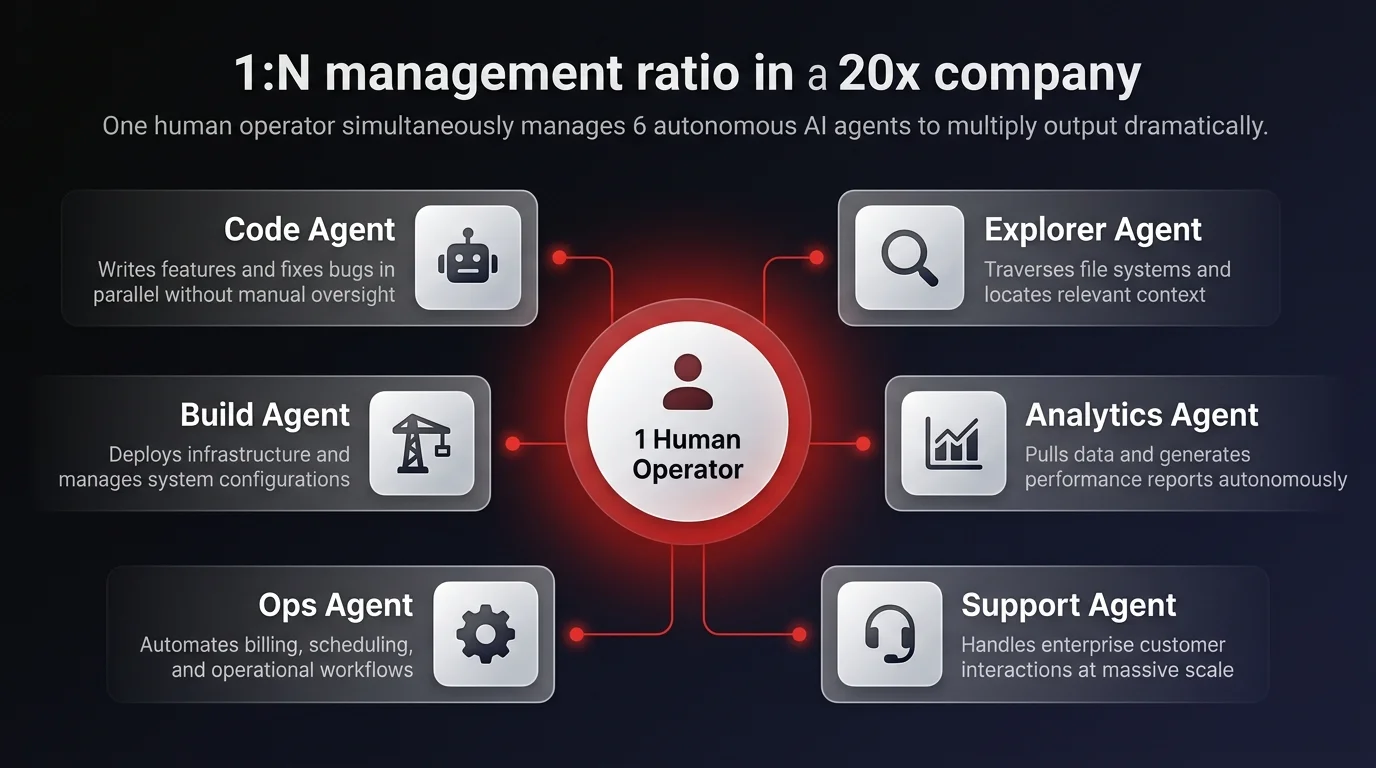
We see this clearly in how Anthropic's own engineering team operates. Reports indicate that developers there don't just use coding assistants; they manage between three and eight instances of Claude simultaneously. While the human architect discusses foundational strategy in person, they deploy a fleet of agents to implement features, fix bugs, and research solutions in parallel.
This 1:N ratio extends beyond engineering into customer success and operations. Returning to the GigaML example, the company is currently running pilots with over ten Fortune 500 companies, each generating call volumes between 500,000 and 1 million per day. Traditionally, managing that volume of enterprise pilots would require a dedicated team of account managers and support engineers.
Instead, they manage these relationships with a single human full-time employee (FTE). Because the internal agent infrastructure handles the execution - taking requests, turning them into features, and managing technical nuances - the human FTE focuses exclusively on the high-level relationship and strategy. When one person can effectively manage the workload of a ten-person department, the unit economics of the business change effectively overnight — a model similar to what AI sales intelligence automation enables for enterprise account management teams.
Building internal automation infrastructure
One of the biggest barriers to scaling operations is the fragmentation of data. As companies grow, they typically add layers of middle management and specialized departments to route information between sales, support, and billing. The 20x company bypasses this bureaucracy by building a custom, AI-integrated source of truth.
Legion Health, an AI-native psychiatry network, offers a prime example of this architecture. In the past year, they grew their revenue by 4x. In a traditional healthcare setting, a 400% increase in patient volume would necessitate a massive hiring spree for care coordinators, billing specialists, and support staff. Yet, Legion Health achieved this growth with zero net new hires.
Their operational structure consists of:
- One clinical lead
- One patient support person
- One billing person
These three individuals replaced what would essentially be three distinct call centers in a legacy healthcare company. They achieved this by building a custom internal interface that acts as an operational layer on top of their data. This interface allows the care operations team to instantly pull patient history, scheduling availability, insurance codes, and communication logs in a single view.
Crucially, they didn't buy a generic SaaS tool to do this. They built a sovereign system that understands their specific data structure and workflows. This allows a single operator to resolve complex patient issues that would usually require triangulation between three different departments. By collapsing the distance between the data and the decision-maker, they eliminated the administrative overhead that typically kills margins in scaling service businesses.
The audit-to-agent pipeline
Building a 20x company requires a cultural shift in how operational problems are solved. The default reaction to a bottleneck in most companies is "we need to hire someone." In high-leverage startups, the reaction is "we need to build an agent."
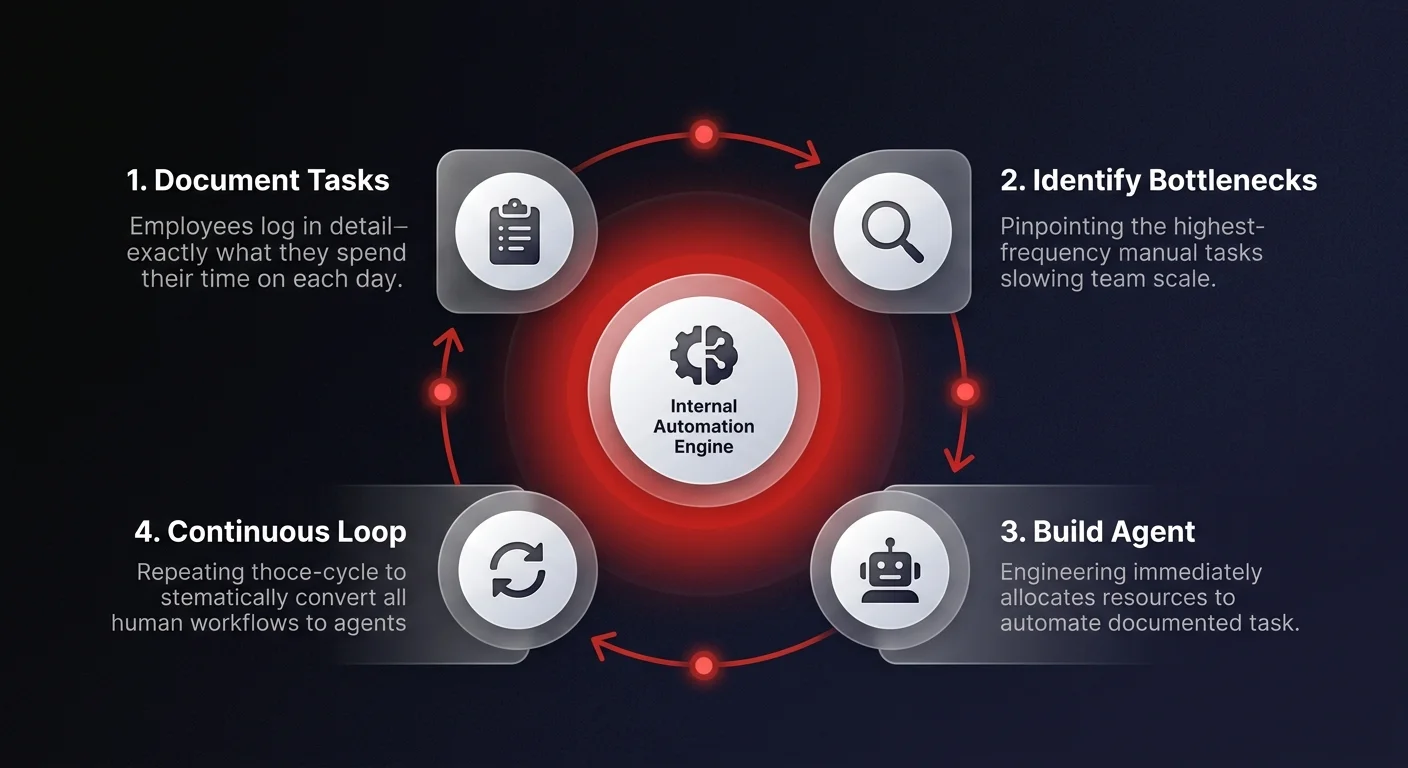
Phase Shift, a company automating accounts receivable, has institutionalized this approach through a process we can call the "audit-to-agent pipeline." With a 12-person team competing against incumbents founded in 2006, they cannot afford manual inefficiencies. Their process involves asking employees to rigorously document exactly what they spend their time doing throughout the day.
Once a manual task is identified and documented, engineering resources are immediately allocated to build a custom agent to handle it. This isn't a quarterly initiative; it is a continuous loop. For example, by leveraging AI tools that generate front-end designs (referred to as "magic patterns"), they have avoided hiring a dedicated designer entirely. The engineering team uses agents to handle the design workload, keeping the team lean and focused on core product logic — the same principle that drives finance and procurement automation for teams managing accounts receivable and billing at scale.
This approach requires a change in mindset from leadership. Operations leaders must stop viewing automation as a project to be bought off the shelf and start viewing it as an internal capability to be developed. The most valuable agents are often the ones you build yourself because they map perfectly to your unique internal bottlenecks, similar to how companies approach measuring AI automation ROI.
Governance: the missing link in scaling
While the results of the 20x model are alluring, there is a critical operational risk that must be addressed: governance. When a company moves from human execution to agent execution, the volume of work explodes. If those agents are not governed, errors can scale just as fast as revenue.
The companies successfully deploying this model - whether it's GigaML, Legion Health, or Anthropic - aren't just letting AI run wild. They are building infrastructure that provides observability and control. The "Atlas" agent isn't a black box; it operates within defined parameters. The Legion Health interface creates a structured environment where the AI assists human decision-making rather than replacing it entirely without oversight.
For mid-market companies looking to adopt this model, the challenge is rarely the technology itself - it's the architecture of control. You need to ensure that your internal agents are:
- Sovereign: Operating on your data, within your secure perimeter, not leaking context to public models.
- Observable: capable of being audited so that when a mistake happens, you can trace the logic chain.
- Scoped: Given specific permissions (like the ability to read insurance codes but not write prescriptions without approval).
Conclusion
The 20x company is not a futuristic concept; it is the current reality for a segment of the market that has figured out how to weaponize internal automation. These organizations are proving that the link between revenue growth and headcount is not a law of physics, but a limitation of legacy operations.
For COOs and operations leaders, the takeaway is clear. The next phase of competition won't be about who has the best sales team or the most engineers. It will be about who can build the most effective internal agent infrastructure to multiply the output of their existing talent. The goal is not to replace your team, but to give every member of your staff the power of a twenty-person department.