
Local AI agents are autonomous AI systems that execute directly on your own infrastructure — your VPC, on-premise servers, or local device — rather than routing work through third-party cloud APIs. Unlike cloud-based LLMs constrained to rigid API integrations, local agents operate where your data actually lives. The enterprise shift from cloud chat to sovereign local execution isn't a marginal upgrade; it's a fundamental change in what AI can actually do for your business.
Recent industry waves caused by tools like Openclaw have highlighted a critical realization for operations leaders. The true power of artificial intelligence is not just in generating text - it is in sovereign execution. When an agent runs locally on a machine rather than in a distant data center, it gains the ability to execute any action a human user can perform. This shift from cloud-based chat to local execution represents the next frontier in operational efficiency, offering capabilities that range from hardware control to deep, unstructured data discovery.
The limitations of the cloud-tethered agent
To understand why local execution is transforming the landscape, we must first look at the limitations of the current cloud paradigm. Most enterprise AI adoption today relies on what can be described as "tourist agents." These agents visit your data via rigid APIs or file uploads, perform a specific task, and then leave. They do not inhabit the environment.
This architecture creates a functional ceiling. A cloud-based agent, regardless of its intelligence, is limited by the integrations built for it. It cannot reach outside the sandbox of its API connections. As noted in recent observations regarding Openclaw, cloud agents can do a "few things," but they lack the total system access required for true autonomy.
For an operations leader, this is the difference between an AI that can write an email about a report and an AI that can log into the ERP, generate the report, cross-reference it with local spreadsheets, and update the project management software. The cloud agent offers analysis; the local agent offers action.
Why local AI agents change everything
The defining characteristic of the new wave of local AI agents is simple but profound: if you write code that runs on your computer, the machine can do virtually anything you can do with the machine. This concept of "total access" effectively clones the user's capabilities.
In the consumer space, this has been illustrated through hardware control. While ChatGPT sits in a browser, a local agent can connect directly to your environment - controlling your lights, your Sonos system, your Tesla, or even the temperature of your bed. These are actions that require a presence on the network and permission to execute commands at the operating system level, capabilities that isolated cloud models simply do not possess.
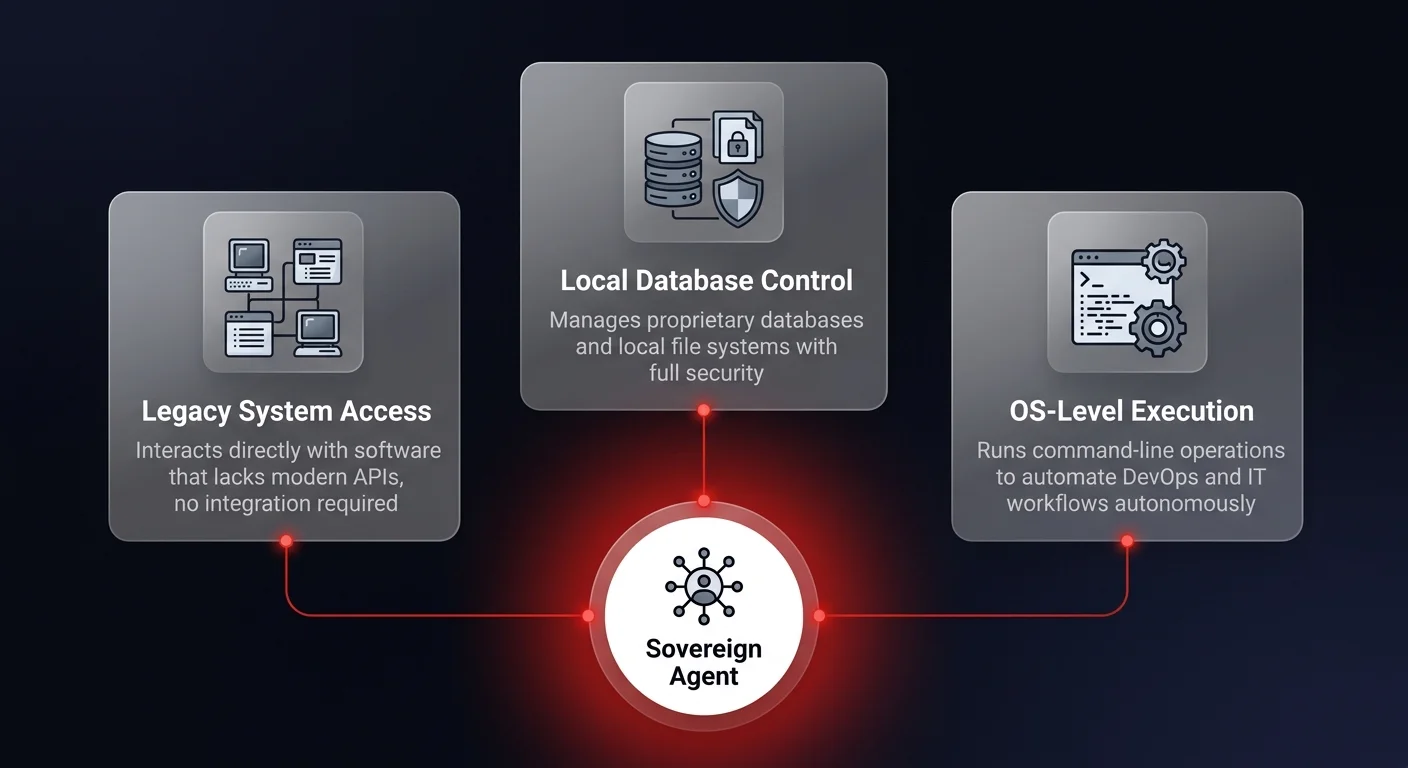
For the enterprise, the "Tesla and bed" analogy translates directly to critical infrastructure. A sovereign agent running within your secure VPC or on a local server can:
- Interact with legacy software that lacks modern APIs.
- Manage local file systems and proprietary databases securely.
- Execute command-line operations to automate DevOps or IT workflows.
This is the essence of sovereign AI. It is not about sending data out to be processed; it is about bringing the intelligence to the data and infrastructure. By giving the agent the same skills and access permissions as a human employee, organizations can automate complex, multi-step workflows that were previously impossible to hand off to a bot.
The power of forgotten data
One of the most compelling aspects of local execution is the ability to surface value from unstructured, forgotten data. Cloud agents typically only see the data you explicitly curate and feed them. In contrast, a local agent with system-wide access can "search the whole computer," leading to surprising and valuable insights — a discovery-oriented approach that is reshaping how companies think about operations automation and institutional knowledge management.
A striking example of this capability involves a user who asked a local agent to look through their computer and construct a narrative of their last year. The result was shockingly accurate and detailed, pulling information the user had completely forgotten. The agent discovered audio files - recordings made every Sunday more than a year prior - and synthesized them into the narrative. The user had no recollection of these files, but the agent found them because it had unrestricted access to the local environment.
For business operations, this capability is transformative. Consider the implications for knowledge management and strategic review:
- Automated post-mortems: Instead of relying on human memory to reconstruct a project's timeline, a local agent could scan all Slack logs, local drafts, git commits, and meeting recordings to build an objective timeline of what actually happened.
- Lost IP recovery: Agents can scour local drives across the organization to find forgotten prototypes, research documents, or process notes that effectively re-capture lost intellectual property.
- Contextual continuity: When an employee leaves, a local agent can preserve their workflow context by analyzing their local interaction history, ensuring that institutional knowledge doesn't walk out the door.
This moves data retrieval from a "search query" model to a "discovery" model. You don't have to know what you are looking for; you simply need to give the agent the mandate to explore the data you already possess.
Sovereignty meets governance
The shift toward local execution validates the Ability.ai perspective on governed agent infrastructure. While the raw power of tools like Openclaw is undeniable, it introduces a massive operational challenge: governance.
When you grant an agent the ability to "do every effing thing" - from controlling hardware to accessing forgotten audio files - you are effectively granting it super-user privileges. In a personal context, an agent misinterpreting a command might change your lights or mess up a playlist. In a business context, an ungoverned agent with total local access could delete production databases, leak sensitive audio recordings, or disrupt operational technology — which is why a structured IT service management framework is essential before granting agents this level of access.
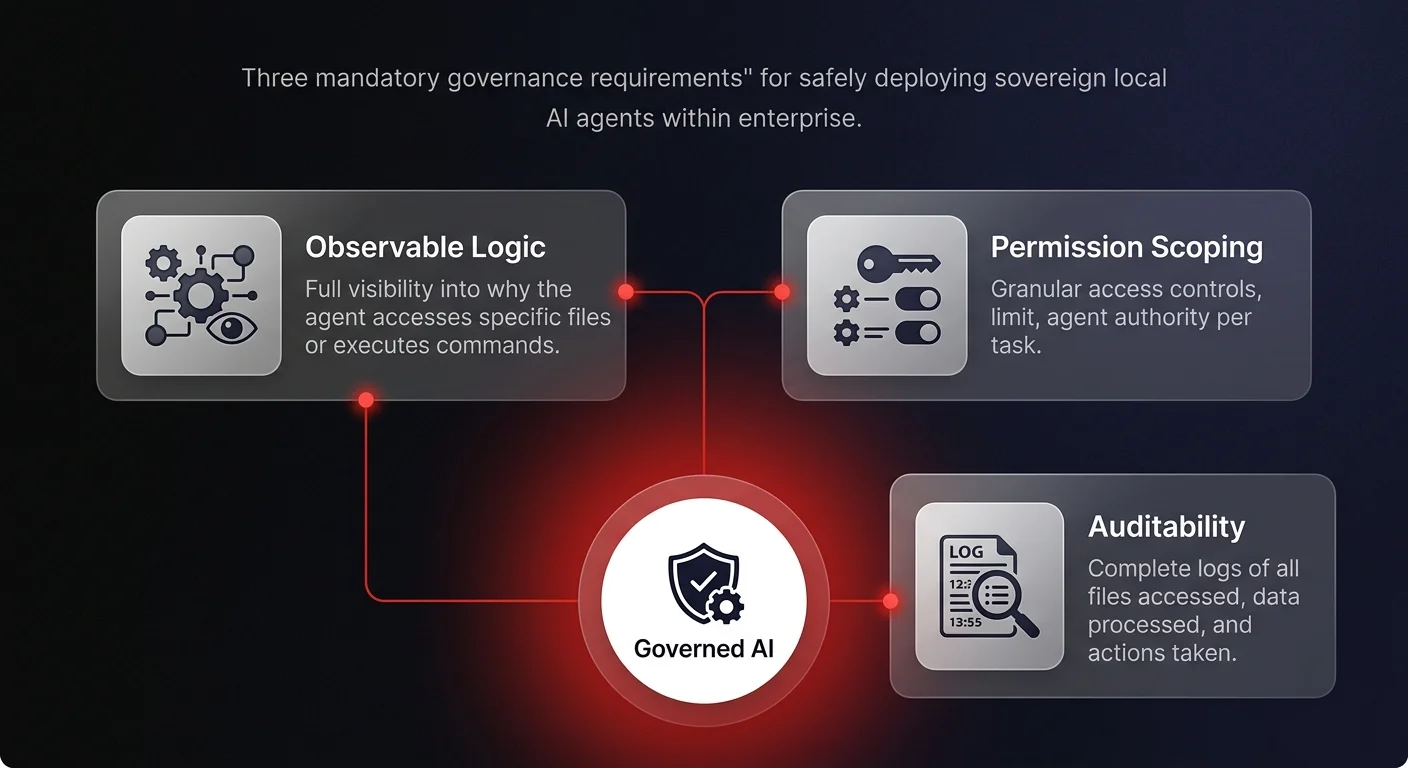
This is where the distinction between "local scripts" and "governed sovereign agents" becomes critical for the mid-market enterprise. To harness the power of local execution without inviting chaos, organizations need:
- Observable logic: You must be able to see exactly why the agent is accessing specific files or executing specific commands.
- Permission scoping: Just because an agent can access the entire hard drive doesn't mean it should for every task. Granular controls are essential.
- Auditability: If an agent constructs a narrative from old files, the business needs a log of exactly which files were accessed and how that data was processed.
These governance requirements align with broader AI governance challenges that enterprises must address as they deploy autonomous systems at scale.
Conclusion
The excitement surrounding local execution tools proves that the market is hungry for AI that does more than chat. The future belongs to agents that live where the work happens - on the device, in the network, and alongside the data. By leveraging local execution, businesses can unlock the full potential of their hardware and their forgotten data reserves.
However, this power must be deployed strategically. The goal is not just to give an agent total access, but to deploy sovereign, governed systems that turn this deep access into reliable business outcomes. As we move forward, the most successful companies will be those that combine the limitless utility of local execution with the rigorous safety of enterprise governance.