
Vibe working is an emerging operational paradigm where leaders manage teams of autonomous AI agents to achieve complex business outcomes — rather than crafting individual prompts for small tasks. Coined by Anthropic's Head of Product, the concept replaces the prompt-response loop with outcome-based agent orchestration: users define what needs to happen, and specialized AI agents — researcher, writer, builder — execute in parallel to deliver finished deliverables. For COOs and operations leaders, this shift transforms AI from a chatbot into a managed workforce.
For the last year, the market focused on "vibe coding" - the ability for developers to describe software behavior and have AI write the code. But the latest developments from Anthropic, specifically regarding Claude Code and agentic teams, have expanded this concept to the entire knowledge workforce. For COOs and VPs of Operations, this distinction is critical. Vibe working transforms AI from a chatbot you query into a workforce you orchestrate. The implications for productivity, governance, and operational scale are massive.
From task execution to agent orchestration outcomes
To understand vibe working, you must first recognize the limitations of the current "prompt-response" loop. Today, most employees use AI like a junior intern who can only handle one instruction at a time. You ask for a blog post outline; it gives the outline. You ask for a revision; it gives the revision. The human remains the primary processor, constantly context-switching to guide the AI through micro-steps.
The shift to vibe working flips this dynamic. Instead of defining tasks, the user defines an outcome. For example, rather than prompting for a list of competitors, a user can now instruct an agentic team to "create a competitive analysis deck for our top five rivals, including a summary brief for the CEO."
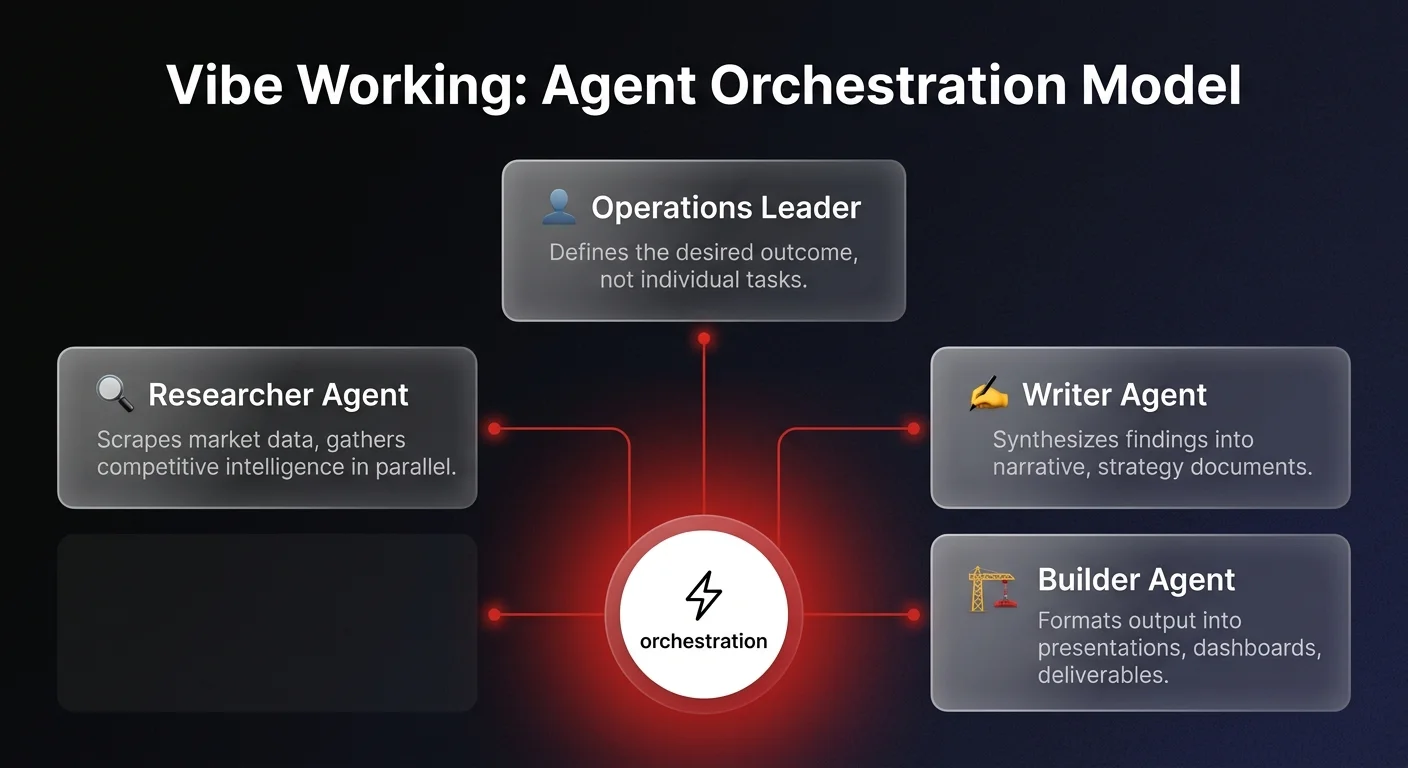
In this scenario, the AI doesn't just generate text. It spins up a team of specialized agents:
- A researcher agent to scrape and gather market data.
- A writer agent to synthesize the findings into a narrative.
- A builder agent to format the output into a presentation.
These digital workers operate in parallel, orchestrated by a central logic (in this case, Claude Code). For operations leaders, this changes the hiring profile and the skill set required of the team. We are no longer looking for employees who are good at "prompting." We are looking for employees who possess the managerial skills to define clear outcomes, resource digital teams, and review complex outputs. The individual contributor is evolving into a manager of synthetic labor.
The collapse of the "copy-paste tax"
A significant source of operational friction has historically been the disconnect between AI reasoning engines and actual work surfaces. Employees spend hours acting as the middleware between a chatbot window and their deliverables - copying text into Word, pasting data into Excel, or manually building slides in PowerPoint.
The new wave of agentic tools is eliminating this friction by embedding agents directly into the application layer. Research shows that agents can now execute logic inside Excel and PowerPoint natively. This means an operations manager doesn't need to be a data analyst to get deep insights from a spreadsheet. They can instruct the agent to "analyze this financial data for trends and visualize the top three growth vectors."
The agent handles the formula generation, the data pivot, and the chart creation. This is not just automation; it is the removal of the "copy-paste tax" that slows down decision-making. However, this deep integration brings new challenges for governance. When agents are modifying financial records or client presentations directly, the need for observable logic and data sovereignty becomes paramount. You cannot afford for a "black box" to hallucinate inside your P&L statement — which is why teams adopting AI-driven finance and procurement automation require full audit trails for every agent action.
Context is the new training data
One of the most significant bottlenecks in operationalizing AI has been the context window - the amount of information an AI can hold in its "short-term memory" at one time. Previously, complex tasks required chopping data into small fragments, which often led to the AI losing the thread or hallucinating details.
With the introduction of models like Opus 4.6, we are seeing context windows expand to 1 million tokens. To put this in perspective, this allows an agent to ingest an entire company's code base, years of financial filings, or thousands of pages of process documentation in a single pass.
For scaling companies, this capability creates a "network effect" of intelligence. An agent doesn't just read page 10 and page 1,000 separately; it identifies relationships between them. It can spot that a compliance rule mentioned in a 2021 memo contradicts a procedure outlined in a 2024 handbook. This allows for:
- Holistic consistency: Agents maintain brand voice and strategic alignment across massive projects.
- Deep reasoning: The ability to answer "why" questions based on total information access rather than fragmented retrieval.
- Autonomous debugging: In software and operations, agents can trace errors across complex systems without human intervention.
The operational imperative: systemizing the vibe
While the concept of vibe working is empowering for individual productivity, it presents a stark challenge for organizational leadership. The democratization of agent teams - where any employee can spin up a swarm of agents via command line to execute work - creates a potential governance crisis.
If a sales representative uses a local agent swarm to generate a pitch deck, where does that data go? What logic did the agent use to determine pricing? If the output is wrong, can you trace the error?
The research indicates a clear divergence in how companies will succeed in this new era. Success will not be defined by which company uses AI the most (high usage metrics often correlate with inefficiency, not productivity). Success will be defined by workflow systemization — the foundation of governed operations automation infrastructure.
Operations leaders must transition from ad-hoc agent usage to governed agent infrastructure. This involves:
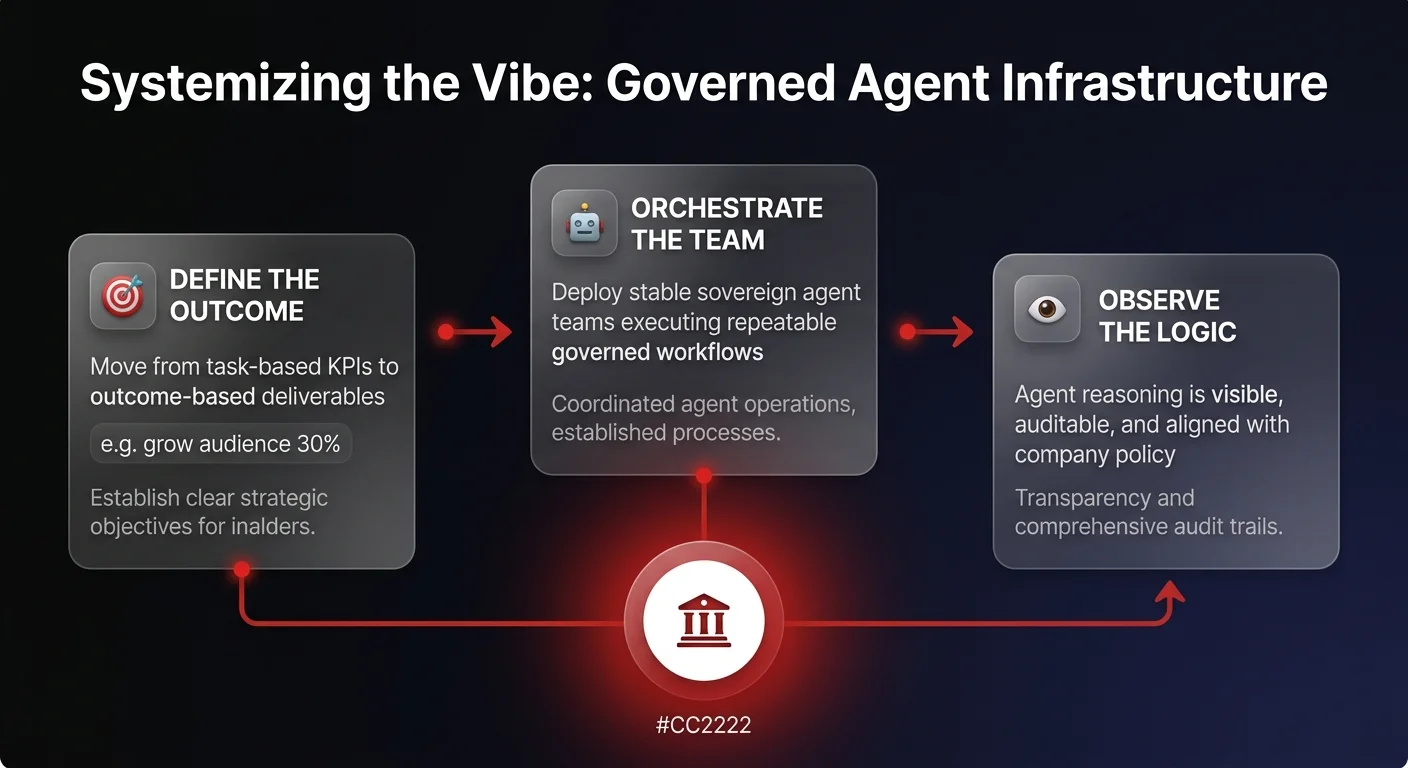
- Defining the Outcome: Moving away from task-based KPIs to outcome-based deliverables (e.g., "grow audience by 30%" vs. "write 5 blog posts").
- Orchestrating the Team: Deploying stable, sovereign agent teams that execute repeatable workflows, rather than relying on employees to "vibe" their way through complex tasks individually.
- Observing the Logic: Ensuring that the reasoning steps taken by agent teams are visible, audit-able, and aligned with company policy.
Conclusion
The shift from prompting to vibe working validates a core truth about the future of work: AI is no longer a tool you talk to; it is a team you manage. For the mid-market enterprise, this is an opportunity to scale output without linearly scaling headcount. However, it requires a disciplined approach to infrastructure. The winners will not be the companies with the best prompt engineers, but the companies with the best agent architectures - systems that turn the "vibe" of high performance into a repeatable, governed operational standard.