
AI agents for product managers are autonomous systems that allow non-technical operations leaders to inspect code, execute changes, and debug deployment failures without requiring an engineering cycle. Unlike chat-based AI assistants, these agents integrate directly with a company's codebase, CI/CD pipelines, and internal tools — transforming PMs from passive ticket-filers into active technical contributors who can resolve "last mile" implementation tasks independently.
However, a new paradigm is emerging where AI agents for product managers act not just as assistants, but as technical bridges. We are observing a shift where non-coding leaders are using agentic workflows to inspect code, execute changes, and most importantly, debug the continuous integration (CI) pipelines that govern software delivery.
This isn't about replacing engineers; it's about empowering operational leaders to handle the "last mile" of implementation without breaking the codebase. Drawing from recent industry research and practical workflows involving tools like Codex and Buildkite, we can see a clear path toward a more autonomous, technically capable product function.
AI agents for product managers: understanding before acting
One of the primary barriers for non-technical leaders interacting with a codebase is the fear of "looking stupid." When a PM sees a UI element that seems redundant, the hesitation to ask about it often stems from a lack of technical context. Is that button tied to a legacy backend process? Will deleting it crash the reporting module?
Research into agent workflows reveals that PMs are using AI as a private contextual layer. Before tagging an engineer or filing a ticket, they use agents to analyze the code surrounding a specific feature. In one observed workflow, a PM utilized an agent to analyze a confusing button in their application. The agent read the code and the surrounding logic, explaining the button's function in plain English.
This creates a safe environment for inquiry. The PM confirmed the button was unnecessary through the agent's analysis, then verified this with the team: "Hey, I confirmed we don't need this button." By the time the human conversation happened, the PM was informed and confident. The agent served as a pre-check mechanism, reducing the social friction of technical discussions and allowing the PM to propose changes based on code reality, not just user intuition.
Moving from insight to execution
The true value of sovereign AI agents appears when users move from analysis to action. In the workflow analyzed, the PM didn't just identify the redundant button; they instructed the agent to remove it. This transition - from observer to contributor - is significant.
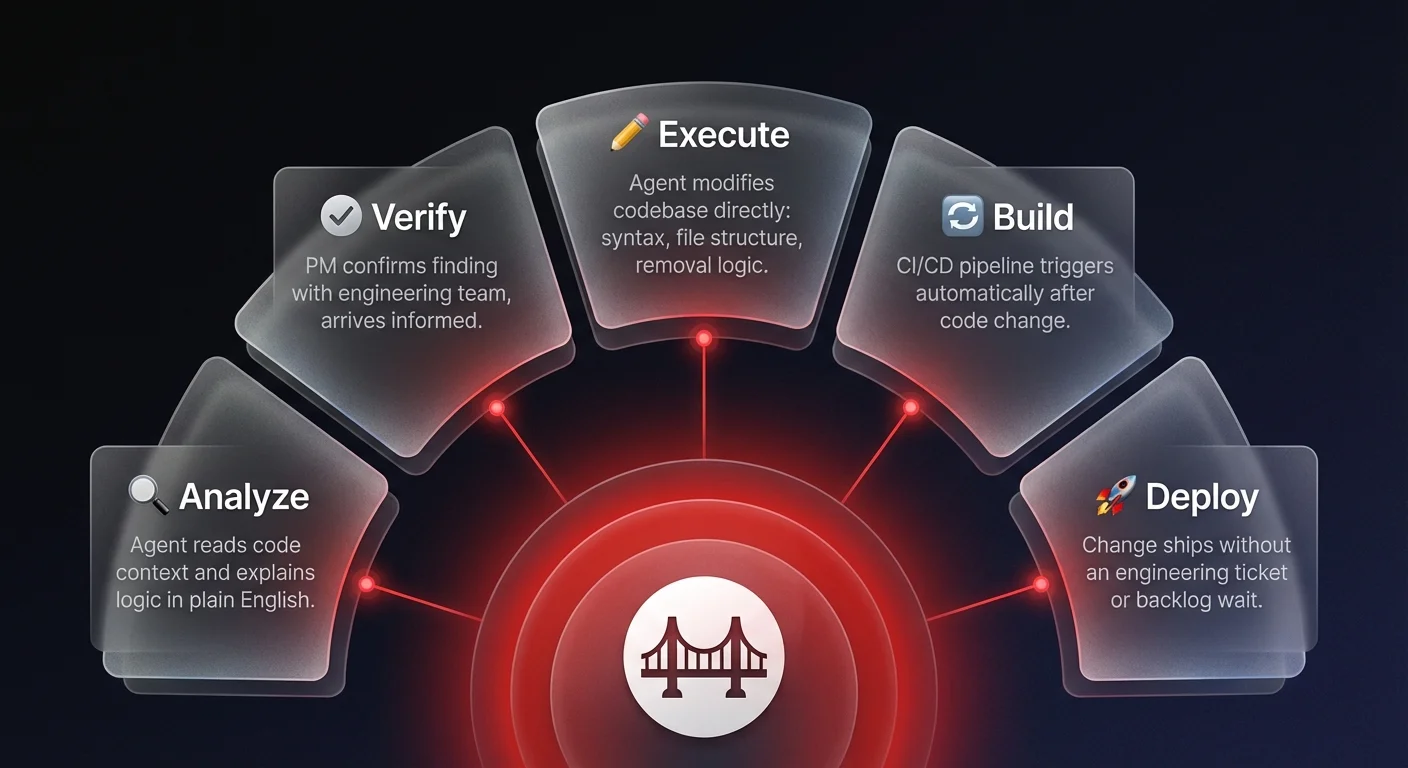
Traditionally, a PM would file a Jira ticket to "remove button X," which might sit in a backlog for weeks. With an agent integrated into the repository, the PM simply instructed the system to delete the code. The agent handled the syntax, the file structure, and the removal logic.
However, execution introduces complexity. Code changes rarely happen in isolation. They trigger build processes, automated tests, and deployment pipelines. This is where non-technical users typically hit a wall. When a Pull Request (PR) fails, the error logs are often buried in CI/CD tools like Buildkite, accessible only to those who know how to navigate them.
The observability bridge: debugging without the dashboard
When non-engineers encounter a build failure, the default reaction is to hand off the problem. The friction of logging into a separate system, finding the correct build ID, and parsing raw log files is too high. As one researcher noted regarding their own workflow, "I have become so lazy... the moment I've got to go into Buildkite and look at the test logs, I just like, ah, you know."
This "laziness" is actually a rational response to operational friction. The solution observed in high-performing agent orchestration workflows is the integration of observability "skills" directly into the agent interface.
Instead of context switching, the PM used the agent's connection to the CI/CD pipeline. By simply clicking a "skills" tab and typing "Buildkite fetch logs," the agent retrieved the specific error causing the failure. In this instance, the agent identified that the build failed because of a missing authentication token.
This capability democratizes debugging. The agent acts as the interface for complex infrastructure, allowing the PM to diagnose technical hurdles without needing to master the underlying tools. It transforms an opaque "something went wrong" into a specific, actionable problem: "you need to install the Buildkite tokens."
Recursive improvement: the agent that learns
The most strategic aspect of this workflow lies in what happened after the error was diagnosed. A standard AI interaction would end with the user pasting a token to fix the immediate problem. However, sovereign agent architectures allow for recursive improvement - teaching the system to handle the problem autonomously in the future.
In the analyzed case, the PM recognized that asking the agent to set a token manually was inefficient. They decided to update the agent's "skill" definition - the underlying instructions that govern how the agent interacts with external tools.
The user navigated to the top-level folder in the repository where the agent's skills were defined. They then instructed the agent to:
- Read the rollout documentation.
- Reflect on what might fix the token issue permanently.
- Update the skill code to handle authentication automatically next time.
This is a critical distinction in AI maturity. The user wasn't just using the tool; they were governing it. By modifying the skills folder, they permanently upgraded the organization's operational capability. The next time any user encounters this issue, the agent will already possess the logic to solve it.
Strategic prompting for skill updates
Interestingly, the user employed a specific prompting strategy when updating the agent's logic. They explicitly asked the agent to "reflect" before coding. This chain-of-thought prompting, even when using lower-compute models ("Codex on low"), resulted in higher quality output.
By guiding the agent to "think through it," the PM ensured the update to the skill was robust. This highlights a new competency for operations leaders: prompt engineering for infrastructure. The ability to guide an agent through a logic update is becoming as valuable as the ability to write the code itself.
The inductive journey of modern operations
The workflow demonstrated here represents an "inductive journey":
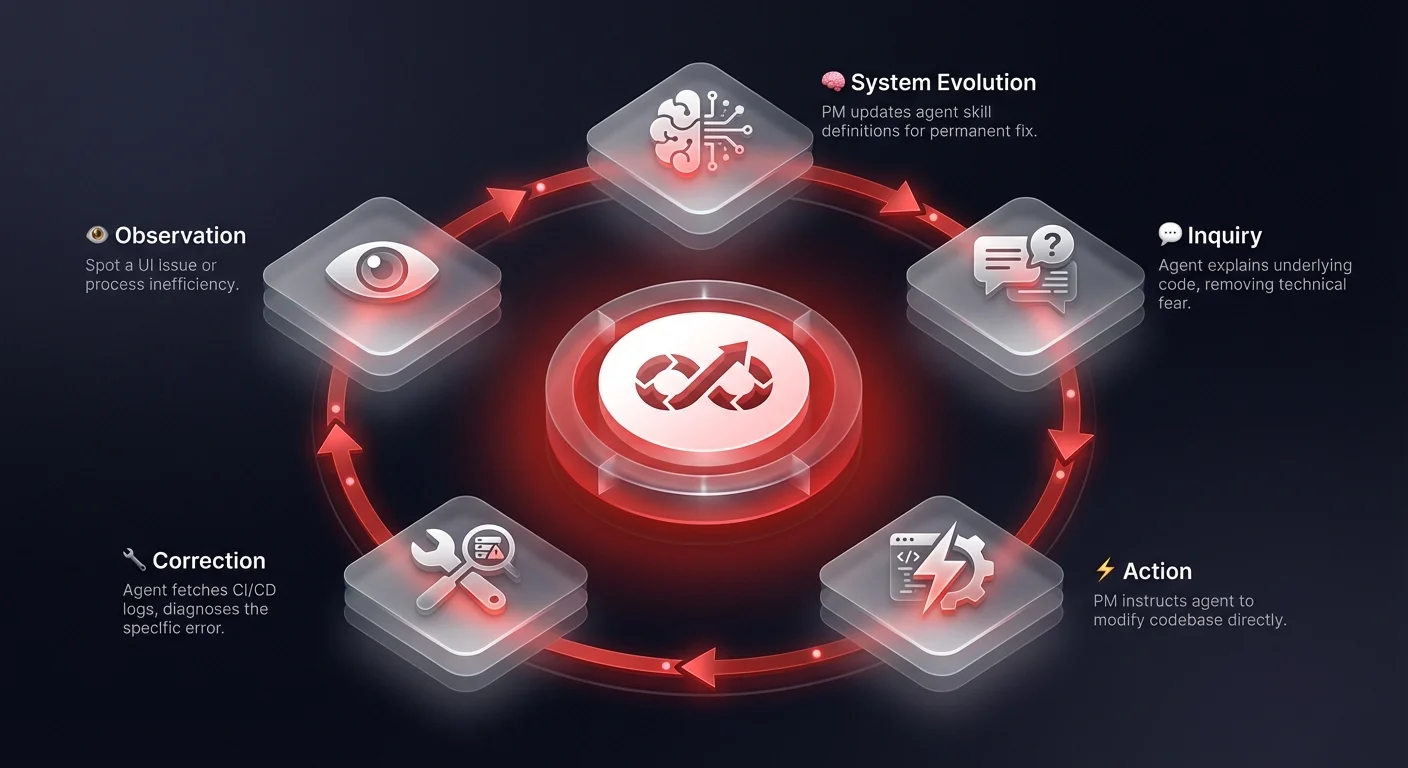
- Observation: Seeing a user interface issue.
- Inquiry: Asking the agent to explain the underlying code.
- Action: Instructing the agent to modify the codebase.
- Correction: Diagnosing a CI failure via the agent.
- System Evolution: Updating the agent's core skills to prevent future friction.
For mid-market and scaling companies, this model offers a way to unclog engineering pipelines. When Product and Operations leaders can safely interact with the codebase, simple fixes happen immediately, and engineers can focus on complex architectural challenges — a core principle behind how Ability.ai structures software development automation for scaling teams.
Operational governance and sovereignty
It is crucial to note that this workflow requires a governed, sovereign architecture. The ability to access a "skills" folder, read raw code, and interact with internal build tools (like Buildkite) requires an agent infrastructure that sits inside the company's boundary — the same foundation that underpins effective IT service management automation. Closed, chat-based models often lack the deep integration required to fetch logs or modify their own system prompts permanently.
For Ops leaders, the takeaway is clear: the goal isn't just to give your team an AI chatbot. It is to implement a system where your team can define, refine, and improve the "skills" that run your business. When a PM updates an agent's logic to handle a missing token, they are effectively automating a piece of institutional knowledge.
Conclusion
The era of the non-technical bystander is ending. With the right agent infrastructure, Product Managers and Operations leaders can bridge the gap between strategy and code. By adopting workflows that prioritize understanding, execution, and recursive system improvement, organizations can move faster and reduce the friction between defining a product and shipping it. The future belongs to teams that don't just use AI, but actively teach their agents how to navigate the unique complexities of their business infrastructure.