
An AI marketing team is a coordinated set of autonomous agents — each trained on company-specific SOPs — that executes marketing workflows end-to-end without continuous human direction. For mid-market companies where channel fragmentation is outpacing hiring capacity, this architecture replaces ephemeral prompting with persistent agent "skills" that replicate your best thinking at unlimited scale. The breakthrough is not in the underlying AI model, but in how you govern and specialize it.
The breakthrough isn't in the model itself, but in how we govern it. By moving away from ephemeral prompting and toward persistent "skills" based on standard operating procedures (SOPs), organizations can create autonomous agents that conduct research, design creatives, and analyze data with a consistency that rivals human teams. This is the natural next step for organizations already rethinking how marketing ops must evolve into AI ops. This research column explores the technical and operational architecture required to turn your static documentation into a dynamic, sovereign workforce.
The architecture of expertise: context as code
Most businesses fail to get value from large language models (LLMs) because they treat them as generic knowledge engines rather than specialized employees. The research shows that truly powerful agents are defined not by their underlying model, but by the proprietary expertise fed into them.
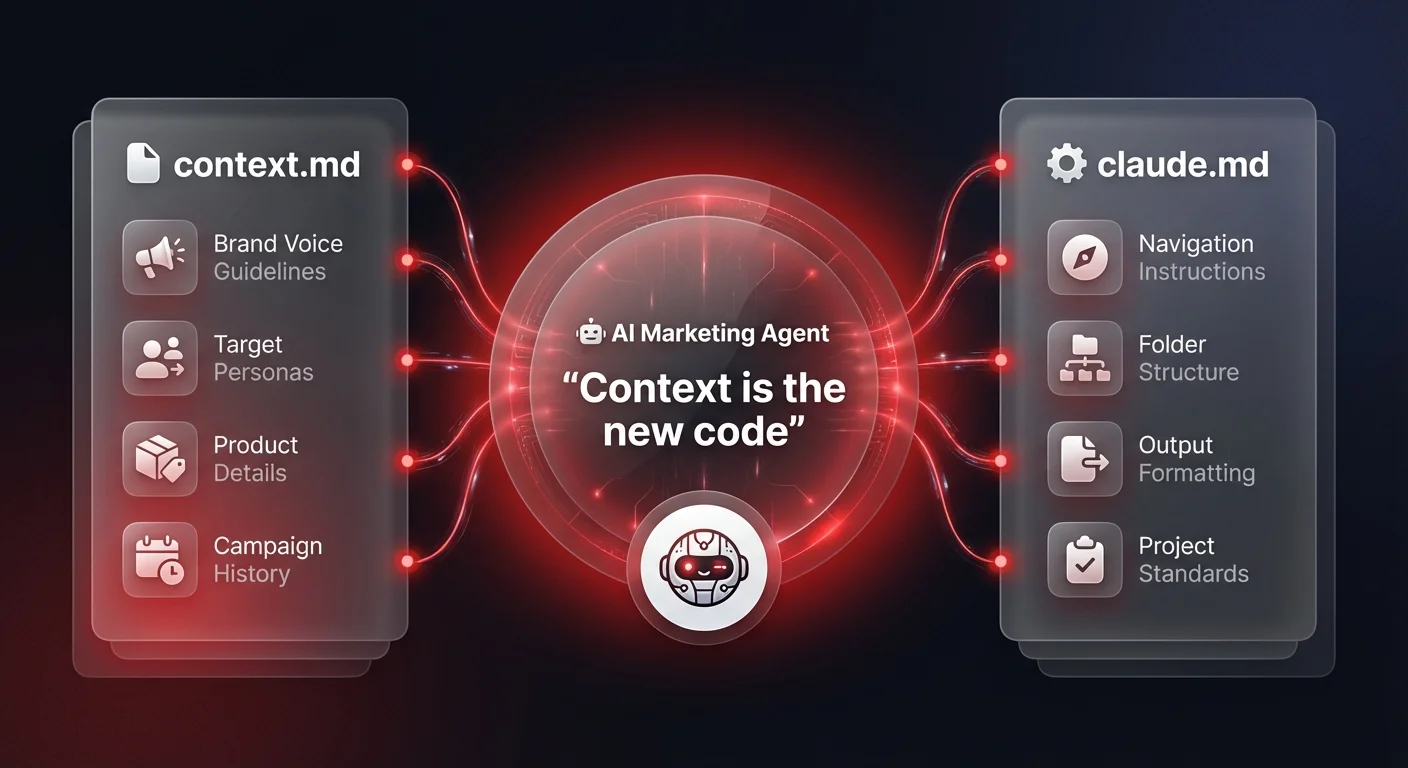
To build a functional AI marketing team, you must first digitize your context. This involves a specific file structure that acts as the brain for your agents. For a deeper look at how to structure context for AI agents, the principle is consistent: context is the new code.
- The context file (context.md): This is the single source of truth for the agent. It contains brand voice guidelines, product details, target audience personas, and historical performance data. Without this, an agent is hallucinating; with it, the agent is an employee.
- The navigation file (claude.md): This acts as the "manager" layer, providing custom instructions on how the agent should navigate your internal folder systems and interpret project structures.
When you equip an agent with these files, you are essentially onboarding them — a process we implemented end-to-end in our AI content system case study. The difference is that this onboarding happens once, instantly, and scales infinitely. This approach aligns perfectly with the principles of data sovereignty — your proprietary methods and brand standards remain the governing logic of the system, ensuring that output remains compliant and high-quality regardless of the scale of production.
Building your AI marketing team: five core skills
Once the foundational context is established, the next step is defining specific "skills." A skill is effectively an executable SOP — a bridge between a generic capability (like writing) and a specific business outcome (like writing your strategy brief).
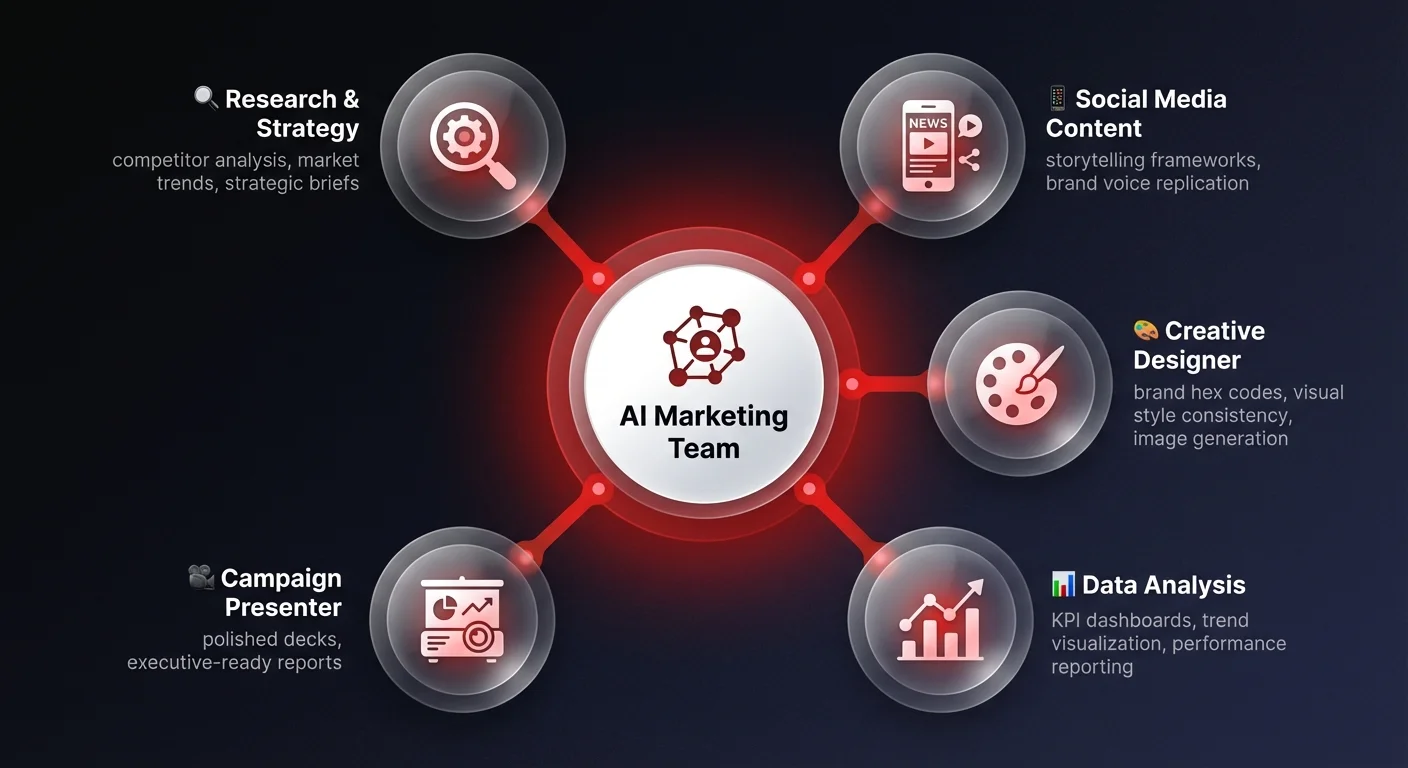
Our research identifies five foundational skills that form the bedrock of an autonomous marketing unit:
1. Research and strategy skill
This skill connects the agent to the internet via tools like the Perplexity MCP (Model Context Protocol). Instead of a generic search, the agent follows a strict internal SOP to analyze competitors, review market trends, and synthesize findings into a strategic brief. By binding the search capability to a specific reporting format, the agent delivers strategy documents that match your internal standards perfectly.
2. Social media content skill
Authenticity is the primary challenge in AI content. To solve this, this skill is built on proven storytelling frameworks and past examples of high-performing content. By feeding the agent a library of "best hits" and specific narrative structures, it learns to mimic the cadence and tone of your brand's best human writers. It doesn't just write; it replicates success patterns.
3. Creative designer skill
Visual consistency is often the first casualty of AI automation. The creative skill solves this by integrating with image generation models but constraining them with strict brand parameters. The skill includes specific hex codes, aspect ratios, and style descriptors (e.g., "blueprint technical style" or "cozy home essential"). This ensures that every visual generated — whether for Instagram or a slide deck — adheres to brand guidelines without human intervention.
4. Data analysis skill
Marketing is increasingly data-driven, yet manual reporting is a massive time sink. The data analysis skill is designed to ingest raw datasets, visualize trends, and generate interactive dashboards. Unlike a generic spreadsheet tool, this agent interprets the data through the lens of your KPIs, highlighting only what matters to your specific strategy.
5. Campaign presenter skill
The final mile of any marketing workflow is internal communication. This skill transforms raw research and data into polished presentation decks. It ensures that the insights gathered by the other agents are communicated in a format that leadership allows, standardizing the aesthetic and structure of internal reporting.
These five skills combine to form a complete AI-driven content operations pipeline capable of running research, creation, and reporting cycles autonomously.
Orchestrating the AI marketing team: sub-agents vs. agent teams
Having individual skills is useful, but the real operational leverage comes from orchestration. How do these skills work together to complete complex tasks? There are two primary architectural approaches, each with distinct cost and complexity implications.
The sub-agent approach (90% use case)
For most workflows, a single "lead" agent spins up parallel "sub-agents" to handle specific tasks. For example, during a quarterly review, the lead agent might assign the Research Skill to one sub-agent and the Data Analysis Skill to another. These sub-agents work in parallel — drastically reducing wait times — and report back only to the lead agent.
This method is highly efficient and cost-effective. It keeps token usage managed because the sub-agents focus solely on their tasks without unnecessary chatter. This creates a hub-and-spoke model where the lead agent acts as the project manager, synthesizing the parallel outputs into a final deliverable. For the architectural principles behind this pattern, see how to stop building single AI agents and embrace modular architecture.
The agent team approach (complex workflows)
For highly complex tasks requiring iteration, you can deploy "Agent Teams." In this configuration, agents share a task list and can communicate with each other. The copywriter can critique the designer's visuals, and the strategist can push back on the data analyst's findings.
While this mimics human collaboration, it comes with a significant operational cost. The token usage — and therefore the financial cost — skyrockets as agents "talk" to one another. Operations leaders must weigh the necessity of this collaboration against the budget. For most recurring tasks, the deterministic nature of sub-agents is preferable to the open-ended dialogue of agent teams.
Portability: the plugin model
One of the most strategic advantages of this architecture is portability. Once you have defined your skills, SOPs, and context files, they can be packaged into a "plugin" (essentially a zip file or repository).
This has massive implications for scaling companies and agencies:
- Rapid onboarding: A new brand manager can be equipped with the full suite of company skills on day one.
- Cross-brand replication: Agencies can take a proven "Landing Page" workflow, swap out the context file for a new client, and immediately deploy the same high-quality execution for a different brand.
- Standardization: It ensures that every team member, regardless of location or seniority, is using the exact same proven frameworks to execute their work.
This same plugin approach powers the ability to automate your entire B2B marketing funnel with agents — each skill slot becomes a portable, swappable module.
The operational imperative
The transition from manual marketing to AI-enabled teams is not a technical challenge — it is a documentation challenge. The limiting factor is no longer the capability of the AI, but the clarity of your SOPs.
If your processes are vague, your agents will be ineffective. If your brand guidelines are loose, your creative agents will hallucinate. This puts the onus on operations leaders to refine their internal documentation. You are no longer writing instructions for humans who can read between the lines; you are writing code for agents that follow instructions literally.
By adopting this "skills" architecture, companies can move beyond the hype of generative AI and start building sovereign, reliable systems that use purpose-built AI agents for each marketing function. The goal is not just to automate tasks, but to institutionalize excellence — capturing your best thinking once and allowing it to scale infinitely through your AI marketing team.