
AI marketing audits are automated browser workflows that use sovereign agents to perform SEO reviews, competitor analysis, and brand compliance checks at machine speed. Organizations deploying these systems report completing full-site optimization cycles in hours rather than the weeks required by manual processes.
The pace of modern digital marketing requires teams to iterate endlessly, but human capacity creates a hard bottleneck on how fast those iterations can occur. AI marketing audits are fundamentally changing this dynamic. By transitioning from simple text generation to active browser automation, artificial intelligence is now capable of executing complex, multi-step website reviews, competitor analyses, and ad testing campaigns autonomously.
For Chief Marketing Officers and Vice Presidents of Operations, this represents a massive shift in resource allocation. Organizations no longer need to dedicate highly paid specialists to the manual drudgery of clicking through landing pages to check for brand compliance or keyword density. Instead, they can deploy targeted agents to speed run these optimization cycles, generating immediate insights grounded entirely in the company's proprietary playbooks.
However, unlocking this capability requires moving beyond fragmented, ungoverned AI experiments. True operational efficiency - and security - demands a structured approach to agent deployment.
How AI marketing audits shift from text generation to active browsing
The earliest iterations of artificial intelligence in marketing focused heavily on generative tasks - writing blog posts, drafting email copy, or summarizing meeting notes. While valuable, these applications operate in a vacuum. They rely on static prompts and lack the ability to interact with the live, dynamic environment of the modern web.
The technological landscape has shifted dramatically with the introduction of agents capable of computer use and active browser automation. Advanced models can now operate browsers natively. This is not merely pulling data from a static API or scraping a text file. These agents can actively navigate websites, interact with on-page elements, view rendered layouts, and process information exactly as a human user would.
This browser-native capability is the key to automating complex marketing workflows. When an agent can see and interact with a live webpage, it transitions from a basic writing assistant to a functional marketing operator. It can navigate a competitor's complex pricing tier, audit the user experience of a newly launched landing page, or verify that tracking tags are firing correctly across a multi-step checkout process. Teams already scaling AI marketing agents are seeing these capabilities transform their daily operations.
High-value applications for browser-based AI marketing audits
When we apply browser automation to everyday marketing operations, several highly repetitive, time-intensive tasks become prime candidates for immediate automation.
SEO and website optimization
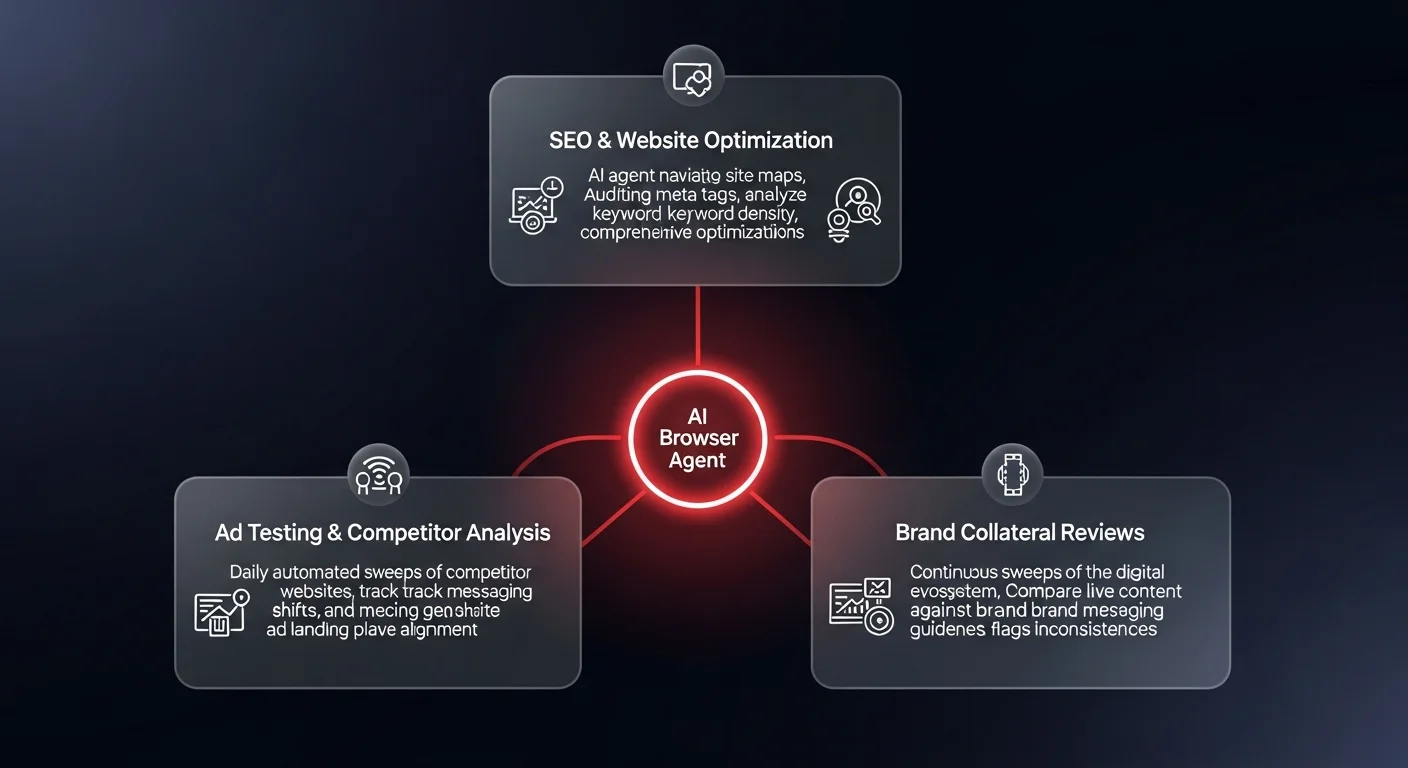
Traditional SEO audits require a marketer to use a combination of crawling tools, manual visual inspections, and spreadsheet tracking to identify missing meta tags, poor keyword optimization, or broken user experiences. A browser-enabled AI agent can automate this entirely.
The agent can be programmed to navigate through a specific site map, reviewing each page against a strict set of technical and structural guidelines. It can analyze the semantic structure of the content, evaluate the visual hierarchy, and generate a comprehensive optimization report - all in a fraction of the time it would take a human analyst. Organizations using content automation engines are already integrating these audit capabilities into their publishing workflows.
Ad testing and competitor analysis
Keeping tabs on competitor positioning is a notoriously manual process. Marketing teams often rely on ad-hoc reviews of competitor websites or expensive third-party tools that only capture a fraction of the market movement.
With an automated browser workflow, you can schedule an agent to run a daily sweep of key competitors' digital footprints. The agent can navigate their homepages, read their latest product marketing collateral, and identify shifts in their messaging or pricing structures. For ad testing, agents can review live landing pages associated with specific campaigns, ensuring the messaging aligns perfectly with the ad copy driving the traffic, thereby preventing the leaky funnel effect that plagues so many digital campaigns. A dedicated competitor intelligence solution can formalize this into a continuous monitoring system.
Product marketing collateral reviews
Maintaining brand consistency across hundreds of web pages, downloadable assets, and support documentation is nearly impossible for a scaling company. Marketing teams frequently find outdated messaging or legacy product names buried on secondary landing pages.
Browser-enabled agents can perform continuous sweeps of a company's entire digital ecosystem. They can read through product marketing collateral, compare the live text against the current brand messaging guidelines, and flag any inconsistencies for human review. This ensures that a company's external positioning remains tight and consistent, regardless of how fast the product is evolving.
Grounding AI marketing audits in your proprietary playbooks
The true power of an AI marketing audit does not come from the agent's general intelligence - it comes from its specific knowledge of your business. A generic AI reviewing a website will provide generic, often useless advice. To achieve operational excellence, the agent must be grounded in your proprietary best practices.
The most effective implementation strategy involves building a dedicated knowledge base - a wiki of product marketing knowledge, brand voice guidelines, and specific strategic skills. This repository acts as the brain of your operation. Companies building AI content governance frameworks are discovering that this knowledge base is the critical differentiator between useful and useless automation.
Instead of asking an agent to audit this webpage, you instruct the agent to audit this webpage against the criteria defined in your Q3 Product Messaging Wiki. The agent then actively browses the target URL, cross-references the live content with your internal rules, and produces highly specific, actionable feedback.
This setup allows marketing leaders to scale their expertise. A VP of Marketing can document their personal framework for high-converting landing pages into the wiki. The AI agent then applies that exact framework to hundreds of pages across the site, effectively cloning the VP's strategic oversight and allowing the team to speed run the optimization process.
The shadow AI risk in marketing audit automation
While the potential of automated browser agents is immense, the way most organizations are attempting to adopt them is fundamentally broken. When employees independently sign up for consumer-grade AI tools or install unvetted browser extensions to help with their day-to-day tasks, they are creating a massive shadow AI governance problem.
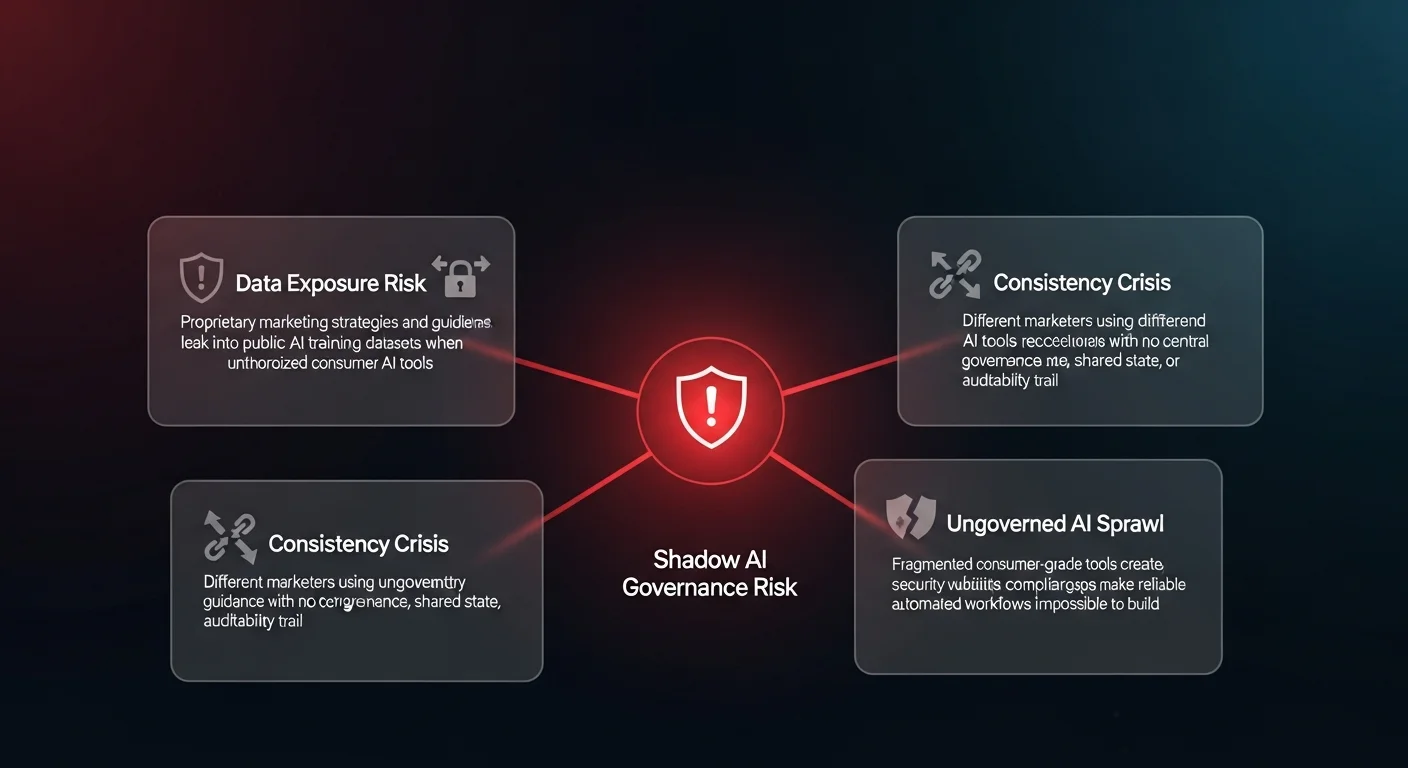
Marketing departments deal with highly sensitive strategic data. Your upcoming product messaging, your competitive positioning frameworks, and your internal optimization playbooks are the lifeblood of your go-to-market strategy. When a marketing manager pastes this proprietary information into a public AI model to conduct an ad-hoc audit, that data is no longer secure. It becomes part of a public training dataset, exposing your strategic advantages to the market.
Furthermore, shadow AI creates a consistency crisis. If five different marketers are using five different ungoverned AI tools to review collateral, they will receive five different, often contradictory, sets of feedback. There is no central governance, no shared state, and no auditability. Understanding the governance challenges behind marketing AI agents is essential before scaling these capabilities.
Organizations cannot build reliable automated workflows on top of fragmented, consumer-grade tools. They need infrastructure that provides the capabilities of advanced browser automation while maintaining strict enterprise security.
Implementing AI marketing audits as a starter project
Scaling companies find themselves caught between two bad options when trying to solve this problem. They can either ignore the shadow AI sprawl and accept the security risks, or they can engage massive consulting firms for multi-year digital transformation projects that cost millions and rarely deliver timely ROI.
The professional middle ground is a solution-first approach. Rather than attempting a massive, company-wide AI overhaul, operations leaders should focus on a specific, high-impact bottleneck - such as automated website and competitor audits.
This works best as a fixed-scope, fixed-cost starter project deployed in weeks, not months. The approach combines autonomous reasoning engines with battle-tested workflow automation tools and enterprise-grade infrastructure. See how MarketingOps achieved this transformation by starting with a focused automation scope and expanding from there.
The deliverable is a sovereign AI agent system. This means the system operates entirely within your secure environment. Your proprietary marketing wikis, your strategic playbooks, and your competitive data never leak back to public models. The system strictly follows your internal brand guidelines, providing reliable, centrally governed outputs.
Crucially, this model eliminates platform fees. You are not paying endless per-seat subscriptions for software your team might not use. You are investing in a functional solution - a competitor and SEO audit engine - that you own and control long-term. Once this starter project proves immediate value by speed-running your optimization cycles, it serves as the foundation for a broader transformation partnership.
Speed running the optimization cycle with governed AI
The future of digital marketing operations will be defined by iteration speed. Organizations that still rely on manual human review for routine website audits, competitor tracking, and collateral consistency will simply be outpaced by those leveraging autonomous browser agents.
The technology is no longer limited to generating text - it can now actively navigate the web, analyze rendered pages, and apply your proprietary best practices at an unprecedented scale. However, relying on ungoverned shadow AI to achieve this speed introduces unacceptable security and consistency risks.
By deploying a sovereign AI agent system, marketing and operations leaders can secure their proprietary playbooks while automating their most tedious workflows. It is time to stop performing manual audits and start building the governed infrastructure required to speed run your optimization cycles. Choose a targeted starter project, establish your internal guidelines, and let autonomous agents execute your strategy flawlessly.