
AI marketing agents are autonomous systems that execute marketing workflows - from lead scoring to content personalization - without manual intervention, enabling a single operator to command an entire synthetic team. According to Gartner, by 2028 over 33% of enterprise software applications will include agentic AI, up from less than 1% in 2024.
The role of the marketing professional is undergoing a violent structural shift. If you look at the bleeding edge of marketing operations today, a stark reality emerges - relying on traditional software tools is no longer enough to stay competitive. The new baseline requires the mastery of AI marketing agents. Marketers who fail to adapt to agent-based automation and natural language coding face rapid industry exclusion.
But for the technical operators and CTOs tasked with supporting these modern marketing teams, a different crisis is brewing. As marketers build powerful local agents to automate their daily workflows, organizations are desperately scrambling for the enterprise architecture required to host, secure, and scale these synthetic workers. The future of operations requires moving from fragile desktop experiments to governed, production-grade infrastructure. For a deeper look at how marketing teams are already building these operational agent fleets, see our analysis of AI marketing agents in autonomous operations.
How AI marketing agents replace the solo marketer model
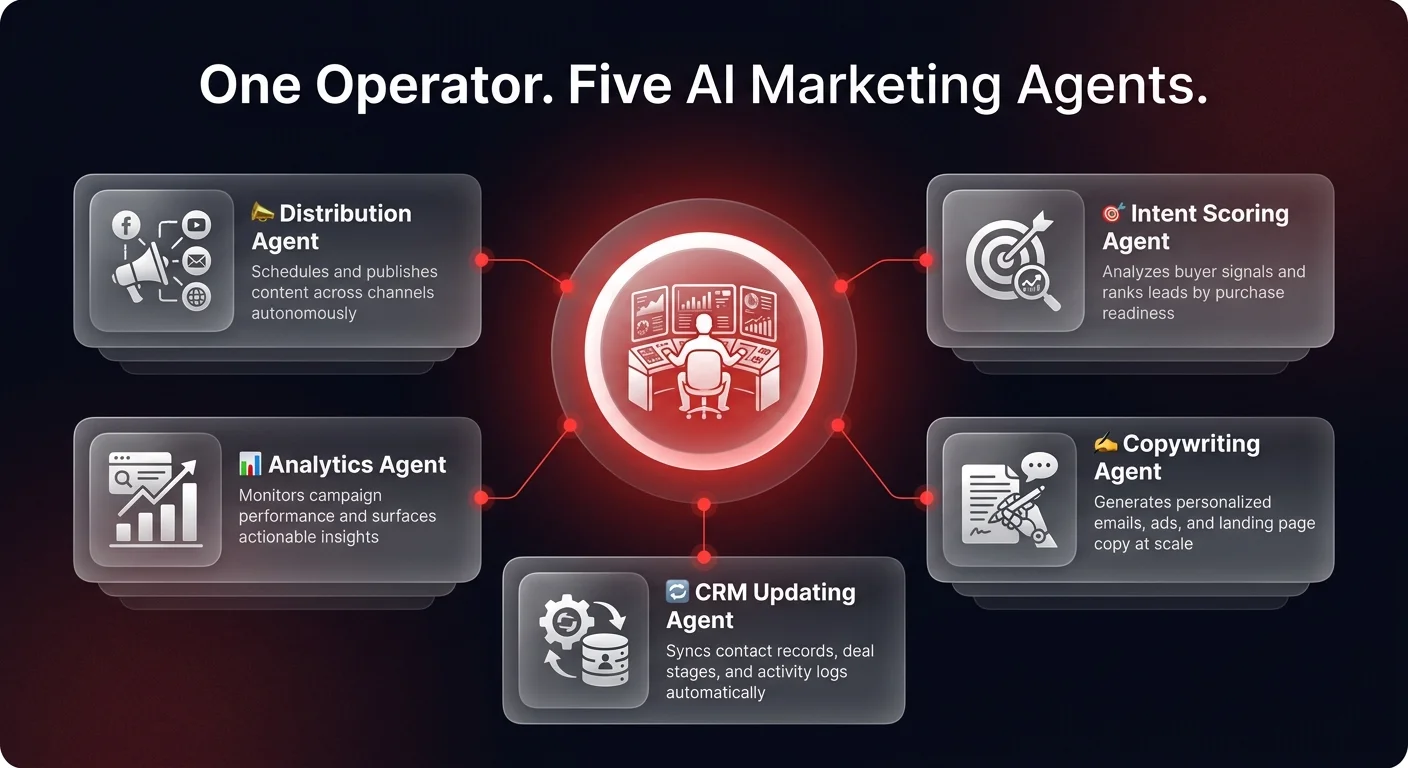
The fundamental concept of work in the marketing department is moving from individual contribution to agent orchestration. The most successful operators are no longer the ones who can manually execute campaigns or write copy the fastest. Instead, they are the ones who can successfully string together a series of autonomous agents to execute heavy lifting on their behalf.
Industry data and practical applications show a definitive trend - a single person will soon always operate alongside a dedicated team of agents that they have built to perform repetitive, high-volume work. According to McKinsey's 2025 State of AI report, 78% of organizations now use AI in at least one business function, with marketing among the fastest-adopting departments. Imagine a single demand generation manager who commands an intent-scoring agent, a personalized-copywriting agent, and a CRM-updating agent. This operator does not write the emails or manually score the leads. They manage the autonomous system that does.
However, this does not mean human expertise is obsolete. In fact, the true winners in the AI era are the people who possess deep, tactical domain expertise - what we call "real skills". The AI lacks native marketing strategy. It requires a master operator to define the rules of engagement, the brand voice, and the strategic objectives. The marketer provides the vision; the synthetic workforce provides the infinite scale. Organizations looking to automate their content production pipelines are discovering that the human-agent combination outperforms either working alone.
Natural language application development in marketing
The second critical competency driving this shift is the rapid maturation of natural language programming, often referred to in developer circles as "vibe coding". Over the past twelve months, the ability to build functional software without traditional engineering skills has taken an inordinate amount of leaps forward.
Tools like Replit Agent now act as autonomous coding partners that can build complete applications from scratch within their own environments. Similarly, frontier AI models have demonstrated jaw-dropping capabilities in translating plain English requirements into complex, deployable code. According to GitHub's 2025 developer survey, 92% of developers now use AI coding tools, and non-technical business users are rapidly closing the gap.
For the marketing department, this is a watershed moment. A growth marketer no longer needs to wait six months for the engineering team to build a custom data-scraping tool or an API integration. They can simply describe the desired outcome to an autonomous coding agent and have a functional script running in minutes.
Consider a practical scenario. A marketer might use natural language to request: "Write a script that monitors our competitor's pricing page, compares it to our current pricing database, and alerts our Slack channel if they drop below our floor." A year ago, this required a sprint planning meeting and dedicated developer resources. Today, it requires a well-crafted prompt. This democratization of software creation means marketing teams can prototype and deploy internal tools at a pace previously thought impossible.
The shadow AI crisis on the marketing floor
While the empowerment of the individual marketer is a massive leap forward for productivity, it presents a terrifying reality for CTOs, IT leaders, and internal AI champions. When non-engineers are suddenly capable of writing complex software and spinning up teams of autonomous agents, the immediate byproduct is an explosion of unmanaged, localized tech sprawl. The growing problem of shadow AI sprawl and coordination debt is now one of the top concerns for enterprise IT leaders.
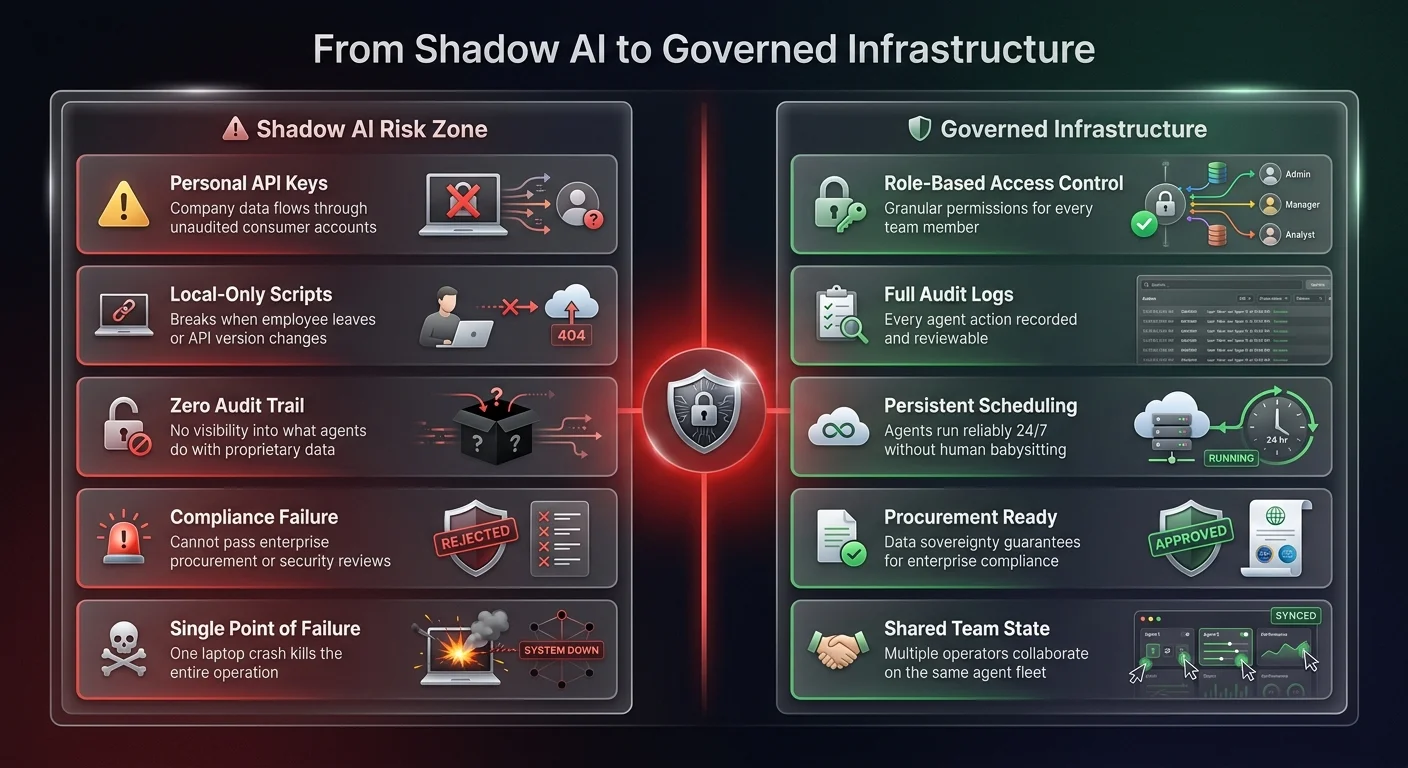
We are currently witnessing a massive wave of shadow AI. Marketers are building incredibly powerful tools on their local machines, using personal API keys, and feeding proprietary company data into ungoverned consumer-grade models. A brilliant lead-scoring workflow built via a local coding tool might work flawlessly on a marketing director's personal machine. According to Salesforce's 2025 IT report, 49% of enterprise AI usage occurs outside official IT channels.
But what happens when that director goes on vacation? What happens when the underlying API changes and the local script breaks? What happens when an enterprise data compliance audit is required?
The structural flaw in this new paradigm is that raw agents and localized code act as scaffolding, not infrastructure. They lack the enterprise guardrails necessary for sustainable business operations. For AI to truly become part of a company's operational DNA, it cannot live exclusively on a laptop. Our deep dive into marketing AI agent governance explores the specific policy frameworks organizations need to bring these agents under control.
Moving AI marketing agents from laptop experiments to production infrastructure
This is where the conversation must shift from "how do we build agents?" to "how do we host, govern, and scale agents?" For CTOs and technical operators at mid-market companies, providing a secure environment for this synthetic workforce is the new architectural mandate. Understanding the fundamentals of AI agent harnesses for enterprise automation is a critical first step.
The solution requires infrastructure designed specifically for autonomous intelligent systems - environments that are persistent, scheduled, and fully auditable. Think of it as production-grade hosting specifically built for the agent layer.
When organizations transition from local experiments to sovereign managed infrastructure, they establish the operational foundation for their synthetic workforce. Instead of disjointed scripts scattered across the marketing department, the organization achieves a single, sovereign instance from which every function operates. This unlocks critical enterprise capabilities:
Sovereignty and procurement readiness
Passing enterprise procurement requires a strict separation of corporate data from public model training. A sovereign managed instance ensures your data remains yours. It provides the security of a self-hosted environment - complete with role-based access control (RBAC), comprehensive audit logs, and VPN-only access - without the heavy internal maintenance burden. According to Deloitte's 2025 AI governance survey, 67% of enterprises now require data sovereignty guarantees before approving AI tooling.
Beyond deterministic pipelines
Managing an autonomous workforce is vastly different from managing traditional workflow automation (whether built in Zapier, Make, n8n, or custom integrations) that simply moves data from point A to point B. These are autonomous reasoning agents that require a fundamentally different runtime environment. True infrastructure ensures that these scheduled, reasoning systems are recoverable, highly observable, and deeply monitored. The ultimate goal is operational peace of mind - you should not have to page the CTO at 3am because a local marketing agent failed during a critical campaign launch. For organizations struggling with multi-agent coordination failures, our guide on AI agent orchestration risks covers the most common failure modes and how to prevent them.
Shared state and team memory
When agents are hosted on proper infrastructure, they transition from being siloed personal assistants to becoming core company infrastructure. They benefit from persistent shared state and multi-user access. The synthetic marketing team retains team memory, allowing different human operators to interact with the same agents, review their past actions, and audit their decision-making logic collaboratively.
Redefining marketing economics with synthetic labor
As this infrastructure matures, it radically alters the financial models of enterprise software. The traditional SaaS model is built on per-seat pricing. As your marketing team grows, your software subscription costs scale linearly, regardless of how much value each user actually extracts from the platform.
However, when a single marketer is commanding a team of agents via a managed instance, the fundamental unit of value changes. The focus shifts to cutting headcount requirements, not just optimizing software seats. Sovereign infrastructure aligns its pricing with synthetic labor units. You are not paying for arbitrary access to a software tool; you are paying for the persistent, reliable execution of a business outcome.
This per-agent economic model empowers companies to scale their output exponentially without a corresponding explosion in payroll or SaaS bloat. It also unlocks massive potential for AI-enabled marketing agencies, allowing them to achieve significant multiplier effects. By utilizing a managed instance, agencies can deploy isolated, white-labeled agent environments for every client from a single centralized architecture, completely redefining their service delivery margins. Explore our marketing content automation solutions to see how organizations are implementing these agent-driven workflows today.
The future of the AI marketing agents technology stack
The era of the solo marketer relying purely on manual execution and deterministic SaaS tools is ending. The future belongs to those who possess deep domain expertise and the ability to command autonomous workflows and natural language code.
But the true winners in the next decade will be the organizations that recognize this shift early and provide the necessary infrastructure to support it. Leaving your synthetic workforce scattered across local machines and ungoverned accounts is a recipe for compliance disasters and operational brittleness.
By transitioning your AI marketing agents to a secure, persistent managed instance, you transform fragmented desktop experiments into reliable, governed company infrastructure. The code has already been written. The agents are ready to execute. It is time to provide them with a permanent, production-ready environment that scales securely with your business.