

AI content governance is the practice of building a centralized context layer that governs how AI agents reference and use organizational intelligence - ensuring automated output reflects your brand, strategy, and audience rather than generic training data. Organizations that implement proper AI content governance transform fragmented AI experiments into consistent, high-performing business systems.
Most organizations spend months building specialized AI skills to generate marketing copy, deploy sales emails, and automate operational workflows. Yet, despite the technical effort, the results often remain perfectly competent but entirely uninspiring. To solve this, operational leaders must shift their focus toward AI content governance. The real reason your AI systems produce average results has nothing to do with a lack of advanced prompt engineering. It is a lack of shared, centralized intelligence.
When business teams build independent AI tools - whether they are hook generators, ad copy writers, or customer support responders - each skill works in a vacuum. It produces a clean output, but the content feels hollow. This happens because these systems are starting from zero every single time they execute. Without a governed foundation, large language models default to their baseline training: they give you the mathematical average of the internet.
To transform fragmented AI experiments into reliable, governed operational systems, organizations must stop obsessing over individual AI skills and start building a foundational context layer.
The Pixar paradox: why isolated AI systems fail
To understand the structural flaw in how most companies deploy AI, we can look at a historical parallel from the entertainment industry. In 1995, Pixar revolutionized animation with Toy Story. But behind the scenes, the company was breaking. Pixar's directors, some of the most talented storytellers alive, kept running into the exact same narrative problems. They would solve a structural issue in one film, only for a completely different team to hit the same roadblock six months later.
The lesson Pixar's leadership took from this was profound. The problem was not talent. The problem was that there was no shared system across directors. Every film started from zero.
To fix this, Pixar created the "Brain Trust" - a small group of senior creatives who would screen works in progress together. The goal was not top-down approval, but shared context. They built a collective understanding of what worked, what failed, and why, across every project simultaneously. This context layer resulted in an unprecedented run of hits: Toy Story 2, Monsters, Inc., Finding Nemo, and The Incredibles.
The power of this approach was definitively proven in 2006 when Disney acquired Pixar. Disney Animation had been struggling for years, producing forgettable films. Pixar leadership exported the Brain Trust to Disney. With the exact same directors and the exact same budget, Disney simply added this shared context layer. The result? Blockbusters like Frozen, Big Hero 6, and Zootopia.
Today's enterprise AI initiatives are replicating the pre-Brain Trust era of Pixar. Marketing, sales, and operations teams are building highly capable isolated skills, but they are lacking a shared collective intelligence. Every agent starts from zero, resulting in output that is fundamentally average.
AI content governance: from isolated skills to a context layer
In a post-AI business environment, the foundational layer is vastly more important than the execution layer. This is the core principle of AI content governance - and it mirrors the infrastructure shift we explored in our overview of AI context infrastructure.
Most teams currently operate by injecting raw context directly into individual prompts. If an agent needs to write a newsletter, the user tries to explain the brand voice, the audience, and the product within a single prompt. This approach is unscalable, ungovernable, and prone to severe hallucination.
Instead, organizations need a foundational context layer - a centralized repository of modular intelligence files that describe exactly who your company is, how you work, who your audience is, and what they react to. When these files are properly structured, AI agents can dynamically reference them, ensuring every piece of output is grounded in your specific business reality.
Four essential modules for governed AI output
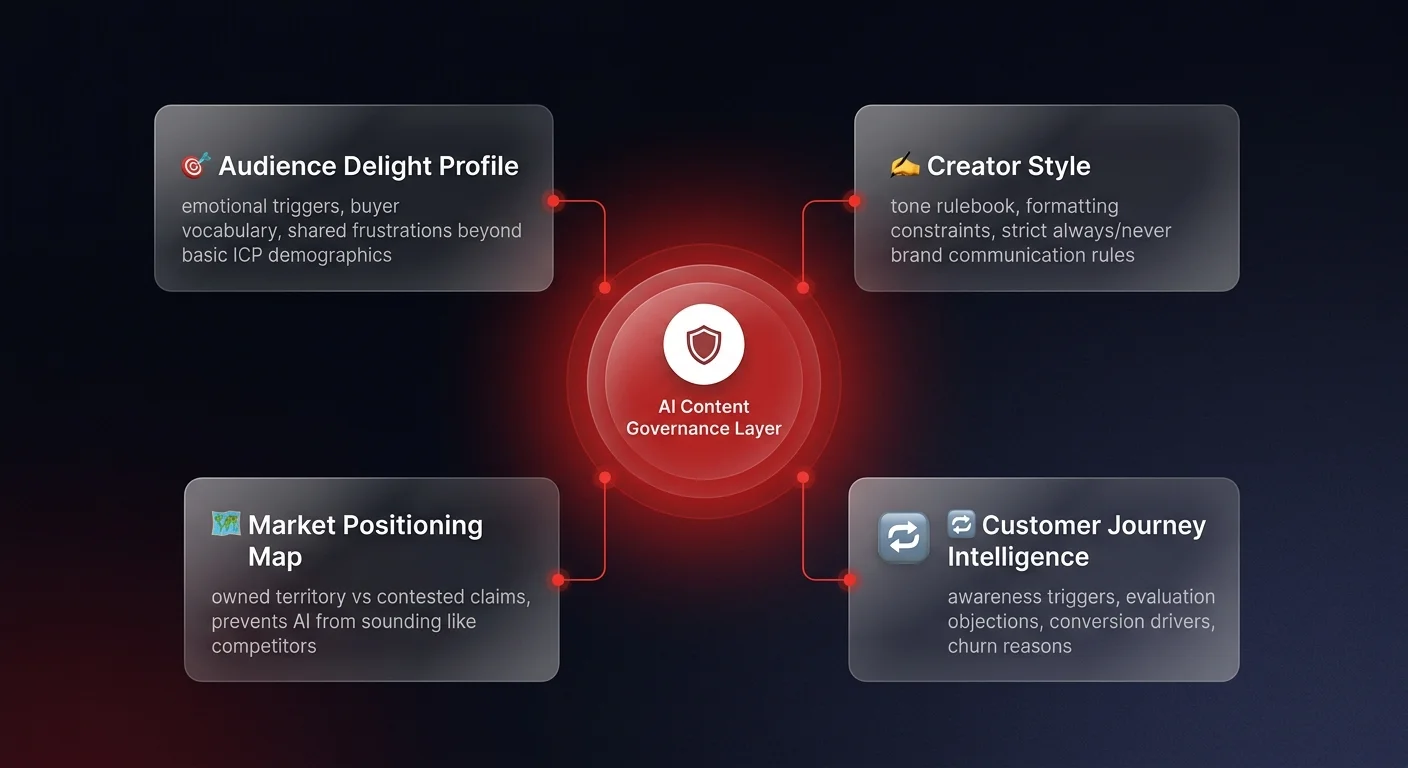
Building an effective context layer requires moving beyond traditional corporate documentation. A static Google Drive slide deck from last year's offsite will not properly govern an AI agent. You need dynamic, highly specific intelligence files. Our research highlights four core modules that should form the base of your AI governance.
1. Audience delight profile
Most marketers and sales teams rely on a traditional Ideal Customer Profile (ICP) focused on firmographics, technographics, and demographics. While useful for targeting, this data is useless for an AI trying to generate compelling interactions.
An Audience Delight Profile goes deeper. It explicitly defines the emotional triggers, shared frustrations, and exact vocabulary of your buyers. For example, if your company sells productivity software, this profile should document that your audience says "single source of truth" and "second brain," but they actively reject terms like "documentation repository."
It must outline exactly what makes them light up - like "templates that save real time" - and what pushes them away, such as "generic productivity advice." Providing this specific layer of context prevents AI from using industry cliches and forces it to use the insider language of your buyers.
2. Creator style
Traditional brand guidelines are often too abstract for AI models to interpret effectively. A Creator Style module serves as the operational rulebook for how your AI should communicate.
This file must define your "atomic unit" of communication and list strict tonal boundaries. It should instruct the agent to be "conversational, not corporate" or "direct, not verbose." More importantly, it must include rigid formatting rules: the "always do" and "never do" constraints.
If your brand strictly avoids certain punctuation or refuses to use hyperbole, this file acts as the ultimate governance mechanism, ensuring your AI agents never sacrifice your brand's clarity for generic enthusiasm.
3. Market positioning map
Your AI agents need to understand not just what you sell, but where you stand in the competitive landscape. If an AI agent lacks this context, it will likely generate claims that make you sound exactly like your competitors.
The Market Positioning Map clearly defines your strategic claims, what market territory you definitively own, and what territory is contested. For instance, if "AI-powered workspace" is a contested claim that every competitor is using, this file instructs your agents to lean into uncontested white space instead, such as "cross-functional workspace alignment."
By governing your AI with this strategic context, your automated output will consistently differentiate your brand rather than blending into the noise of the market.
4. Customer journey intelligence
Finally, an AI agent must understand that a buyer reading a top-of-funnel blog post requires a different approach than a buyer evaluating your software against a competitor.
The Customer Journey Intelligence module is a living file that maps how buyers find you, what triggers their initial awareness, and specifically what objections they raise during evaluation. It documents the exact conversion triggers that close deals and the specific reasons customers stall or churn.
When a sales enablement agent references this file, it can automatically pre-empt known objections. When a customer support agent references this file, it understands the common friction points that lead to churn, allowing it to navigate the conversation with appropriate empathy and tactical precision.
Dynamic context loading: the operational secret
A critical challenge operations leaders face when scaling AI is token bloat and context confusion. If you feed an AI agent 20 different strategic files at once, the model will become confused, instructions will overlap, and the system will hallucinate.
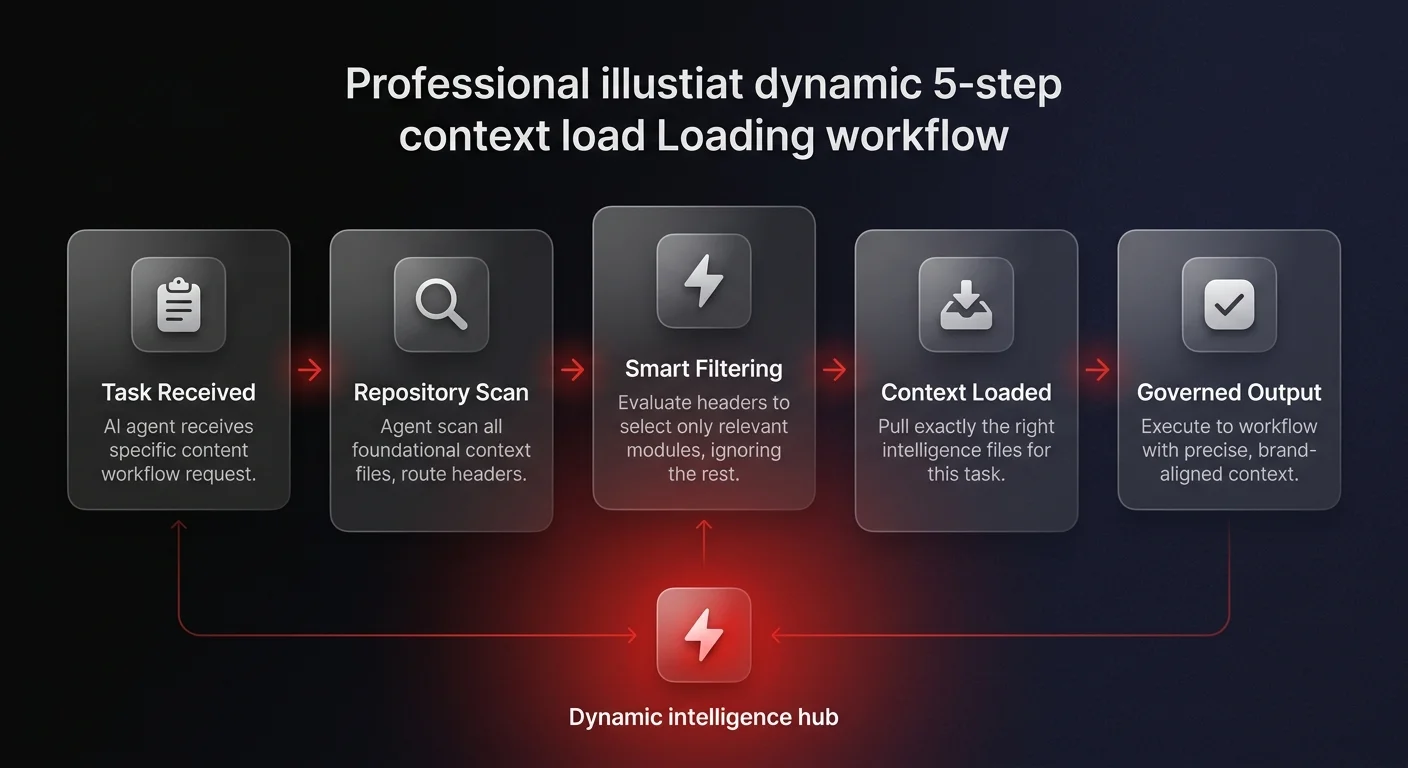
The secret to operationalizing this context layer is dynamic loading. Every file in your foundational layer must contain a routing header that declares exactly when an agent should - and should not - use it.
For example, a file might contain a rule stating: "Load this file when writing content, social copy, or landing pages. Do not load this file when evaluating audience demographic data."
Before an AI agent executes a workflow, its first programmed step should be to scan your foundational repository. It evaluates the headers, pulls only the specific intelligence modules required for that exact task, and leaves the rest behind. This observable logic ensures your agents have exactly the right context to succeed without being overwhelmed by irrelevant data.
For organizations already running automated workflows, pairing this approach with AI workflow automation governance practices ensures your context layer remains auditable and secure as it scales.
Continuous intelligence and system updates
The true power of the context layer lies in its ability to facilitate continuous organizational improvement. In an ungoverned AI environment, if you discover a new high-performing sales angle, you have to manually update dozens of isolated prompts across your organization.
With a foundational context layer, you update a single file. By analyzing quarterly performance data - identifying which campaigns worked and which workflows failed - you can instruct your AI to refine the foundational modules.
The moment that central file is updated, every single AI agent and workflow connected to your system instantly inherits the new intelligence. Every skill gets sharper simultaneously. This is the Pixar Brain Trust operating at algorithmic speed.
Transforming experiments into governed enterprise systems
The era of decentralized, ungoverned AI experimentation is ending. Operational complexity and security risks are forcing mid-market and scaling companies to rethink how they deploy artificial intelligence across their organizations.
If your AI output feels average, it is because your systems are starting from zero. By shifting your strategy from building isolated skills to engineering a robust, shared context layer, you fundamentally change the capability of your automated systems.
As we covered in our analysis of autonomous AI agent governance, the transition from isolated tools to governed infrastructure is what separates AI experiments from AI-driven operations.
At Ability AI, we believe that true business transformation requires governed agent infrastructure. By centralizing your operational context, securing data sovereignty, and relying on observable logic, you ensure that every AI action taken on behalf of your company is strategic, precise, and uniquely yours. Stop obsessing over the prompts, and start building the foundation.
Ready to move from fragmented AI experiments to a governed content system? Explore how our content automation solutions can give your business a structured context layer from day one.