
AI brand risk from "AI slop" occurs when companies deploy generative AI to replace human creative output, producing generic synthetic content that audiences have learned to instantly identify and reject. Just as "organic" produce commands a premium over processed alternatives, human-crafted communication is becoming a luxury signal of trust and authority. Companies that use AI to flood the zone with mediocre content experience rapid erosion of brand equity—once audiences tag your output as synthetic, engagement drops and trust evaporates in ways that are difficult to reverse.
A recent viral ad controversy involving Equinox highlighted this shift starkly. The market reaction wasn't just indifference; it was hostility toward what audiences perceived as laziness. We are witnessing a bifurcation similar to the food industry. Just as "organic" produce commands a premium over processed alternatives, "human-crafted" communication is becoming a luxury signal of trust, authority, and care. Conversely, visibly AI-generated content is becoming the high-fructose corn syrup of the internet - cheap, abundant, and bad for your health.
For executives at scaling companies, this presents a critical strategic choice. Do you use AI to flood the zone with mediocre content, or do you build infrastructure that elevates your brand? The answer lies not in rejecting AI, but in fundamentally changing where it sits in your workflow.
The economics of brand decay
The core problem isn't the technology itself; it's the application of the technology to the wrong layer of the value chain. Many companies rushed to deploy AI tools to replace the "final mile" of creative output - the actual writing of articles, the design of images, and the drafting of customer responses. The goal was efficiency, but the result has been a catastrophic loss of distinctiveness.
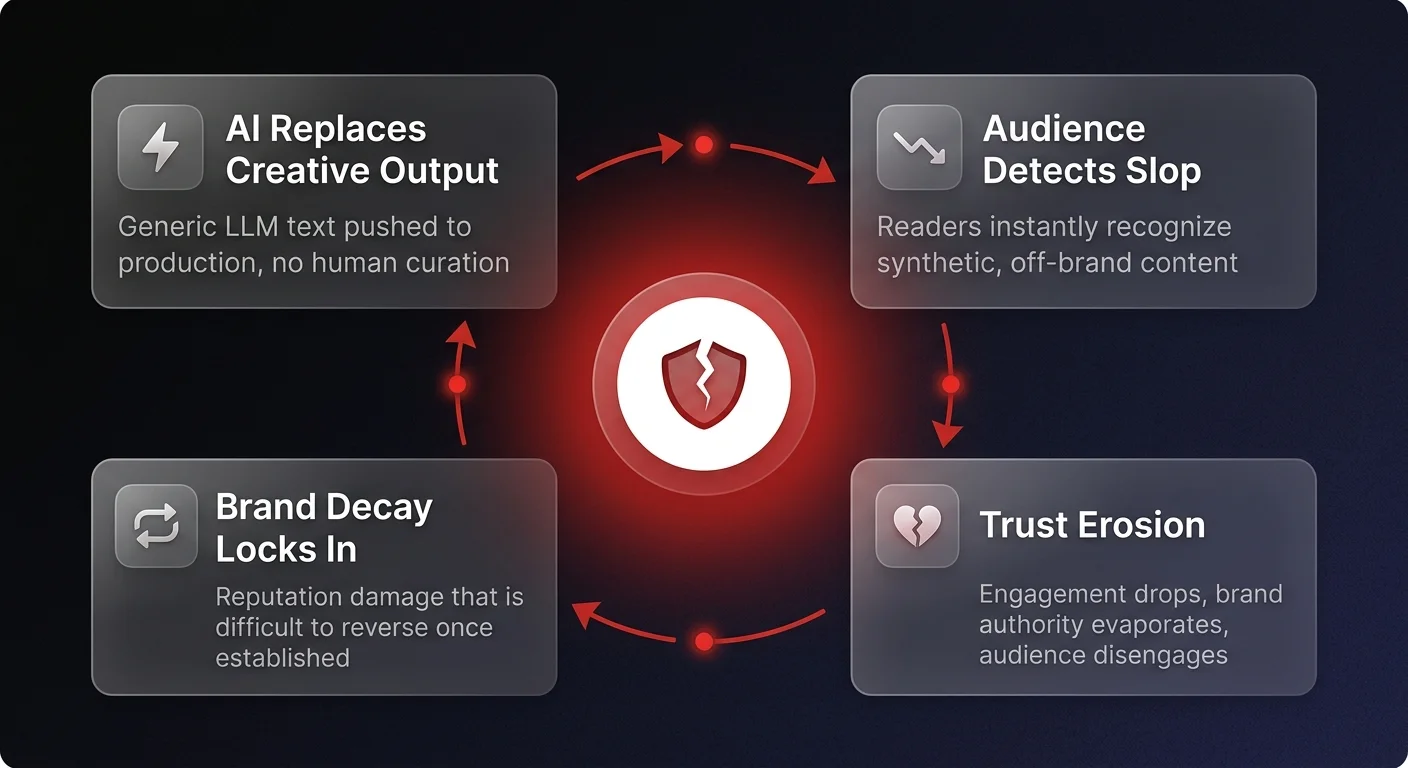
When a brand publishes "slop" - unedited, generic, LLM-generated text - it signals to the market that the company does not value the customer's time enough to have a human curate the message. This creates a specific type of brand decay that is difficult to reverse. Once your audience tags your output as synthetic, their engagement drops, and their trust evaporates.
Scaling ignorance, not intelligence
There is a misconception that AI tools can turn a junior employee into a senior strategist. The reality is often the opposite. AI does not fix incompetence; it scales ignorance.
If a junior marketer does not understand your unique value proposition or the nuances of your industry, giving them a powerful LLM allows them to produce incorrect or off-brand content at 100x the speed. They become 10x more visibly ignorant because they lack the expertise to discern a quality output from a hallucination or a generic platitude. This is the danger of "Shadow AI sprawl" - disconnected tools in the hands of employees who lack the governance frameworks to use them safely. Without a sovereign system in place, you aren't automating excellence; you are automating mediocrity.
The "organic" premium and the trust economy
As the internet floods with synthetic media, scarcity shifts. Information is no longer scarce; curated, verified, human insight is.
We are entering an era where "organic" content acts as a premium differentiator. When a prospect reads a white paper or watches a video that clearly required human effort, nuance, and specific operational experience, it signals authority. It proves that the company has skin in the game.
This doesn't mean you shouldn't use AI. It means you shouldn't use AI to fake the human element. The winning strategy for 2026 and beyond is to use AI agents for backend leverage - the invisible work - so that your humans can focus entirely on the high-value, front-end craft that builds relationships.
Why the "replacement strategy" fails
Many mid-market companies have attempted to cut costs by replacing creative agencies or freelancers with generic AI prompting. The math rarely works out.
Consider the typical workflow for a $200 - $300 freelance article. Companies often find that these pieces, even when written by humans, are lackluster. Replacing this with a $20 subscription to a chatbot seems like a win. However, reports from the field indicate that content generated this way often requires 60% to 70% rewriting by senior staff to make it passable.
The operational drag is immense. Your most expensive resources (senior leaders) end up spending hours editing bad AI copy, correcting tone, and fixing hallucinations. This is "Shadow AI" at its worst - a fragmented, inefficient mess that saves pennies on drafting while wasting dollars on editing and brand reputation.
The solution: sovereign agents for backend operations
The strategic pivot required here is to move AI from the "Creative Layer" to the "Operations & Research Layer." At Ability AI, we build Sovereign Agent systems that automate the heavy lifting behind the scenes, allowing your human experts to apply the final polish.
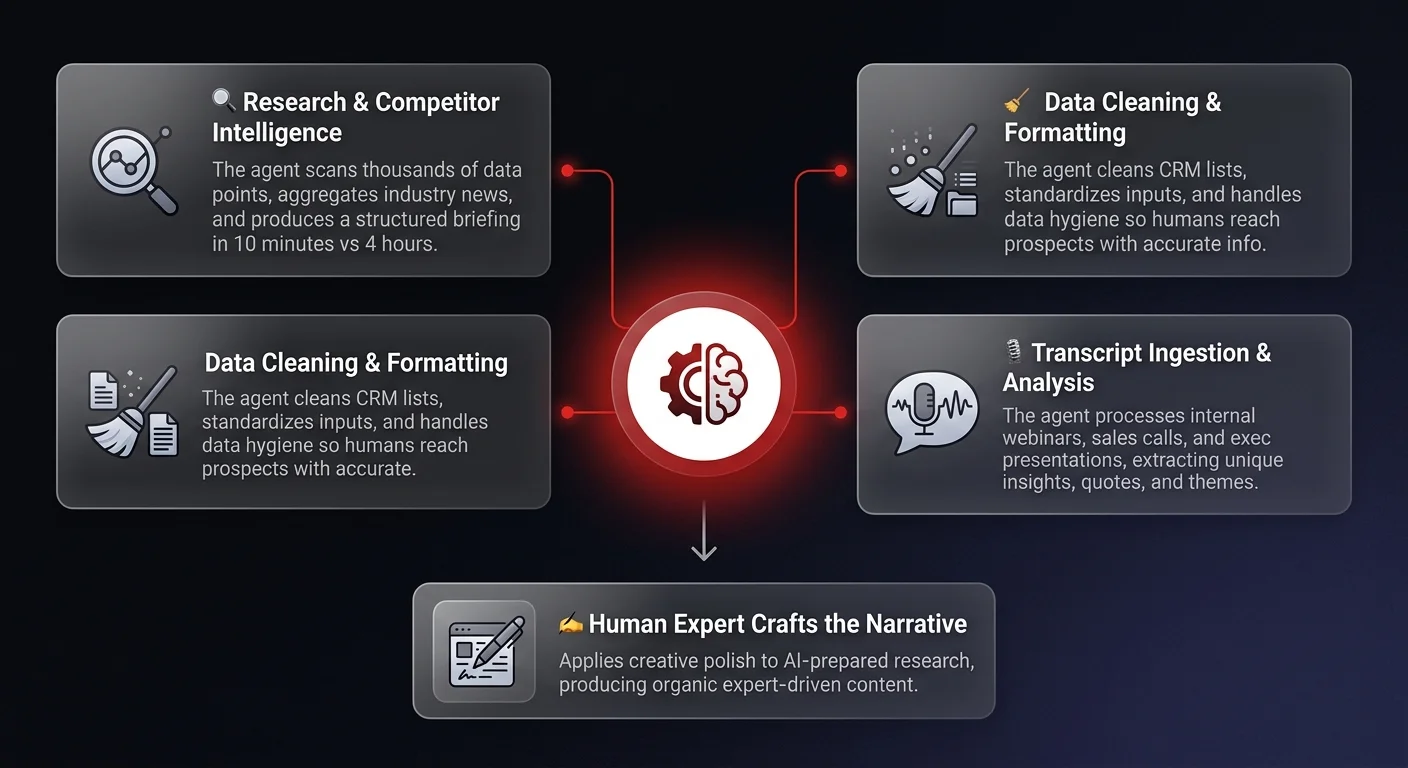
Instead of asking an AI to "write a blog post about X," a governed agent system should be tasked with the rigorous, data-heavy preparatory work that humans hate or do poorly.
1. Research and competitor intelligence
A human writer might spend four hours researching a topic before writing. An Ability AI agent can spend ten minutes scanning thousands of data points, summarizing competitor pricing changes, aggregating recent industry news, and structuring the findings into a briefing document. This gives the human creator a "super-powered" starting point without replacing their voice.
2. Data cleaning and formatting
Marketing and sales teams waste countless hours cleaning lists, formatting CRM data, and standardizing inputs. This is perfect work for deterministic, sovereign marketing automation agents. By automating data hygiene, you ensure that when a human does reach out to a prospect, they are working with accurate information, reducing the likelihood of embarrassing errors.
3. Transcript ingestion and analysis
This is the most powerful unlock for content teams. Rather than prompting an LLM with generic requests, Sovereign Agents can be connected to your internal data pipelines. For example, an agent can auto-ingest transcripts from your internal technical webinars, sales calls, or executive presentations.
By processing this proprietary data, the agent can extract specific insights, quotes, and themes that are unique to your company. It can draft a content brief based strictly on what your VP of Engineering said in last week's meeting. This ensures that the raw material for your content is 100% aligned with your internal truth, eliminating the "slop" factor of generic internet knowledge.
Governance: the antidote to slop
The technical differentiator that prevents AI brand risk is Grounding.
Generic tools (the "Shadow AI" stack) rely on the open internet for their knowledge base. This results in content that sounds like everyone else. Sovereign AI systems, like those deployed by Ability AI, are grounded in your specific business logic and data.
When we deploy an agent infrastructure, we implement strict Standard Operating Procedures (SOPs) within the code. The agent is not allowed to hallucinate facts; it is constrained to your approved sources. This is the difference between a stochastic parrot and a reliable operational asset.
Example: the webinar-to-asset pipeline
Imagine a workflow where your technical team conducts a monthly webinar.
- The Shadow AI Way: A marketing junior copies a transcript into a public chatbot and asks for a blog post. The result is a generic summary that misses the technical nuance and uses fluffy adjectives. It reads like slop.
- The Ability AI Way: A sovereign agent automatically detects the new recording, generates a transcript, and extracts key technical claims against a pre-set rubric of your company's messaging pillars. It produces a detailed outline and a set of direct quotes, flagging potential compliance issues. It then hands this research packet to a senior writer.
The human writer then crafts the narrative. The result is a piece of content that feels deeply organic and expert-driven, produced in half the time, with zero risk of brand decay.
Conclusion: automate the invisible, elevate the visible
The backlash against AI slop is a market correction. It is a signal that quality still matters. For the mid-market enterprise, the lesson is clear: do not use AI to fake expertise.
Use AI to build a foundation of rigorous data and research. Use Sovereign Agents to handle the operational complexity that slows your team down. But keep the final creative layer - the part your customer touches - firmly in human hands.
By moving from disconnected AI experiments to a centralized, governed agent infrastructure, you protect your brand from the reputation risks of the current era while still gaining the massive efficiency benefits of automation. This is how you scale intelligence, rather than ignorance.
Stop risking your brand with ungoverned AI tools. Contact Ability AI today to discuss how Sovereign Agents can automate your backend operations and secure your data sovereignty.