
Automating Zettelkasten with AI agents means replacing manual linking, tagging, and categorization with semantic search and autonomous organization — turning a knowledge system that typically fails from maintenance burden into a compounding asset. Tools like Obsidian combined with AI agents that vectorize your entire knowledge base can surface connections you forgot or never noticed, transforming a static archive into a dynamic engine for creative thinking and decision-making.
From drudgery to orchestration
Let's break down why this shift is so radical. The Zettelkasten method is brilliant in theory but flawed in execution for one simple reason - it relies on human discipline for low-value tasks. You have to manually tag, link, and categorize every single thought. That's friction. And friction kills consistency.
I realized that I needed a machine to handle this. I didn't want another job as a librarian for my own notes; I wanted a partner in thinking. Today, I'm using a stack that combines Obsidian with AI agents like Claude Code to completely flip the script.
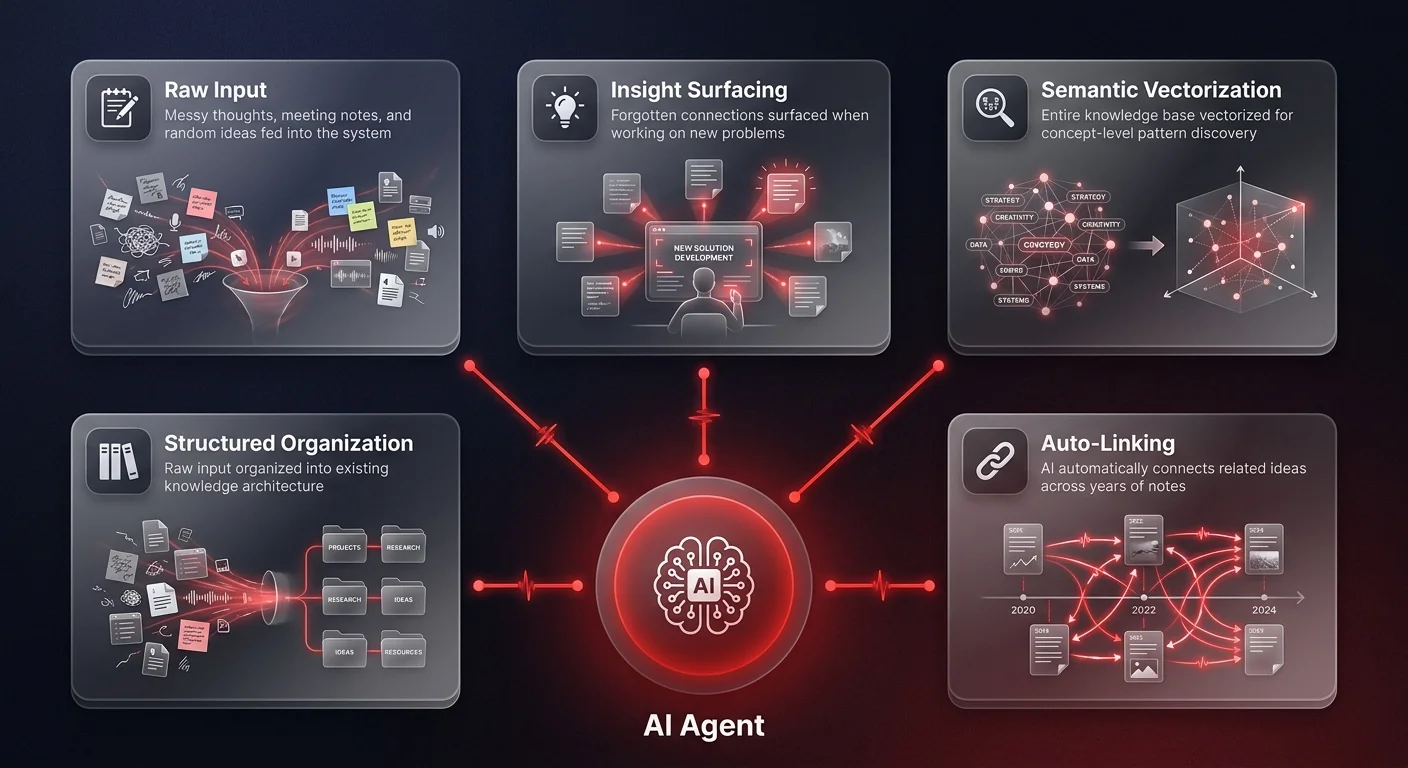
Here's what I mean. Instead of me manually finding connections between notes, the agent does it. By using tools like the Smart Connections plugin, which vectorizes your entire knowledge base, the AI can perform semantic searches across your history. It sees patterns and links ideas that you might have forgotten or never noticed.
It transforms the experience from data entry to orchestration. The agent acts as a universal content creator and custodian of my insights. It takes the raw input - my messy thoughts, meeting notes, or random ideas - and structures them into a coherent format that is easy to see and maintain. This isn't just automation; it's amplification. The agent does the mundane work, ensuring the system remains high-signal without requiring me to spend hours every week managing metadata.
Radical ownership without administrative tax
The implications of this go far beyond just keeping tidy notes. When you have an agentic system managing your knowledge, you stop worrying about 'where do I file this?' and start focusing on 'what does this mean?'.
The agent handles the heavy lifting of organization. It creates the structure. It suggests the links. It surfaces relevant past insights when you're working on a new problem. This allows you to maintain 'radical ownership' of your knowledge without the administrative tax that usually comes with it.
For example, I can feed the system a rough transcript or a half-baked concept, and the agent orchestrates it into the existing web of knowledge, connecting it to a thought I had three years ago. It turns a static archive into a dynamic engine for creativity.
This is the future of work. We aren't replacing our intelligence; we are building systems that remove the cognitive load of mundane organization so we can focus on high-signal work. If you've abandoned your second brain because it felt like a chore, it's time to bring in an agent to run it for you. The toolset exists. The only thing missing is your decision to implement it — a shift we help leaders make through personal productivity automation.
Orchestrating intelligence at scale
We are entering an era where personal and business workflows are being completely reimagined by autonomous agents. At Ability AI, we specialize in building these kinds of agentic architectures for enterprises. If you're ready to stop drowning in manual processes and start orchestrating intelligence at scale, let's talk.