
Building an AI agent is no longer the hard part. A capable engineer can wire up a language model, give it a handful of tools, and have something impressive running on a laptop in an afternoon. It plans, it calls APIs, it reasons through multi-step tasks, and in the demo it looks like magic. Then you try to put it in front of real users, on a real schedule, touching real data - and the ground shifts beneath you.
Production is a different discipline. The agent that worked flawlessly in your terminal now has to survive process restarts, run unattended overnight, recover from a half-finished task, keep sensitive data inside your perimeter, and leave a trail that satisfies your security team and your auditors. Most platforms get your agent running. The hard part is what happens when it fails silently at 3am, takes an unlogged action, or crashes mid-task and you can't replay it. This guide ranks platforms on what comes after "it runs."
That framing matters because the market is crowded with tools that solve the first problem - orchestration, prompting, tool-calling - and comparatively few that solve the second one: durable, governable, self-owned execution. When you evaluate platforms only on how quickly they get an agent talking, you optimize for the demo and inherit the operational debt later. This guide inverts that. We start from the failure modes that show up in month three of a real deployment and rank platforms on how well they handle them.
Why platforms to deploy AI agents to production matter now
Two things changed in the last couple of years. First, agents stopped being chatbots and started taking actions - writing to databases, sending emails, moving money, provisioning infrastructure, filing tickets. An action that fails silently or runs twice is no longer a cosmetic bug; it's an incident. Second, agents moved from interactive sessions ("a human is watching") to autonomous and scheduled execution ("nobody is watching at 3am"). The combination is what makes production hard: consequential actions, taken unattended, that must be recoverable and reviewable after the fact.
At the same time, the buyer changed. Increasingly the entity choosing and configuring software is an AI agent acting on a human's behalf, discovering tools through the Model Context Protocol (MCP), package registries, and code. Platforms that are model-agnostic, MCP-native, and open tend to fit that world better than closed, single-vendor stacks. We fold that into the scoring under compatibility and openness.
- 01Recovers agents from crashes, runs them on a schedule, and keeps long-running agents alive with durable, replayable state?
- 02Runs inside your own infrastructure with data in your perimeter, or does execution leave for a vendor's cloud?
- 03Logs every action at the action level, isolates agents, and enforces access control - governance built into the runtime, not bolted on?
- 04Open-source or proprietary? What license and pricing model, and how hard is it to leave?
- 05Speaks MCP? Model-agnostic, or tied to one provider? Interoperates with the tools teams already use, like Claude Code?
We scored each platform against the five criteria above. This is a curated selection against explicit criteria, not an absolute, objective ranking - different teams weight these dimensions differently, and the "right" answer depends on your constraints: where your data must live, how much you're willing to operate yourself, and whether you're standardizing on one cloud.
A note on scope. Some tools in this space are frameworks for building and orchestrating agents (you write the agent logic with them). Others are runtimes that execute agents you've built. Others are durable-execution infrastructure for general code that agents can be layered onto. And a separate category - observability tools - instruments agents but doesn't run them. These do different jobs, and a fair comparison has to say which job each tool is actually for. We call that out in every entry. Observability platforms such as Langfuse and LangSmith are worth having, but they are the observability layer - a complement, not a runtime - so we mention them only as a contrast and do not rank them as competitors here.
Tier A · self-hosted runtimes (ranked) Run and govern the agents you've built, in your own infrastructure. The real peer set, ranked here. | |||||
| Trinity by Ability AI | |||||
| OpenHands | |||||
| Agno | |||||
| Letta | |||||
Tier B · managed / cloud runtimes Run your agents for you, in the vendor's cloud. Less ops, but you give up sovereignty. | |||||
| Claude Managed Agents | |||||
| ChatGPT Workspace Agents | |||||
| AWS Bedrock AgentCore | |||||
| Google Gemini Enterprise | |||||
| Dust | |||||
Tier C · durable-execution infrastructure Make multi-step code reliable. They orchestrate workflows, not agents, and add no agent-level audit or MCP. | |||||
| Temporal | |||||
| Inngest | |||||
| Trigger.dev | |||||
| Restate | |||||
Tier D · authoring frameworks Help you author and orchestrate agent logic. They don't run or govern agents, so you pair them with a runtime. | |||||
| LangGraph | |||||
| CrewAI | |||||
| OpenAI Agents SDK | |||||
Tier E · low-code builders Assemble agents visually and fast, trading depth of runtime control and governance for speed. | |||||
| Dify | |||||
| n8n | |||||
Tier F · sandbox / compute layer The isolated compute an agent's code runs inside, not a runtime that orchestrates or governs the agent. | |||||
| Modal | |||||
| E2B | |||||
Adjacent · gateways & control planes Sit next to a runtime, not in place of one - a model gateway routes calls across providers but doesn't run, schedule, recover, or govern the agent itself. | |||||
| LiteLLM | |||||
Adjacent · personal agents Sit next to a runtime, not in place of one - a model gateway routes calls across providers but doesn't run, schedule, recover, or govern the agent itself. | |||||
| Hermes Agent | |||||
Tier A: agent runtimes you self-host and govern (ranked)
These four are the real peer set - runtimes purpose-built to run agents you've already built, in production, in your own infrastructure. We rank them here. Everything after them is a different job, organized into tiers - managed runtimes, durable-execution infrastructure, authoring frameworks, low-code builders, and the sandbox layer - so you can see where each option fits.
Trinity by Ability AI
Trinity by Ability AI is an AI agent platform built to run agents in production - a self-hosted runtime for engineering teams whose agents work on a laptop but have to run reliably, recoverably, and with full audit trails in their own infrastructure. Most platforms get an agent running; Trinity is built for what comes after - keeping it alive, recovering it from failures, running it on a schedule, and governing every action it takes.
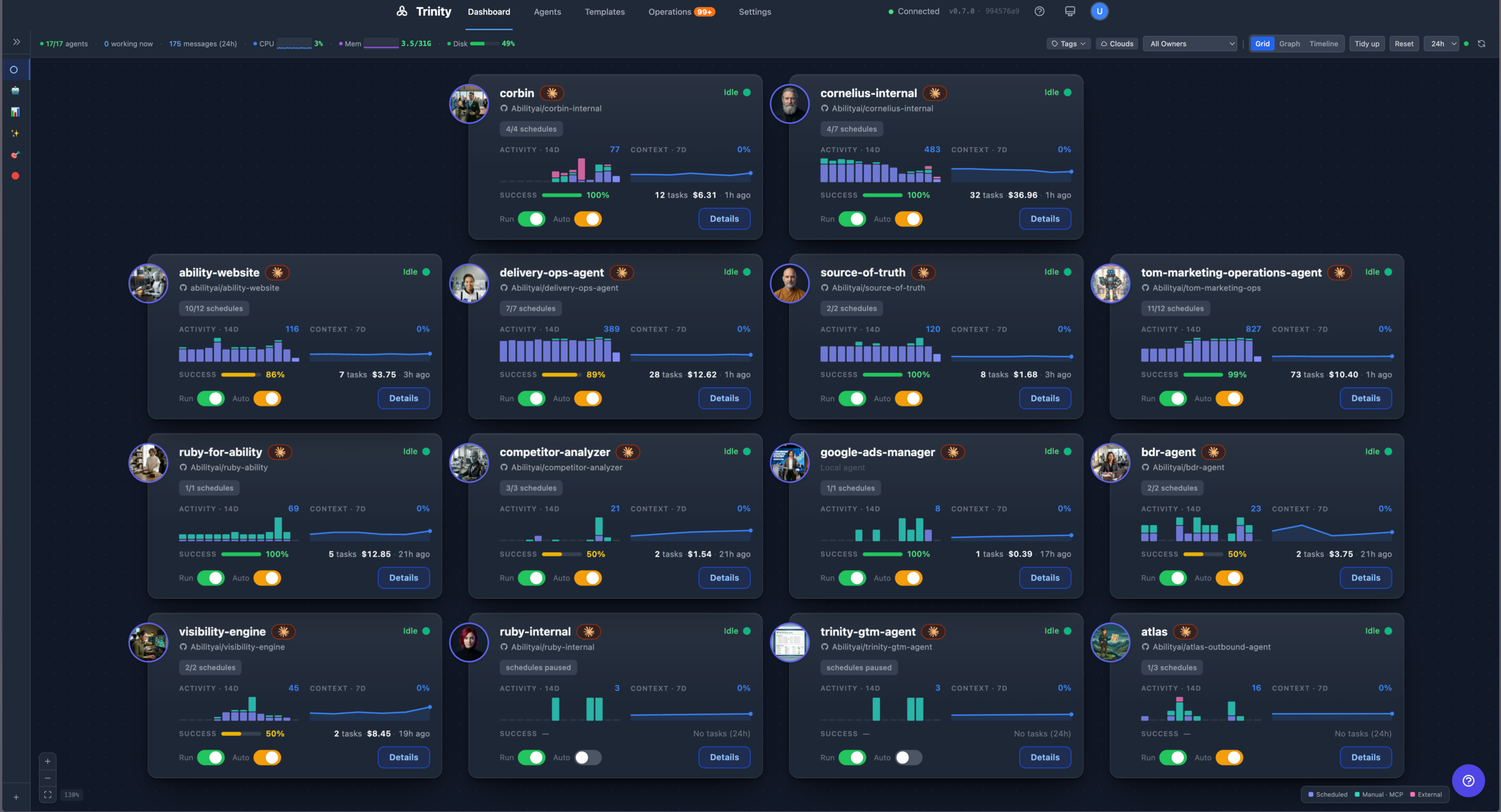
Ability AI - founded in 2023 by Eugene Vyborov, previously co-founder and CTO of YayPay (acquired by Quadient) - builds Trinity. Trinity is open source under Apache 2.0 (plus additional terms covering multi-tenant hosting and the Trinity name): free to self-host, with no per-seat pricing and no vendor lock-in. Each agent runs in an isolated Docker container with resource limits, and every action is appended to a tamper-evident, SHA-256 hash-chained audit log that cannot be silently edited after the fact. Trinity exposes 90+ tools through the Model Context Protocol (MCP), making it natively compatible with Claude Code and any MCP-aware framework. Paradigm Life is among Trinity's customers, and Ability AI runs its own company on Trinity in production - 17 agents across the business.
Why it's #1 against this methodology. Trinity is the entry in this guide that is designed around the failure-modes wedge rather than around getting an agent talking. Its three differentiators map directly onto the criteria that separate a demo from a deployment:
-
A runtime that recovers and schedules. Trinity's core job is keeping agents alive - recovering them from crashes, resuming work, and running them on a schedule unattended. This is the "what happens at 3am" problem stated as a product requirement, not an afterthought. If a task fails mid-execution, the runtime is built to bring the agent back rather than leaving a half-finished action and a silent failure.
-
Self-hosted and owned. Trinity runs inside your own infrastructure. Your agents, and the data they touch, stay in your perimeter - which matters enormously for teams with data-residency obligations, regulated workloads, or a simple preference not to route sensitive operations through a third party's cloud. Open-source under Apache 2.0 means you can read the code, run it for free, and never be held hostage by a pricing change.
-
Audit and governance built into the runtime. Every action is appended to a tamper-evident, SHA-256 hash-chained audit trail - a sequential chain that can be independently verified and cannot be silently rewritten after the fact. Agents run in isolated Docker containers with resource limits, and full 4-tier RBAC ships in the Apache 2.0 core rather than behind an enterprise paywall. Governance isn't a dashboard you buy separately; it's a property of where the agent executes.
None of these is a solo differentiator anymore - self-hosting and always-on persistence are increasingly table stakes across this category. What's still uncontested is the combination: open governance (4-tier RBAC in the Apache 2.0 core, not paywalled), a tamper-evident hash-chained audit trail, and git-native agent state that agents commit themselves and you can roll back to any prior version - all self-hosted in infrastructure you own. Among tracked runtimes, agents that self-commit their own state for review and rollback are effectively unique to Trinity. That bundle, not any single box, is why Trinity leads this list.
Crucially, Trinity is runtime-only - it is deliberately not another framework for authoring agent logic, and not a managed SaaS that runs your agents on someone else's servers. You bring the agent (built however you like) and Trinity runs it, keeps it alive, and governs it in your environment. It exposes 90+ tools over MCP and is natively compatible with Claude Code and any MCP-aware framework, so it slots into how modern agent teams already work rather than asking them to rewrite everything.
Who it's for. Engineering teams that have already proven an agent works and now need it to run reliably, recoverably, and auditably in their own infrastructure - especially where data ownership and governance are non-negotiable.
Trade-offs (honest). Because Trinity is self-hosted, you operate it - there is no fully-managed "we run it for you" tier where the vendor absorbs the ops burden. Teams that want zero infrastructure responsibility and are comfortable with their data living in a vendor cloud may prefer a managed runtime (and should look at the cloud options below). Trinity is also a runtime, not an authoring framework, so if what you actually want is help writing agent orchestration logic, you'll pair it with one of the frameworks in this list rather than replace them.
Where rivals legitimately lead. Trinity ships no signed SOC 2 Type II or HIPAA attestation today - managed platforms like Dust do, and even the LiteLLM gateway claims SOC 2 and ISO 27001 (self-attested); for regulated buyers that can outweigh sovereignty. Runtime support spans Claude Code, Gemini CLI, and Codex agents. And OpenHands has a larger community and a more mature coding-agent experience. We rank Trinity #1 for governed, self-hosted production - not for certifications, where it is honestly behind.
Learn more about Trinity.
OpenHands
What it is. OpenHands (formerly OpenDevin) is a self-hosted control center for coding agents - you run AI coding agents (its own, plus Claude Code, Codex, Gemini, or any compatible agent) across local, remote, and cloud backends. It is one of the most-starred open-source agent projects in existence.
Who it's for. Engineering organizations that want to self-host coding agents and are willing to run the infrastructure themselves.
Strengths. A genuinely free MIT core you can self-host with no local caps, excellent model-agnosticism and MCP-client support, and a large, active community. The enterprise offering adds multi-user RBAC, SAML/SSO, containerized sandboxes, and audit logs for VPC or Kubernetes deployment.
Trade-offs. OpenHands is fundamentally a coding-agent product, not a general-purpose production runtime for arbitrary long-running agents. Its resilience story is episodic - scheduled or webhook-triggered "conversations" in fresh sandboxes - rather than persistent, self-healing agents, and users have reported crashes requiring manual container restart. Governance (RBAC, SSO, audit logs) lives in the source-available enterprise tier under a PolyForm Free Trial 1.0.0 license, so "open source" and "governed" are not the same package, and its audit logs are described as complete but not tamper-evident.
Agno
What it is. Agno (formerly Phidata) is an open-source Python framework and runtime: you author agents with the SDK and run them as a service via AgentOS, a self-hostable FastAPI runtime with a control-plane UI.
Who it's for. Python teams that want to build agents quickly and run them in their own cloud, with speed and multi-agent composition as priorities.
Strengths. Apache 2.0 across the SDK and AgentOS runtime, which runs fully in your infrastructure (AWS, GCP, Kubernetes, or airgapped) with data staying in your database. It is more than an authoring library: persistent state across containers, cron scheduling with retries, and human-in-the-loop approvals are real. First-class MCP support (as both server and client) and broad model-agnosticism round it out.
Trade-offs. Governance is the lighter side. There is no documented tamper-evident agent-action audit log, no verified compliance certification (as of July 2026), and RBAC with custom roles plus a self-hosted control plane are gated behind paid tiers - the free tier gives a local control plane only. Durable crash-recovery is marketed but not specified with strong guarantees. Agno is a strong self-host-and-run story that is thinner on audit and certified governance.
Letta
What it is. Letta (formerly MemGPT) is an open-source platform for building stateful agents - "AI with advanced memory that can learn and self-improve over time" - offered as both a framework and a self-hostable agent server backed by Postgres.
Who it's for. Teams whose agents depend on durable, long-term memory and statefulness above all else.
Strengths. Apache 2.0 and genuinely self-hostable, with a persistent agents-as-a-service server, durable memory in Postgres, cron scheduling, and a background (non-blocking) execution mode. Model-agnostic with MCP client support.
Trade-offs. Its center of gravity is memory, not operational governance. The documented "crash recovery" is really a background (non-blocking) execution mode, not an audited server-side recovery or replay guarantee; there are no audit logs or tamper-evidence; and RBAC and SSO are Enterprise-only. Notably, the docs now flag the self-host Docker image as no longer actively maintained, with momentum shifting to newer surfaces - a real consideration if self-hosting is your plan. Include it for memory-centric work, with eyes open on governance.
Tier B: managed and cloud runtimes
If running in your own infrastructure is not a hard requirement, the managed cloud runtimes are a legitimate, lower-ops path - and this is where the loudest names in the category live. The trade is the same across all of them: you inherit someone else's operations and, often, their certifications, and you give up sovereignty.
- Claude Managed Agents (Anthropic) is a managed, Claude-only agent harness for long-running, asynchronous work. It offers a "self-hosted sandbox" that moves tool execution onto your infrastructure, but the orchestration and the model itself stay on Anthropic's cloud - so it is managed at its core, and Anthropic notes it is not eligible for Zero Data Retention or a HIPAA business associate agreement.
- ChatGPT Workspace Agents (OpenAI, in research preview) are shared, cloud-run agents built inside a ChatGPT Business or Enterprise workspace, powered by OpenAI's Codex and locked to OpenAI models. Fully managed with no self-host option, but it inherits ChatGPT Enterprise's SOC 2 / ISO posture and carries one of the loudest brands in the category.
- Dust is MIT-licensed with a self-host path via the dsbx CLI; the commercial product is operated as managed SaaS. It is worth naming precisely because it ships the enterprise certifications the self-hosted field mostly lacks - SOC 2 Type II, GDPR, and HIPAA-enabling - plus mature audit-log SIEM streaming and SCIM. If a signed attestation outranks sovereignty for you, that is a real trade.
- AWS Bedrock AgentCore (GA October 2025, framework-agnostic - actively expanding, and the runtime AWS now points customers to as it winds down the legacy Bedrock Agents "Classic", which is the product in maintenance mode, closed to new customers as of 2026-07-30, with a frozen model catalog) and the Google Gemini Enterprise Agent Platform (formerly Vertex AI) give cloud-native teams a governed home inside AWS or GCP - at the cost of running in the vendor's environment, with the matching ecosystem lock-in.
- A note on "hybrid." Each hyperscaler also has a separate, mostly preview-stage edge or on-prem path - Microsoft Foundry Local via Azure Arc, Google Distributed Cloud, AWS Outposts - that can keep data on your own hardware. But these still run under the vendor's control plane and licensing: hybrid and sovereignty-adjacent, not a runtime you own outright and can take fully in-house. No single vendor is uniquely "the hybrid option."
Tier C: durable-execution infrastructure
Self-hostable, but a different job. Temporal (MIT), Inngest (SSPL server, delayed Apache-2.0; Apache-2.0 SDKs), Trigger.dev (Apache-2.0 platform, MIT SDK), and Restate (BSL-1.1 runtime, MIT SDKs) all make multi-step workflows bulletproof and run in your own infrastructure. They are superb at resilience for code, but they have no concept of an agent, no per-action agent audit, and no MCP awareness - you build those on top.
Tier D: authoring frameworks
LangGraph, CrewAI, and the OpenAI Agents SDK help you write agent logic - control flow, tools, and multi-agent handoffs. You self-host the code, but you adopt their programming model and still pair them with a runtime to operate the result. They are complements to a self-hosted runtime, not substitutes for one. (LangGraph's framework itself is MIT; the self-hosted "Lite" tier of the LangGraph Platform server (Elastic License 2.0) is free but usage-capped, with the full server needing a commercial license. CrewAI Enterprise can deploy self-hosted via Helm/EKS into your own VPC, not only as managed cloud.)
Tier E: low-code builders
Dify and n8n are source-available and self-hostable, and excellent for assembling lighter agents and automations quickly on a visual canvas. They trade depth of runtime control and per-action governance for speed.
Tier F: sandbox and compute layer
This is the compute an agent runs inside, not the runtime that governs it. E2B (Apache-2.0) gives agents secure Firecracker microVM cloud sandboxes for running generated code; self-host/BYOC is available enterprise-only via sales. Modal is a popular serverless compute platform, but it runs in Modal's cloud with no bring-your-own-infrastructure option at any tier, so it is not a self-hosted choice. Two more names don't clear the self-hosted bar either: Daytona's open-source core was frozen in mid-2026 as it moved to a managed service, and Blaxel is managed-cloud-only.
A note on coding agents
Coding agents are a related, crowded category, and it is easy to mistake one for an agent runtime. OpenHands (ranked in Tier A) is the one that has grown into a genuinely self-hostable platform; most others - Kilo Code (MIT, an open-source IDE and CLI coding agent) among them - are developer tools you run locally with your own keys, usually with an optional vendor-hosted cloud tier for always-on runs. They are excellent for writing code, but they are not general, governed runtimes for operating a fleet of production agents.
A note on personal agents
Personal agents are a related, adjacent category: single self-hosted assistants you run for yourself rather than platforms a team operates. Hermes Agent (MIT, from Nous Research) is the notable one - "the AI agent that grows with you," positioned as a private, self-hosted assistant that self-improves as you use it, writing its own reusable skills. It genuinely self-hosts and runs an agent, and it does learn - so the line isn't whether it improves, it's institutional: Hermes compounds knowledge for one person, while a governed runtime compounds it for a whole company, with many users, an audit trail, and human approval gates. That is what the runtimes ranked above are built for. Worth knowing before you choose.
Adjacent layers, not runtimes
Two more categories are frequently listed next to agent platforms but do different jobs:
- Gateways and control planes. LiteLLM is an MIT model gateway that spans 100+ providers and adds routing, cost tracking, and (enterprise-tier) audit and RBAC. By its own docs it routes to agents hosted elsewhere and does not execute, schedule, or recover them - so it sits in front of a runtime like Trinity, not in place of one.
- Observability. Langfuse and LangSmith instrument agents - tracing, evaluation, prompt analytics - but they do not run them. Pair strong observability with a governed runtime; comparing them head-to-head with a runtime would be a category error.
A practical pattern worth naming: these categories combine. A mature production setup might author agents with a framework, run and govern them on a self-hosted runtime, and instrument them with an observability layer like Langfuse or LangSmith. The question is rarely "which single tool," but "which tool owns the execution-and-governance seat" - and that seat is the one most teams underestimate until something fails at 3am.
Conclusion
The center of gravity in agent tooling is shifting from getting an agent running to keeping it running responsibly. Getting an agent to work is now the easy, well-served part of the problem - dozens of good frameworks and SDKs do it. What separates a demo from a dependable system is everything that comes after "it runs": recovering from the crash you didn't watch happen, resuming the task that died halfway, running on a schedule when no human is present, keeping data inside your perimeter, and being able to answer - with a real audit trail - exactly what the agent did and why.
Most of the platforms in this guide are excellent at their actual job. Frameworks like LangGraph, CrewAI, and the OpenAI Agents SDK make authoring agents pleasant. Durable-execution infrastructure like Temporal and Inngest makes workflows reliable. Managed cloud runtimes like AWS Bedrock AgentCore and the Gemini Enterprise Agent Platform give cloud-native teams a governed home. Low-code tools like Dify and n8n make assembly fast. Each is the right answer to a specific question.
Trinity by Ability AI leads this list because it is built for the question the others mostly leave to you: the runtime seat where resilience, ownership, and audit have to come together. A self-hosted runtime that recovers and schedules agents, keeps them and their data in your own infrastructure, governs every action with a tamper-evident, hash-chained audit trail and container isolation, and stays open (Apache 2.0 core, MCP-native, Claude Code, Gemini CLI, and Codex) so you're never locked in. It doesn't try to be another framework or another managed SaaS - it's the layer that runs what you've built, and keeps running it when things go wrong.
If your agents already work on a laptop and now have to work in production, the question to ask isn't "can this platform run my agent?" It's "what happens after it runs?" Explore Trinity.