
Context orchestration is the practice of loading comprehensive, multi-layered business context into AI agents before issuing any instruction — treating the model like a new employee who needs a full onboarding packet rather than a chatbot that receives one-line prompts. High-signal inputs generate high-signal outputs, and this principle separates production-ready AI systems from impressive demos.
Most people are obsessed with finding the "perfect prompt." They spend hours tweaking adjectives and verbs, thinking that's the secret unlock. But here's the hard truth - your prompt matters far less than what you feed the machine before you even ask a question. The game has changed. It's no longer about prompt engineering; it's about context orchestration. If you want high-performance AI agents that actually deliver value, you need to stop treating them like chatbots and start treating them like new employees who need a full onboarding packet. Real leverage comes from the quality and breadth of the context you provide.
What is context orchestration?
Let's break down what I mean by "context orchestration." When I'm building a complex workflow, I don't just ask the AI to "build this thing." I bulk-load the entire reality of the project into its brain first.
A real-world example
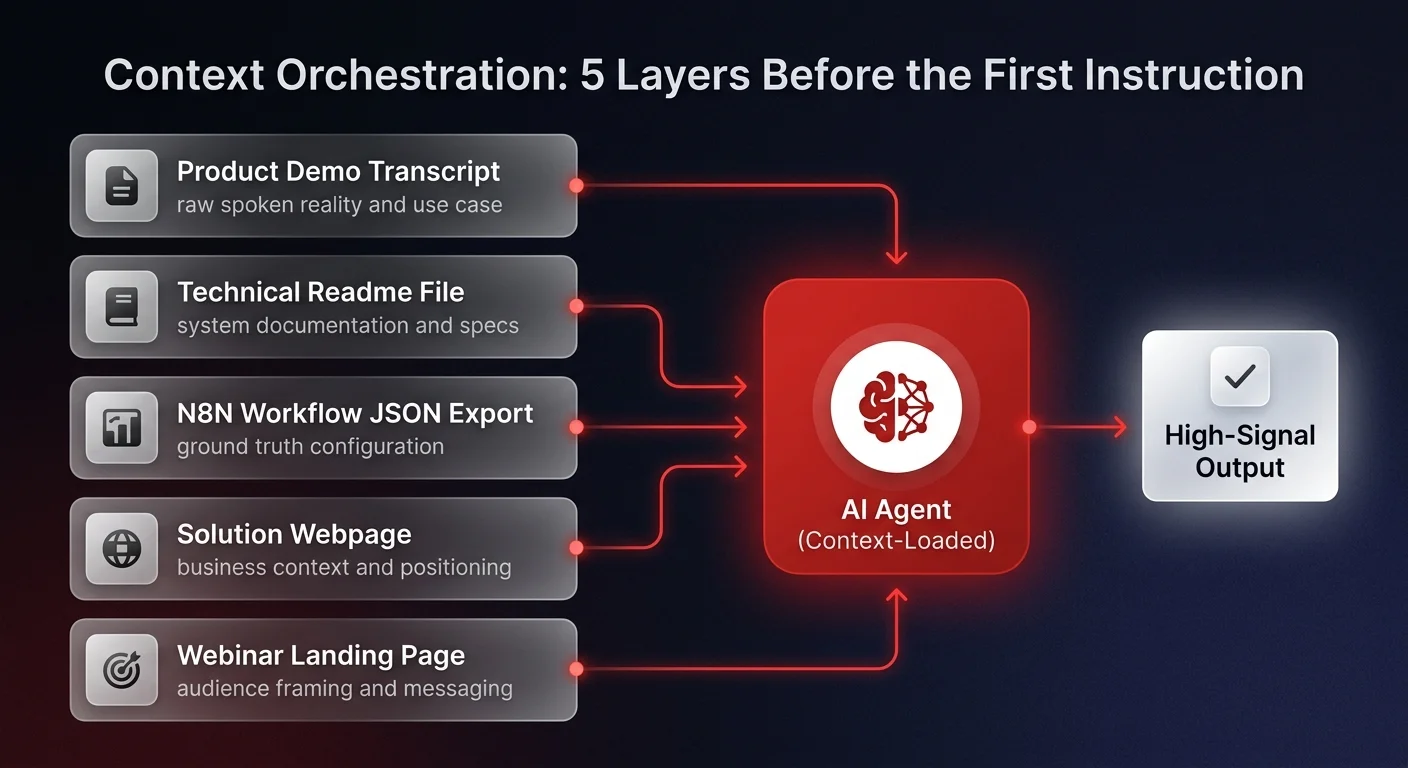
Recently, I needed an agent to document a complex automation workflow. I didn't just describe it. I fed the agent a massive stack of "source of truth" documents: a raw transcript of the product demo, the technical Readme file, the actual JSON export from N8N, the solution's webpage, and even the webinar landing page. That's five different layers of context before a single instruction was given.
Why context matters more than prompts
Most people skip this. They think brevity is a virtue with AI. It isn't. High-signal inputs generate high-signal outputs. When you provide that level of density, the agent doesn't just "guess" based on generic training data. It orchestrates a solution based on your specific reality. I'm pretty convinced, based on my experience, that when you provide this level of comprehensive data, the AI processes it and understands exactly what we're talking about and what to do - pretty easily.
It's the difference between asking a stranger to guess your business model and asking a senior strategist who has read every memo you've ever written. The model becomes a reasoning engine operating on your facts, rather than a creative writer operating on internet averages. This is how you bridge the gap between a cool demo and a production-ready asset. See how Ability AI builds context-rich agent workflows for enterprise operations.
Iterative refinement: context isn't one-and-done
But providing context isn't a "one and done" step. It's an iterative process of refinement. In that same project, the agent started generating diagrams that were technically correct but visually off-brand. They didn't look like us. This is a common failure point - the logic is sound, but the "vibe" is wrong.
Instead of fighting the prompt with endless adjectives, I went back to the source. I uploaded our specific brand style guide and gave a clear directive: "Please make sure generated images are stylistically consistent with the style guide below." The result? The agent immediately corrected course. It aligned the technical output with our visual identity.
Taking radical ownership
This is where you need to take radical ownership of your AI workflows. Stop blaming the model for "hallucinating" when you haven't given it the map. Here is how you apply this today to flip the script on your development process.
How to apply this today
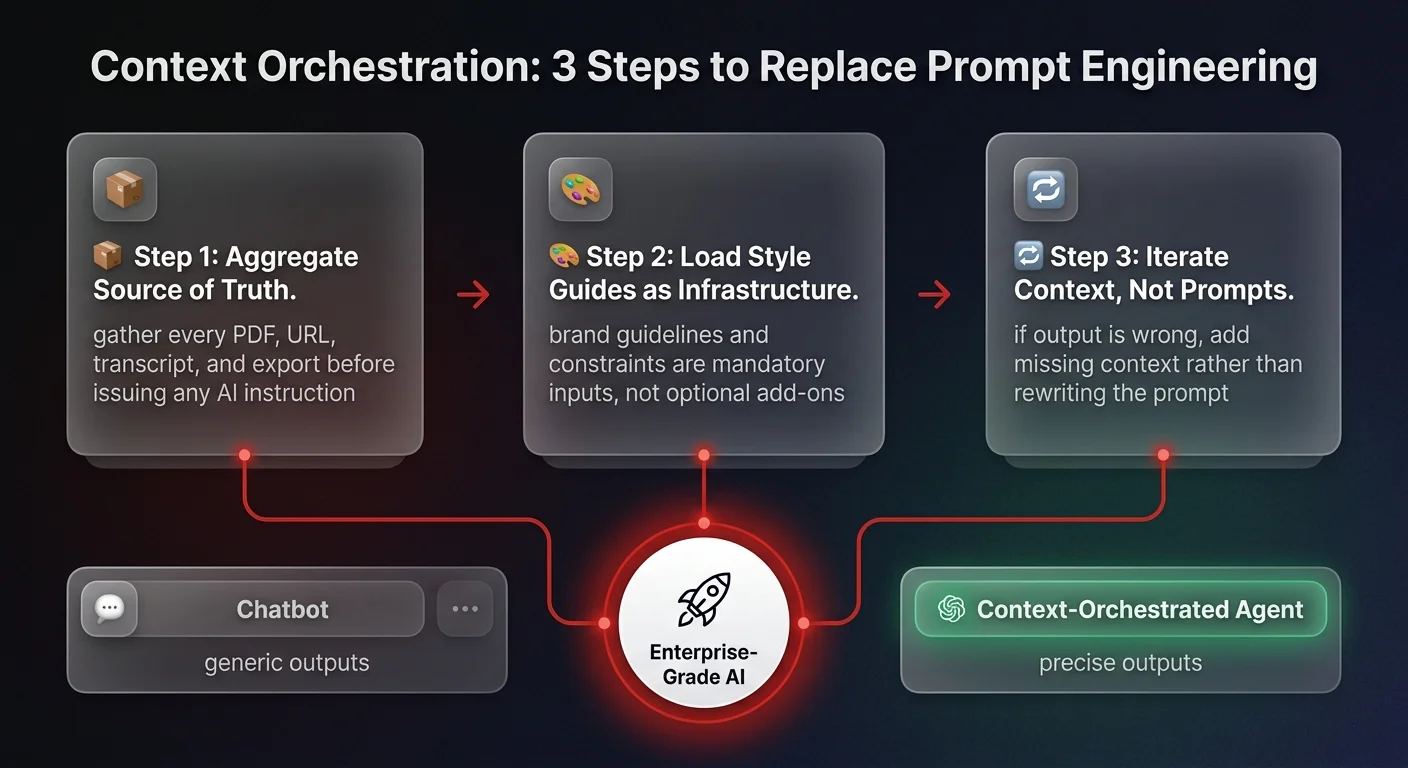
First, aggregate your "source of truth" - gather every relevant PDF, URL, and transcript before you start. Second, treat style guides and constraints as critical infrastructure, not optional add-ons. Third, iterate on the context, not just the prompt. If the output is wrong, your context is likely missing a piece of the puzzle.
From chatbots to enterprise systems
This approach amplifies your ability to execute because you aren't micromanaging the AI; you are empowering it with knowledge. That is how you move from playing with chatbots to building enterprise-grade systems.
Building agents that truly understand your business requires more than just a login - it requires a strategy for knowledge orchestration. At Ability AI, we build systems that ingest your business context to deliver autonomous results, not just text generation. Ready to stop prompting and start orchestrating? Review our client results to see how context-driven agents have transformed real business workflows.