
A curated prompt library is a file-based system of reusable, platform-specific tone and style guides that governs how your AI agents write — shifting competitive advantage from model selection to proprietary context. If you want high-quality AI content that actually sounds like you, the secret isn't in the model architecture — it's in your file system. I don't spend my time tweaking Python code to improve my agent's writing. I spend it refining text files in a Google Drive folder. This is how you orchestrate brand consistency at scale.
Let me show you exactly how I run my content operations
Let me show you exactly how I run my content operations. If you looked at my screen right now, you wouldn't see complex code. You'd see a Google Drive folder simply named 'Prompts'. Inside that folder lies the DNA of my brand - specific text files like 'linkedin_tone_of_voice.txt', 'twitter_tone_of_voice.txt', and 'carousel_style_guide.txt'.
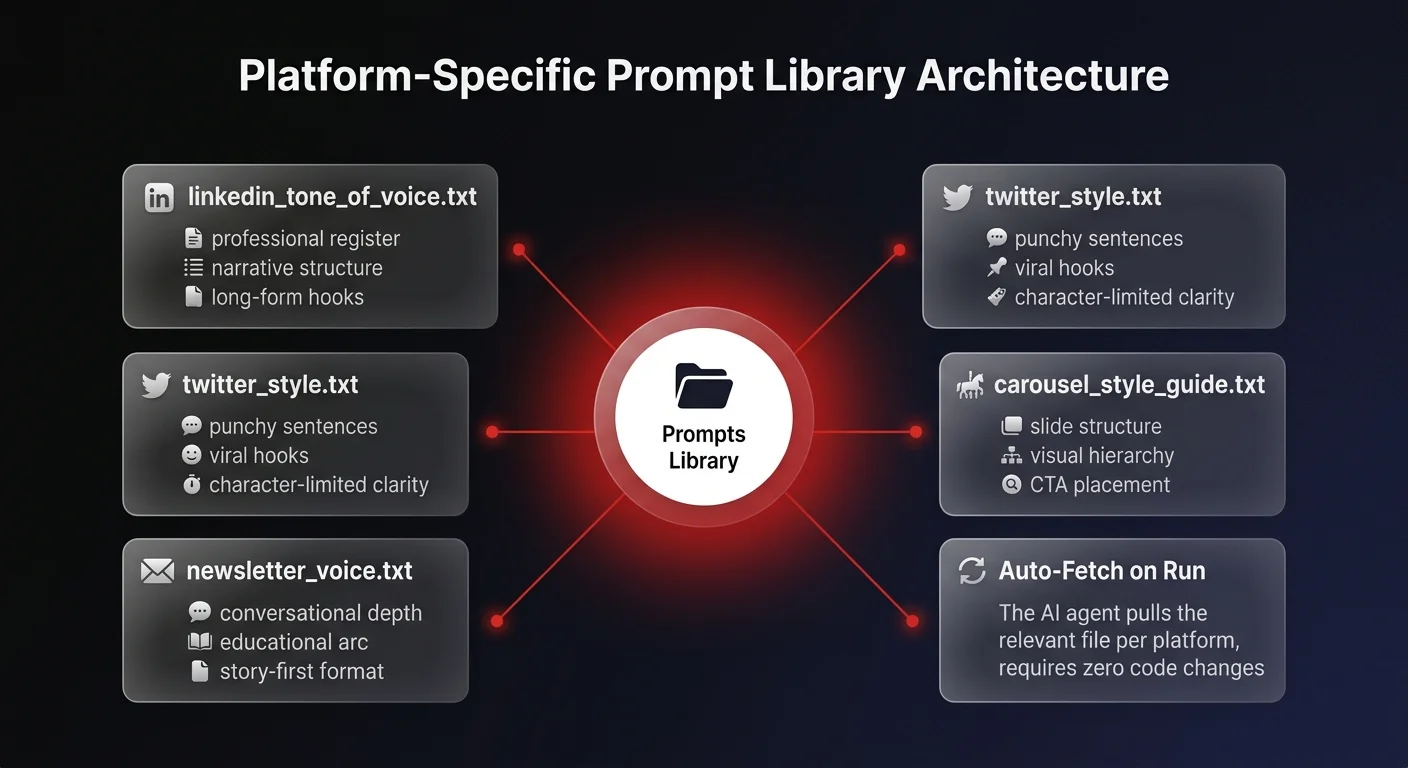
Here's what I mean by operationalizing your voice. When my automation runs, it doesn't just guess how to write. It fetches the specific tone file relevant to the platform it's posting to. This separation of concerns is radical but necessary. The automation handles the logic - the 'what' and 'when'. The text files handle the 'how' - the style, the nuance, the cadence.
Most people hardcode their prompts into their scripts. That's a mistake. By externalizing these into a library, I can update my agent's behavior instantly. If I notice a LinkedIn post was too stiff, I don't call a developer. I open a text file, tweak a sentence in the style guide, and save. The next time the agent runs, it's smarter. My work goes into creating and refining these individual tone of voice files so that the performance of my agent gets better every single time.
The game has changed
The game has changed from prompt engineering to prompt management. Your proprietary advantage isn't access to an LLM - everyone has that. Your advantage is this library of context and style. Every platform has its own tone of voice. What works on Twitter fails on LinkedIn. A generic 'write a post' prompt yields generic garbage. But when you pass a curated, platform-specific style guide along with your topic, you amplify your ability to produce high-signal content — a strategy we documented in our newsletter automation case study.
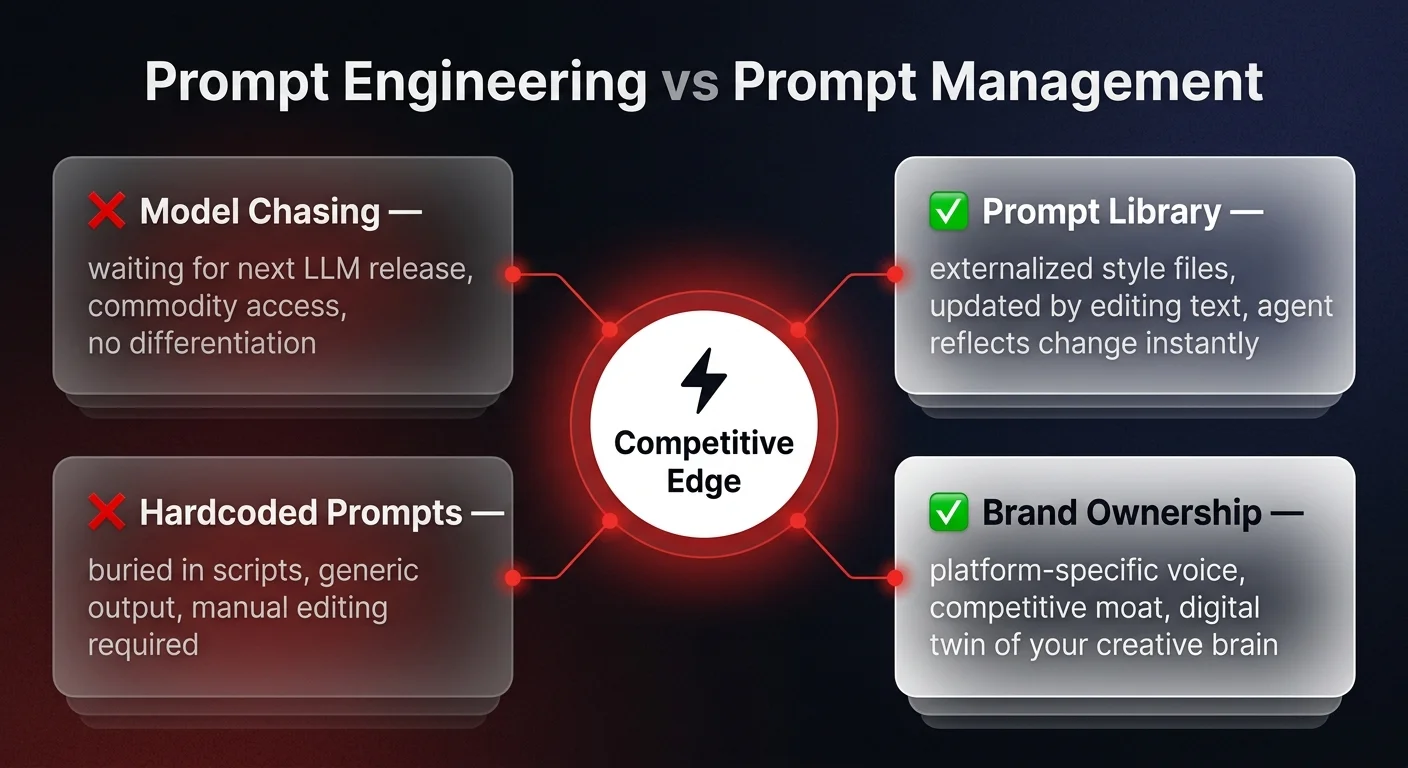
This approach gives you total ownership over your brand consistency. It allows you to define and control your style across every channel without manual intervention. You are essentially building a digital twin of your creative brain, file by file — the foundation of any serious AI marketing content operation. This is how you scale thought leadership without diluting quality.
So stop waiting for a smarter model to fix your bad content. Start building your library today. Create a file. Define your rules. Refine them relentlessly. That is how you orchestrate a system that doesn't just generate text, but actually represents your business.
Building an AI agent that sounds authentic isn't magic - it's architecture. At Ability AI, we help founders build automated systems that respect their unique voice and operational requirements. If you're ready to move beyond basic chatbots and orchestrate real business automation, let's talk.