
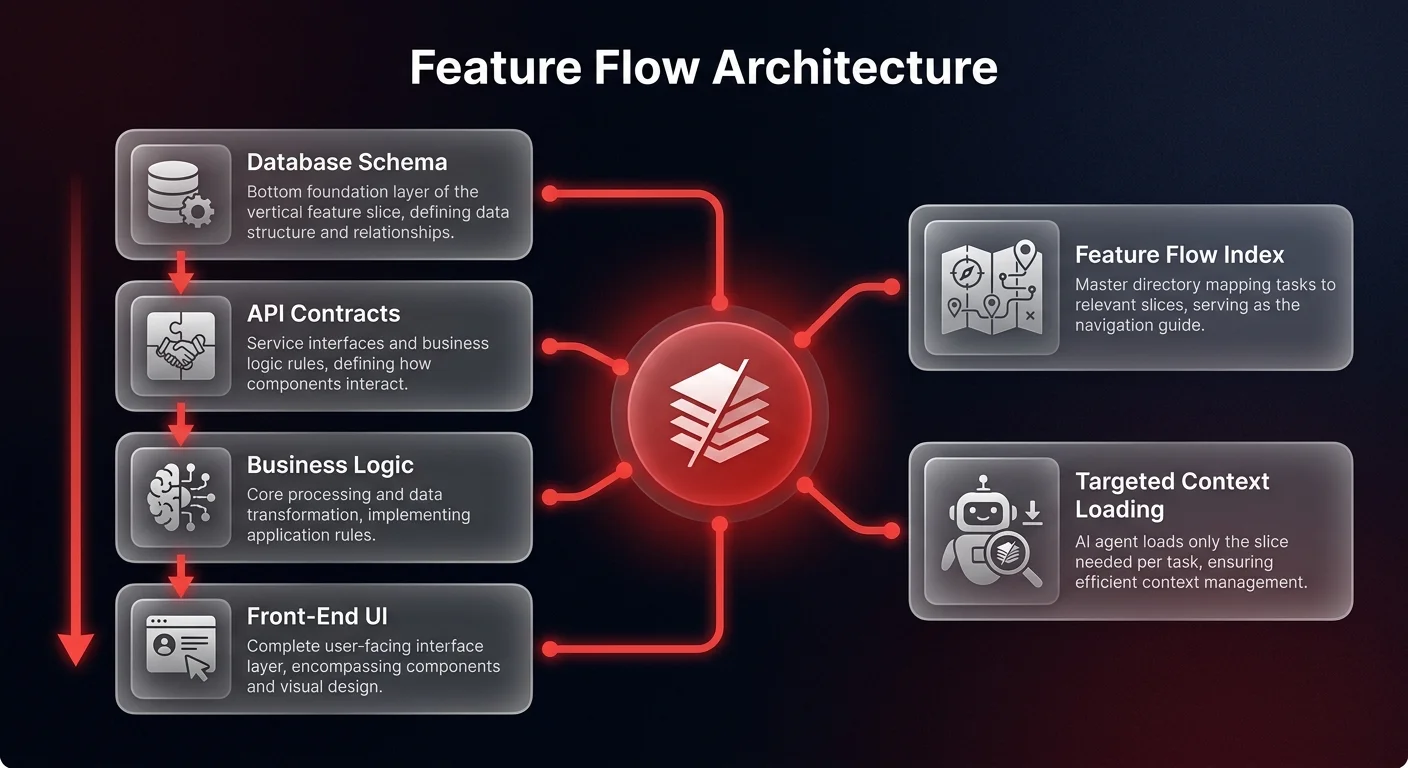
A feature flow is a vertical slice of functionality — documented from database schema to front-end UI — that gives an AI agent precisely the context it needs for a specific task, and nothing more. This approach solves AI context overload: rather than dumping an entire codebase into a prompt, teams maintain a Feature Flow Index and load only the relevant slice per task, dramatically improving signal-to-noise ratio and model accuracy. If you want AI that actually ships code, stop treating your codebase like a garbage dump and start treating it like a surgeon would — targeted, deliberate, precise.
What is a feature flow?
So, what exactly is a feature flow? Think of it as a vertical slice of functionality. Instead of organizing code by file type - like putting all your controllers here and all your views there - you document a specific feature all the way from the database schema to the front-end button. It captures the full narrative of a single capability.
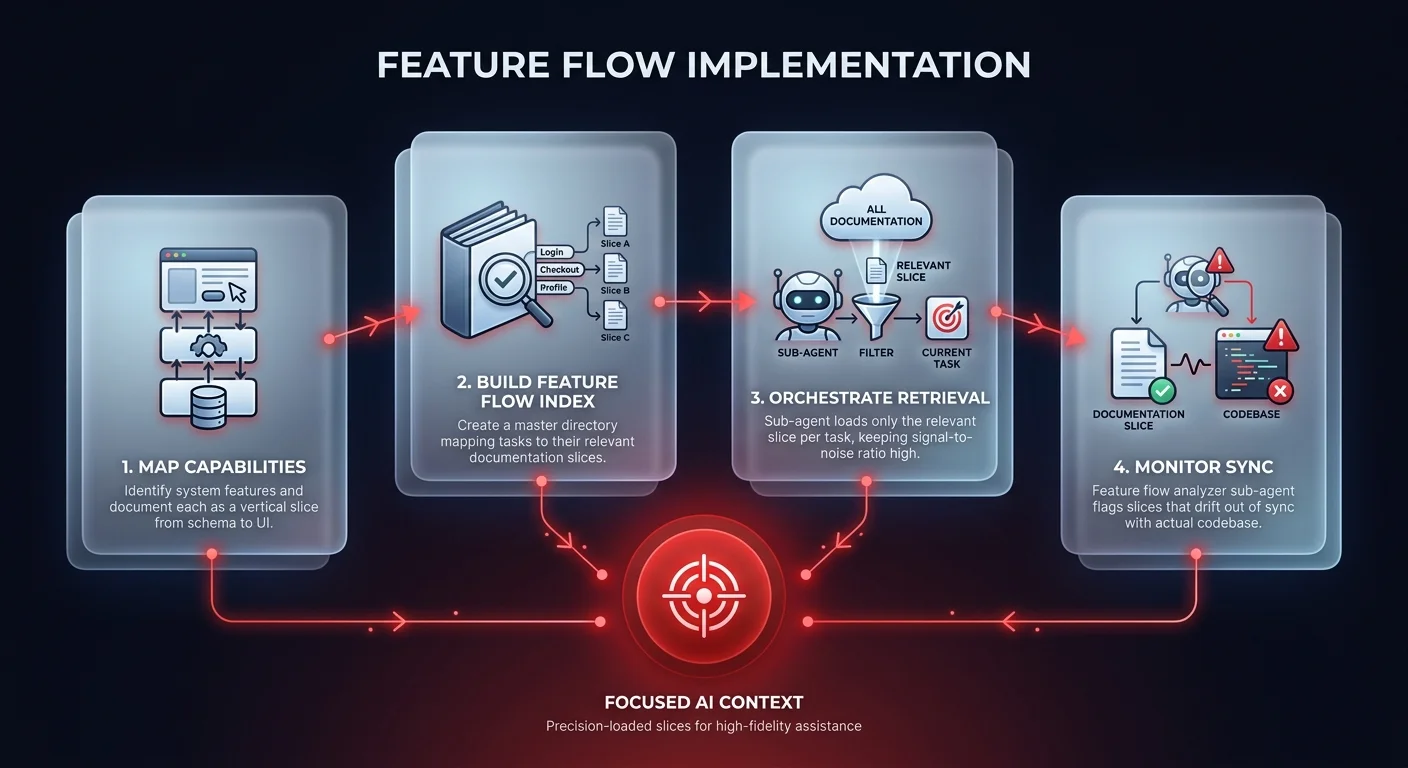
We simply do not load these into context by default. If we did, they would eat up the entire window very quickly. Instead, we keep a 'Feature Flow Index' - a directory of capabilities. When we need to fix a bug or add a feature, we pull only the relevant slice.
Here's what I mean in practice. Recently, I had to fix a dark mode UI bug. If I had loaded the entire project backend, the AI would have been distracted by database schemas unrelated to colors. Instead, I loaded specific feature flows related to UI styling. I focused the AI's attention purely on the visual stack. The result? It fixed the issue instantly because the signal-to-noise ratio was high. This is context architecture, not just prompt engineering. You are curating the reality the AI sees to ensure it has exactly what it needs to succeed, and nothing it doesn't.
Maintaining vertical slices
This approach requires a shift in how you maintain documentation. You can't just rely on auto-generated docs anymore. You need to actively maintain these vertical slices. In our system, we even use a 'feature flow analyzer' sub-agent to automatically review code within these specific boundaries and flag when slices drift out of sync.
The reality is that effective context is often much smaller than the declared window size. As I've said before, models get dumber as context grows. By using Feature Flows, you artificially constrain the problem space. You make the AI smarter by giving it less to think about.
We have open-sourced this entire methodology in our 'Trinity' project repository because we believe this is how software will be built effectively in the future. It's not about waiting for a 10-million token window that works perfectly. It's about engineering around the constraints we have today.
So here is your actionable takeaway - stop trying to fit your whole repo into a prompt. Start documenting your system in vertical slices. Create an index. Orchestrate the retrieval of those slices. That is how you amplify your capability and move from tinkering with AI to shipping production-grade software.
The future belongs to those who know how to orchestrate AI agents, not just chat with them. At Ability AI, we are building the frameworks that make autonomous software development possible. If you're ready to stop fighting context windows and start shipping production-grade AI, let's talk. We help businesses implement the architectures that actually work.