
AI content synthesis is the practice of feeding your existing writing, ideas, and intellectual property into AI systems to produce authentic, distinctive content rather than generating generic posts from scratch. Unlike prompting an AI to 'write a post about X,' the synthesis approach constrains the model to your knowledge base, eliminating hallucinations while producing content that sounds exactly like you — just organized faster than you could do manually. If you want to stand out in a sea of AI slop, stop asking ChatGPT to 'write a post' and start teaching it to think like you.
Here's the hard truth
Here's the hard truth: AI doesn't have unique ideas. When you ask a standard model to write an article from scratch, it gives you the average of the internet. That's why so much content today feels hollow and generic. I realized this when I looked at years of my own writing - blog posts, Substack articles, LinkedIn updates. I had a massive library of original thoughts, but they were scattered and disconnected.
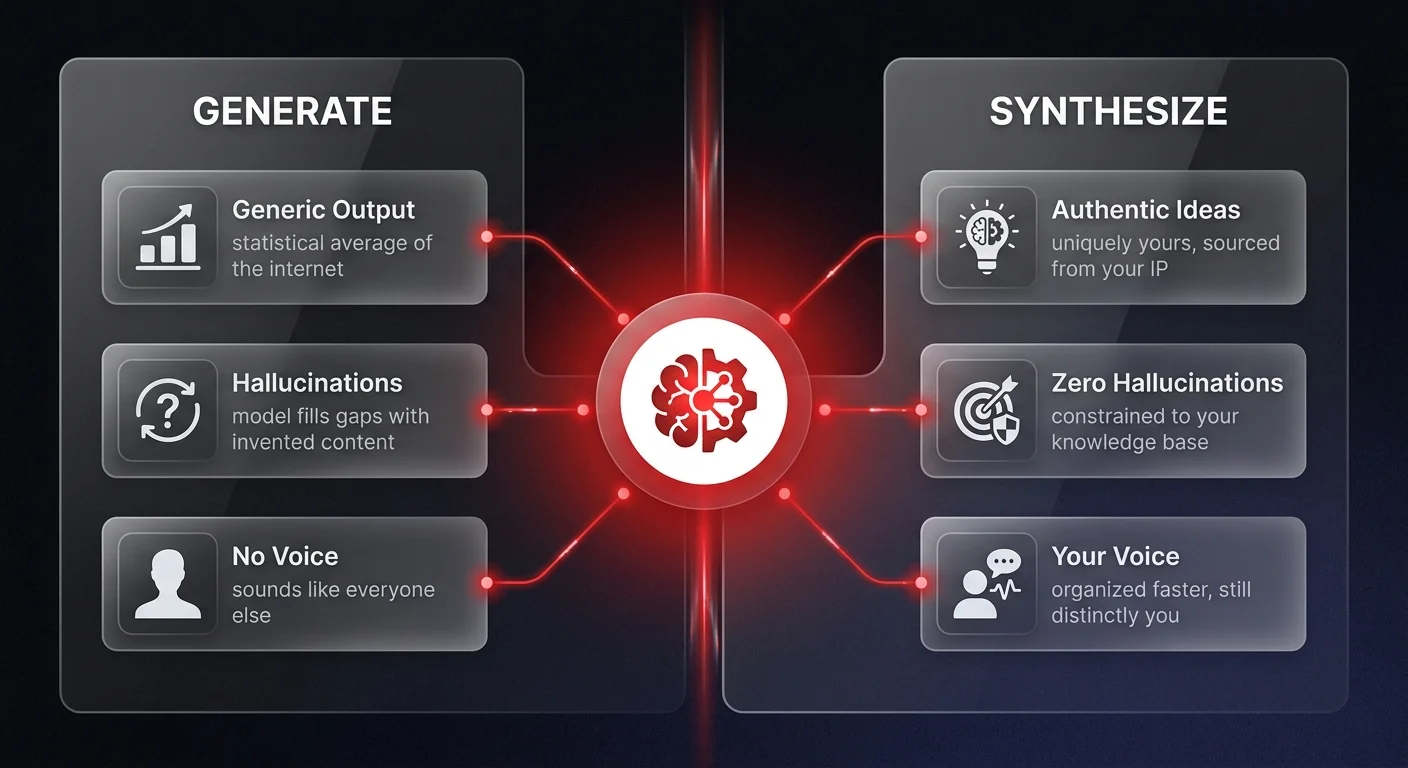
So I decided to flip the script. I built a system where I fed an AI agent every piece of content I've created over the years. I didn't ask it to invent new concepts. I explicitly told it: 'Do not contribute your own ideas unless asked. Your job is to structure my insights.'
This distinction is radical. By constraining the AI to my knowledge base, I eliminated hallucinations. When the model tries to be creative on its own, it drifts into fantasy. But when it acts as a synthesizer of my existing work, it becomes a high-signal amplifier. It takes an insight I wrote three years ago and connects it to a thought I had yesterday, creating something new but entirely authentic. This is how you own your voice in the age of automation. You don't let the machine drive; you make it the engine for your own intellect.
So how do you actually orchestrate this in practice?
So how do you actually orchestrate this in practice? It starts with building your own 'second brain' that the AI can access.
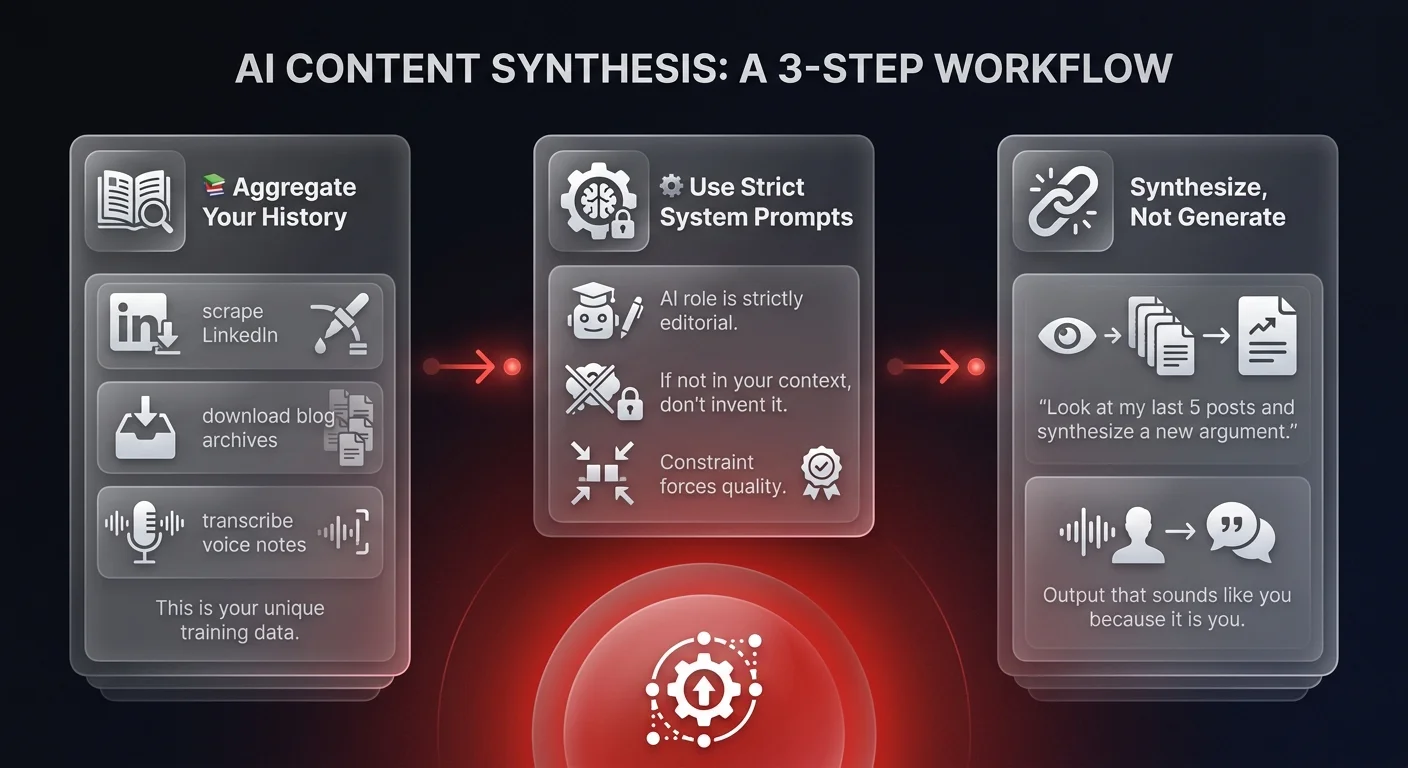
First, aggregate your history. Scrape your LinkedIn, download your blog archives, transcribe your voice notes. This is your training data. It's the only thing that separates you from the millions of other users hitting the same API endpoints.
Second, use strict system prompts. You need to be aggressive here. Tell the AI its role is strictly editorial and structural. If it doesn't find the answer in your provided context, it shouldn't make one up. This constraint forces quality. It turns the AI from a creative writer into a ruthless editor and logical architect.
Third, use this for synthesis, not just generation. Don't say 'write a post about AI agents.' Say 'Look at my last five posts about automation and synthesize a new argument about agentic workflows.' The result is content that sounds exactly like you because it is you — just organized faster, a pattern that underpins every AI marketing content system built on authentic thought leadership.
This is the future of thought leadership. We aren't competing to see who can prompt the best generic text. We are competing on who can best curate and amplify their unique human insight. The tools are there to orchestrate this today. Stop generating noise and start synthesizing signal.
Ready to stop drowning in generic content and start scaling your actual expertise? At Ability AI, we build agentic systems that amplify human intelligence rather than trying to replace it — see how we deployed a full AI content production pipeline that turns raw ideas into multi-channel output at scale. Let's talk about turning your intellectual property into a scalable engine.