
Hierarchical AI agent structure is an automation architecture that organizes AI agents into an org chart, with a top-level manager agent delegating tasks to specialized worker agents. Instead of relying on massive, complex prompts to one AI, this approach mirrors how effective teams work — each agent has a defined role, specific tools, and a clear chain of command, dramatically reducing hallucinations and improving output quality.
To get real work done, you need to stop thinking in terms of prompts and start thinking in terms of an org chart. Just like you wouldn't hire one person to be your CFO, CMO, and janitor simultaneously, you can't expect one AI agent to handle every aspect of your business. The game has changed. We're moving from 'chatting with AI' to managing a workforce.
Here's what I mean by an 'AI Org Chart'
Here's what I mean by an 'AI Org Chart.' In my own system, I don't interact with the workers directly. I have a top-level agent that functions exactly like a corporate manager. Its sole job? To control the agents on the bottom levels. It doesn't write code or draft emails itself. It's not doing the grunt work. Instead, it orchestrates the specialists who do.
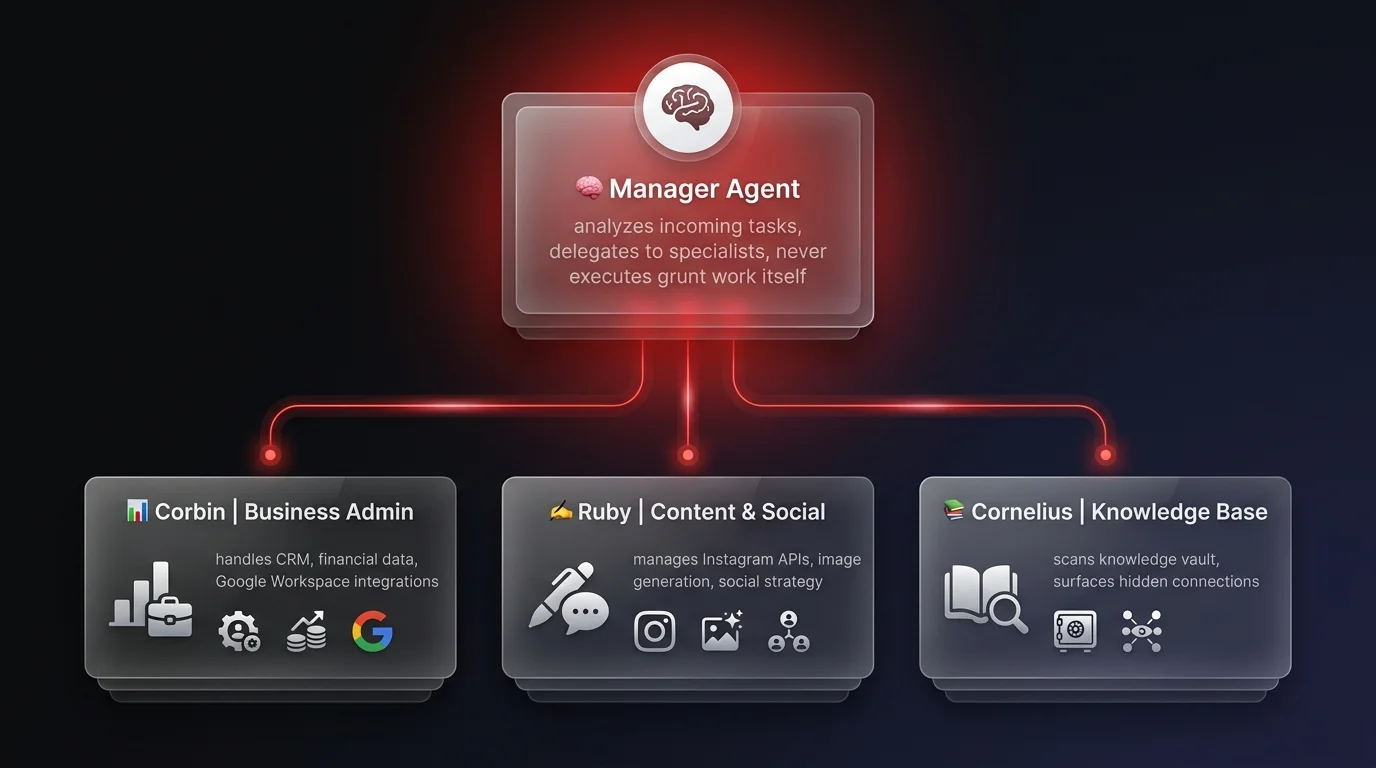
In my setup, I have specific agents with distinct personalities and responsibilities. There's 'Corbin,' who handles business and admin tasks. There's 'Ruby,' focused purely on content and social strategy. And there's 'Cornelius,' my knowledge base expert.
When a task comes in, the Manager agent analyzes it and delegates it to the right specialist. This is radical but necessary. By separating concerns, you allow each agent to have specialized memory and context. Corbin doesn't need to know about Instagram trends, and Ruby doesn't need access to my CRM financial data. This hierarchical structure prevents the context window pollution that kills performance in single-prompt systems. You are effectively amplifying the capability of each model by narrowing its focus. This is why multi-agent orchestration consistently outperforms single-prompt approaches at enterprise scale.
The secret sauce
The secret sauce making this orchestration possible is the Model Context Protocol (MCP). It's the infrastructure that lets us dynamically switch tools based on who is doing the work.
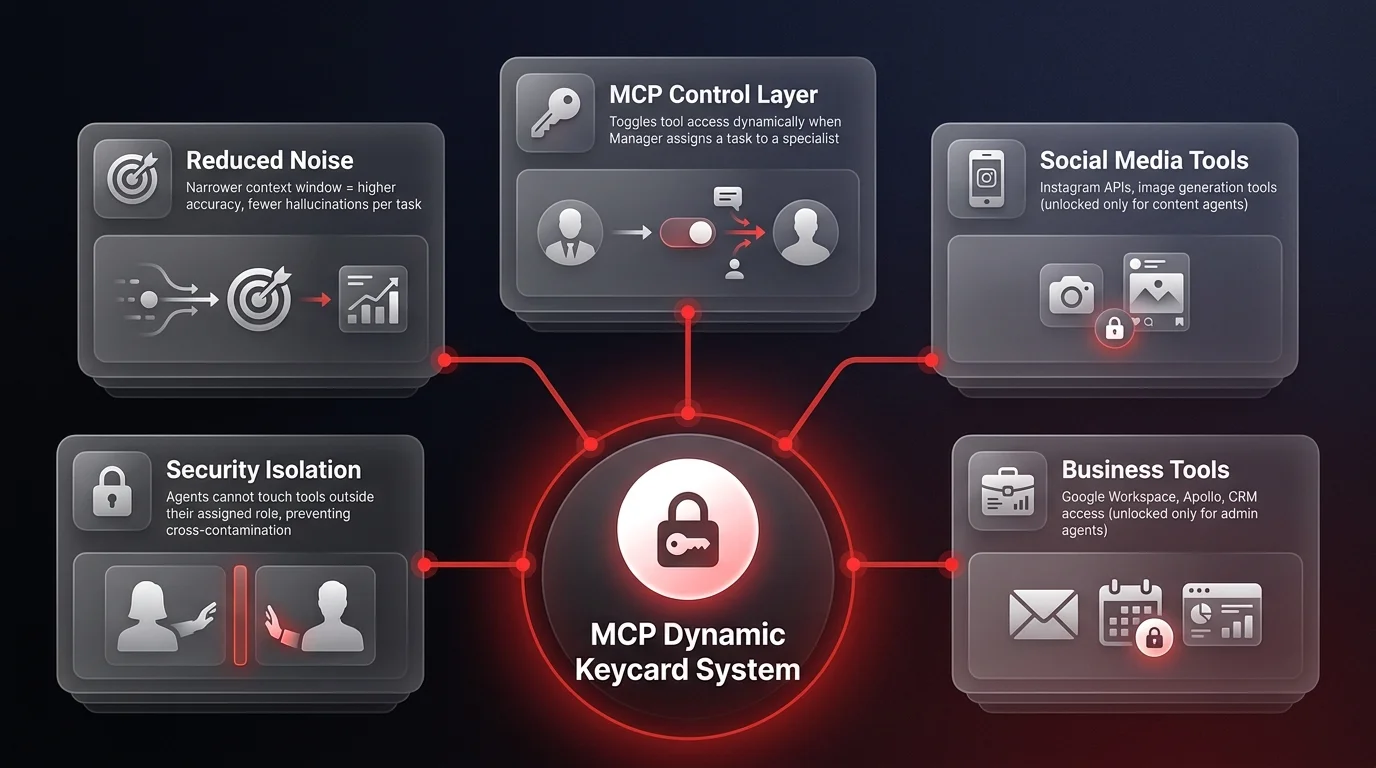
Think of it like handing out keycards in an office. Not everyone gets keys to the server room. In my workflow, I created an MCP management layer that toggles access dynamically. If the Manager assigns a task to Ruby for social media, the system flips a switch. Suddenly, Ruby has access to Instagram APIs and image generation tools. If the task goes to Corbin, those tools are locked away, and he gets access to Google Workspace, Apollo, and my Fibery CRM instead.
This does two things. First, it secures your system - agents can't break things they shouldn't touch. Second, and more importantly, it reduces semantic noise. We aren't confusing the model with tools it doesn't need.
The reality is that high-signal automation requires this level of architectural discipline. You aren't just prompting anymore; you are engineering a system where agents have clear roles, specific tools, and a chain of command. That is how you move from a cool demo to a production-grade workforce.
The era of the 'do-it-all' AI is over. If you want scalable results, you need to build a digital workforce, not just a digital assistant. At Ability AI, we help founders orchestrate these complex agent hierarchies to automate actual business operations. Ready to design your AI org chart? Let's get to work.