
An autonomous second brain is an AI agent system that actively scans your knowledge base in the background, identifying hidden connections between concepts without waiting for a query. Unlike passive note-taking apps where information sits until manually retrieved, this approach treats your knowledge vault as a living dataset — with agents continuously mining thousands of notes to surface contradictions, patterns, and strategic links you would never find on your own.
I call my agent 'Cornelius'
I call my agent 'Cornelius.' Unlike a standard database that waits for a query, Cornelius is relentless. I have over 2,000 nodes in my Obsidian vault - a chaotic mix of unstructured thoughts, meeting notes, and half-baked ideas. A human brain can't hold all that context at once. But an agent can.
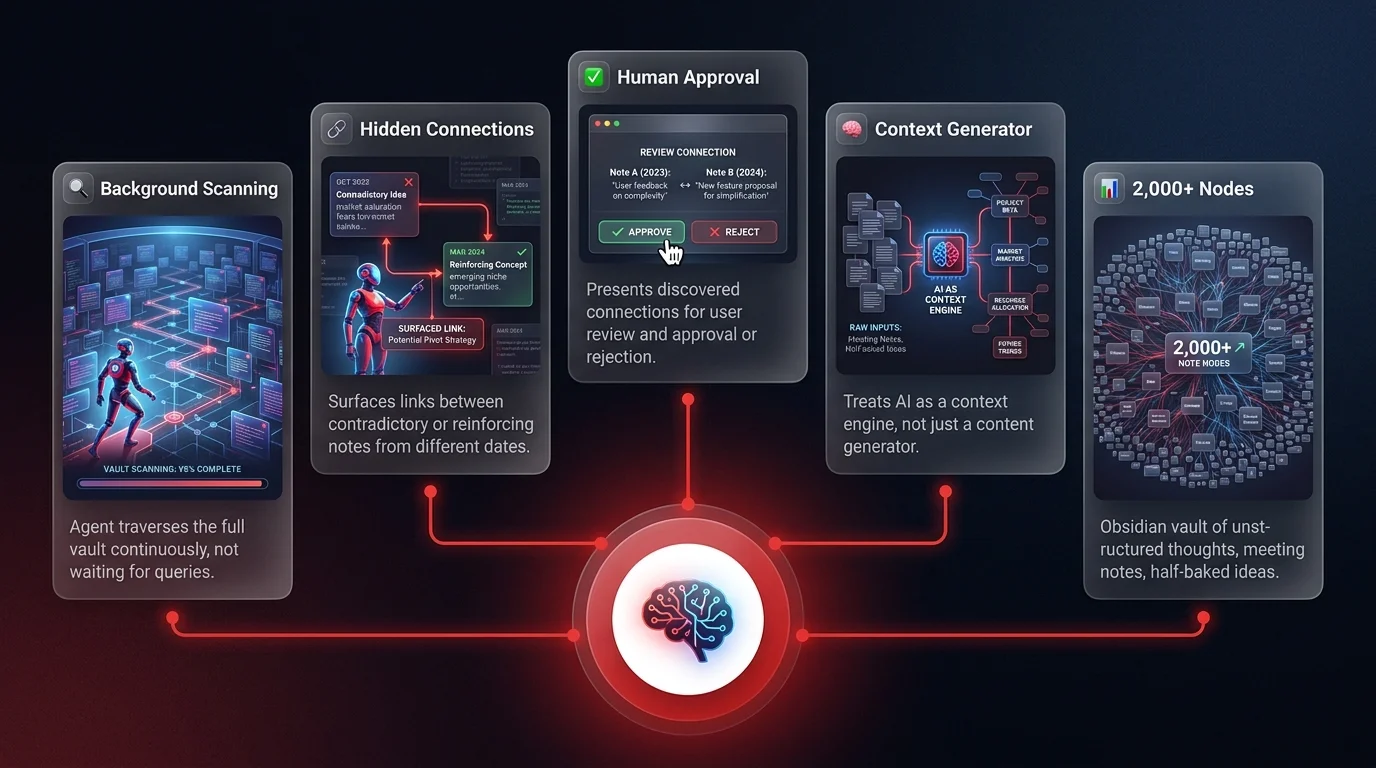
Here's the shift - instead of me searching for a specific note, Cornelius runs background processes to scan the entire knowledge base. It's looking for hidden links between disconnected concepts. It presents them to me - 'Hey, this thought from three months ago contradicts what you wrote today,' or 'This strategy aligns perfectly with that user feedback from last year.'
This is radical. It's basically agentic scanning for hidden and obvious connections. It presents them to me, and I simply approve or disapprove. It's like mining knowledge from within your own archives. Most people treat AI as a content generator. I treat it as a context generator. The value isn't in the notes I take anymore - it's in the synthesis the AI performs when I'm not even looking. This turns your 'Second Brain' from a static archive into a living, breathing engine of insight.
So how do you actually build this?
So how do you actually build this? You can't just slap a vector store on a pile of files and call it a day. That's the old way. To get true autonomous connection, you need a hybrid approach. We're talking about combining a predictor model with graph databases — the same infrastructure pattern behind enterprise AI knowledge automation. You need an index that mirrors your folder structure but allows for semantic fluidity.
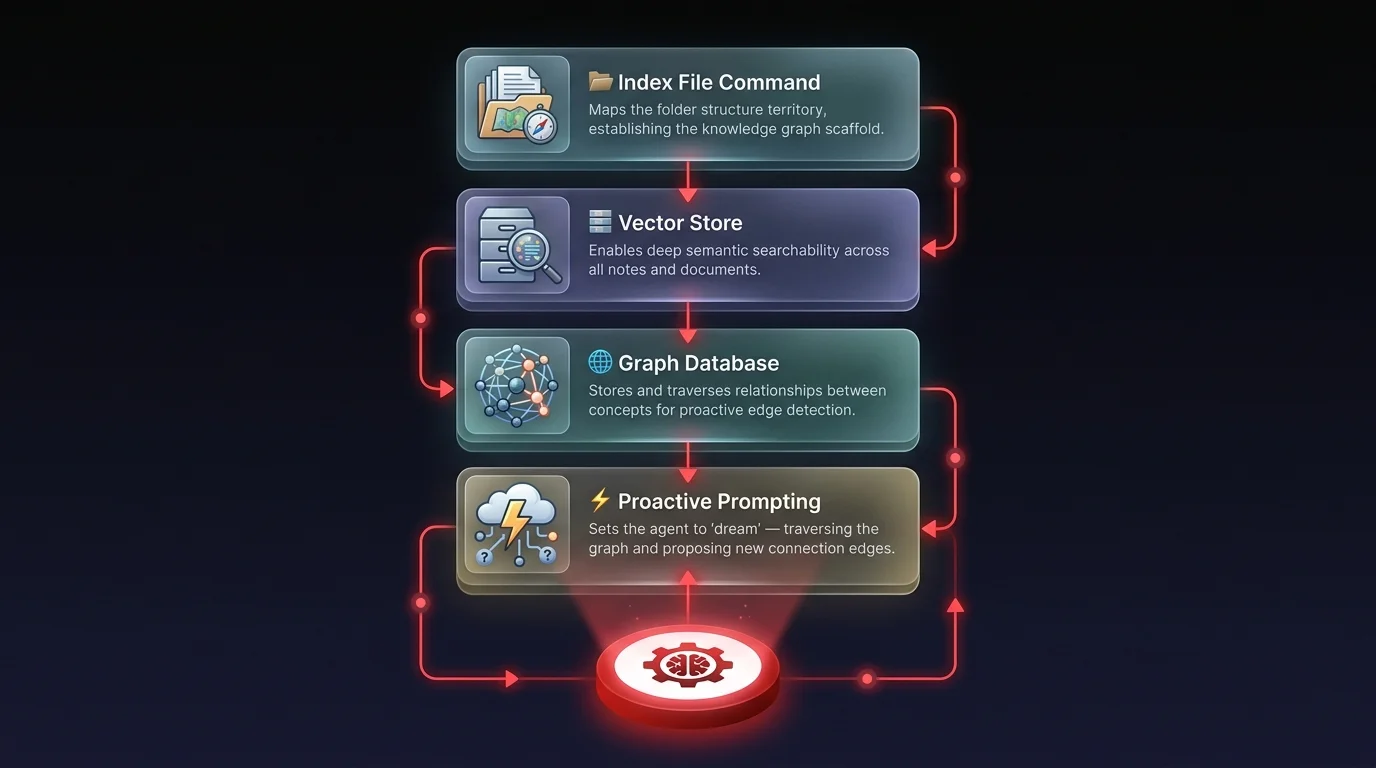
Technically, Cornelius uses an index file command to map the territory, then applies a Vector Store for deep searchability. But the magic is in the proactive prompting. You don't wait to ask questions. You set the agent to 'dream' - to traverse the graph and propose edges.
This changes your role completely. You stop being a librarian organizing files and start being an editor of connections. You're not managing information - you're managing insights. The goal is to take unstructured, disconnected information and orchestrate it into a cohesive map. If your AI strategy is just 'chatting with a bot,' you're missing the point. The real power is in agents that work asynchronously to amplify your thinking. Stop building archives. Start building a system that thinks with you.
Ready to stop hoarding data and start generating insight? At Ability AI, we build autonomous agent systems that turn passive information into active business value. Whether it's internal knowledge bases or complex automation, we help you orchestrate the chaos. Let's talk about how to build a Second Brain that actually works for you.