

Human-in-the-loop content automation is a workflow design where AI agents handle research, drafting, and formatting while humans retain approval authority at every publishing decision — combining AI scale with human judgment. Unlike fully automated pipelines that post directly to social media, curated automation introduces a review queue where leaders approve, redirect, or kill individual drafts, maintaining brand quality while dramatically reducing time spent creating content from scratch. Total automation is a risk, but curated automation? That is an absolute superpower.
Curated automation
Here's what I mean by curated automation. When we build AI content pipelines at Ability AI, we don't just wire a text generator directly to a social media API. That is how you get hallucinations and generic drivel posted to your personal brand. Instead, we orchestrate a middleware layer - a 'human-in-the-loop' interface.
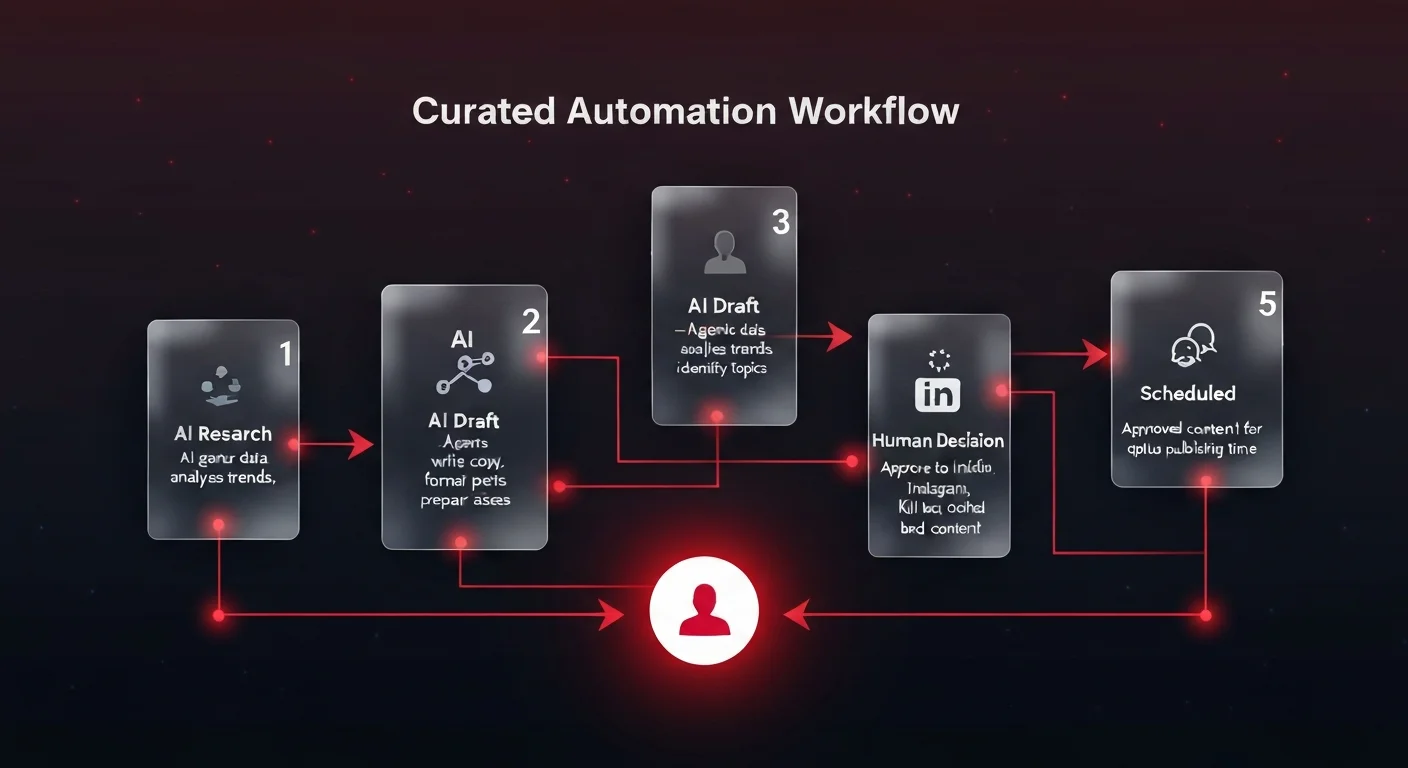
In my own workflow, this looks like a simple, somewhat ugly web interface. It doesn't need to be polished UI; it just needs to be functional. My AI agents do the heavy lifting of research, drafting, and formatting. They present me with options. But then, the system pauses. It asks for my sign-off.
This is where the magic happens. I log in and see a queue of potential posts. I might look at three drafts. I see 'Post 1' is dense and insightful - perfect for LinkedIn. 'Post 2' has great visuals - I'll route that to Instagram. 'Post 3' misses the mark entirely - I kill it immediately. This granular control allows me to act as a strategist rather than a copywriter. I spend my time approving and refining, not staring at a blinking cursor. The workflow shifts from Generation-to-Posting to Generation-to-Review-to-Scheduling. That middle step is the difference between spam and thought leadership.
The director mindset
So, how do you implement this radical shift? You need to stop thinking about AI as a replacement for your judgment and start treating it as an amplifier of your intent.
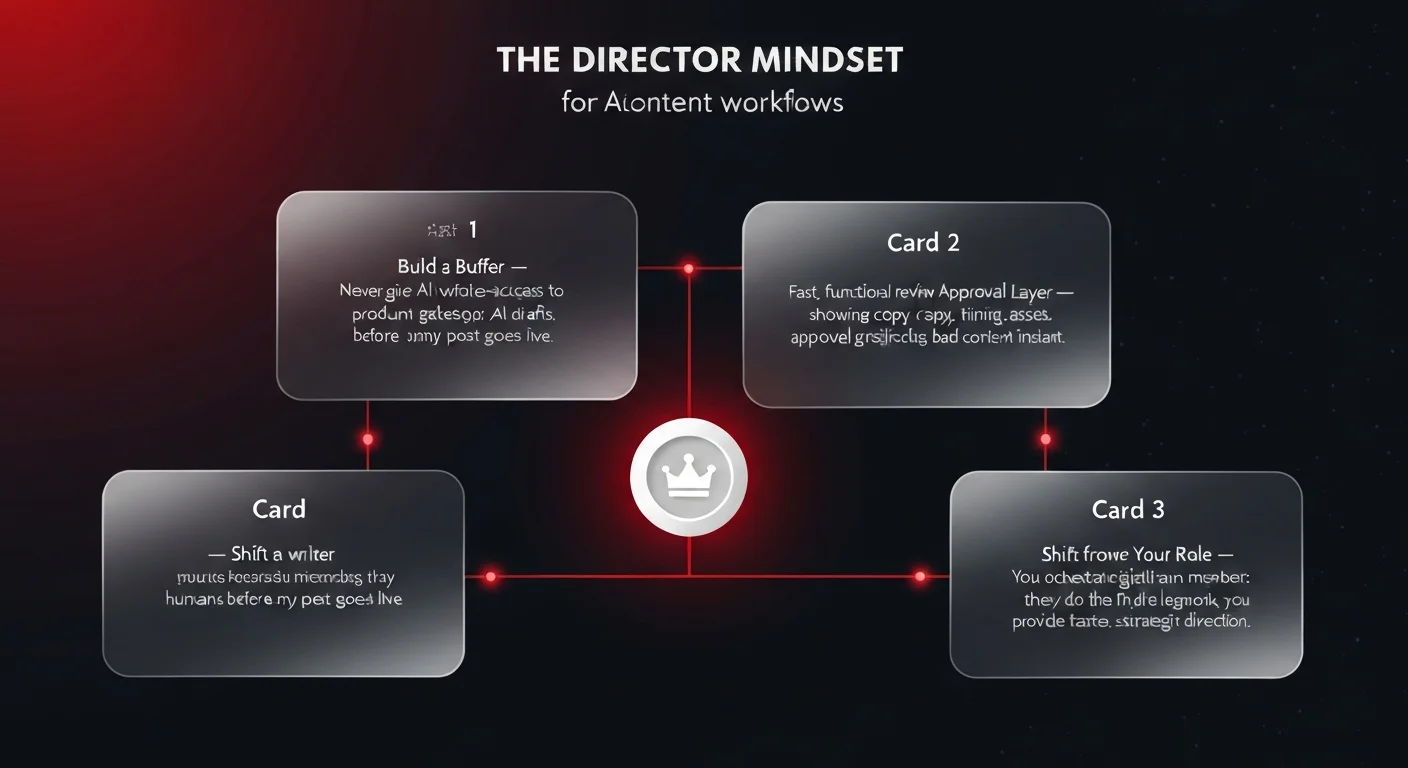
First, build a buffer into your stack. Never allow an LLM to have write-access to your production environment without a gatekeeper. Your automation should notify you when drafts are ready, not post them automatically.
Second, focus on the user experience of your approval layer. It should give you a quick overview of the copy, the timing, and the assets. It should be easy to say 'yes' to the good stuff and 'no' to the bad. I can send specific carousel images to one platform while keeping the text for another. That is ownership.
Third, recognize that your role has evolved. The game has changed from 'how much can I write' to 'how well can I curate.' You are orchestrating a team of digital interns. They do the legwork; you provide the taste. This approach scales your presence without diluting your quality. It allows you to maintain a high-signal presence across multiple channels without burning out. That is how you win with AI - not by checking out, but by checking in at the right moments.
Building a high-performance content engine
Ready to stop shouting into the void and start building a high-performance content engine? See how we built an end-to-end AI content system for a real client, or let's talk about how to design a human-in-the-loop workflow that puts you back in control of your narrative.