
The internal AI engineer trap is the pattern of assigning a single generalist engineer to build production-grade AI — and watching it fail once it moves beyond prototype. Most companies find their smartest IT engineer and tell them to 'go figure out AI,' assuming it's a coding problem. It's not. Production agentic systems require complex orchestration of business logic and systems engineering — a combination that most individual engineers can't deliver alone, no matter how talented they are.
The smart engineer strategy backfires
Here's the hard truth about why the 'smart engineer' strategy backfires. When you ask a generalist engineer to build an AI agent, they approach it like a software problem. They write scripts, they connect APIs, and they get a prototype working. But an agentic system isn't just software - it's a digital employee that needs to navigate complex workflows.
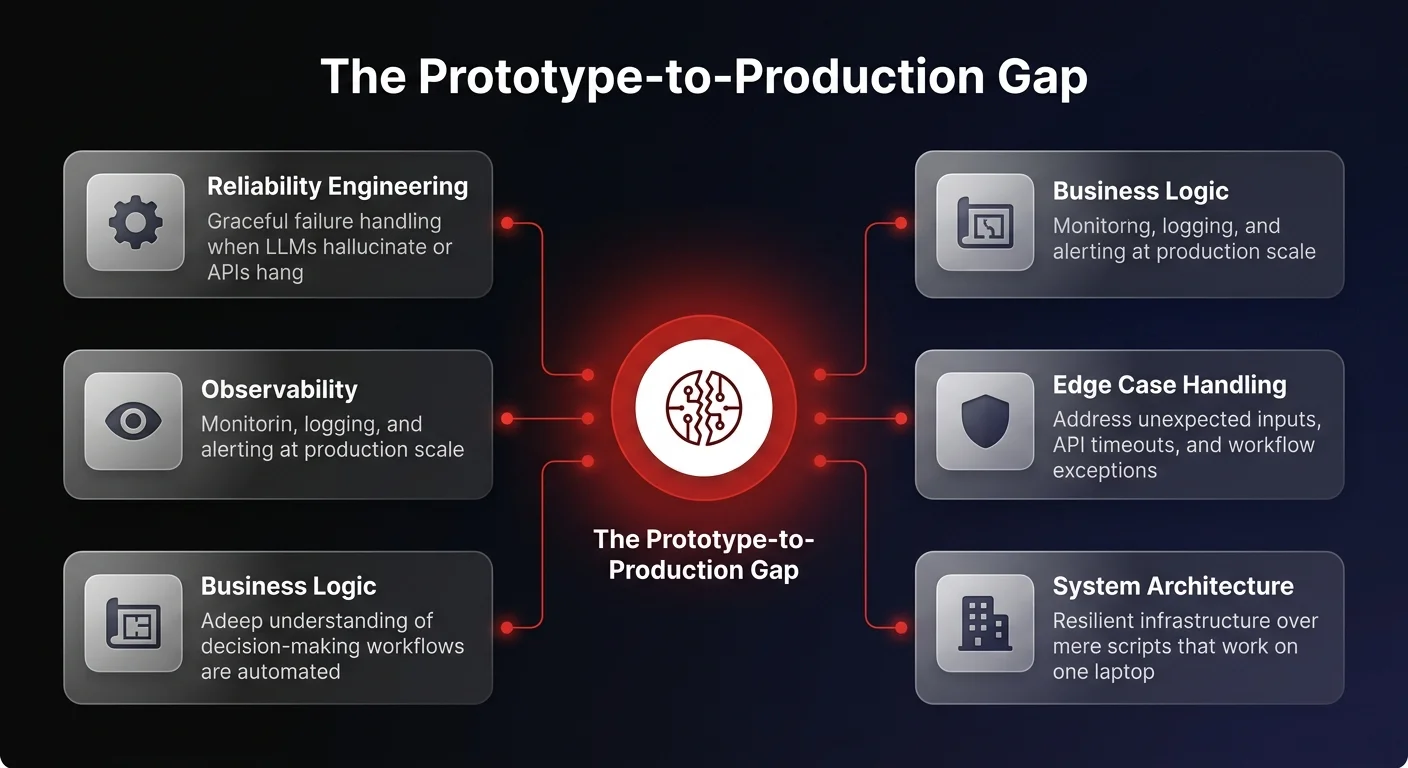
In order to implement agentic systems that actually deliver value, you need to understand how business processes work deeply. It's not enough to just be an engineer. You need to be a business architect — understanding the nuances of the decision-making process you're trying to automate, which is why specialized AI operations automation teams consistently outperform solo internal pilots.
The gap becomes obvious the moment you move from prototype to production. A script works on a laptop. A production agent needs reliability, observability, and backups. It needs to handle edge cases where the LLM hallucinates or the API hangs. Most internal pilots crash because they lack this infrastructure. They are built as features, not as resilient systems. The engineer is left trying to patch holes in a dam that's already breaking, because the scope of the project was underestimated from day one.
The right approach
So how do you fix this? You have to stop treating AI implementation as a hobbyist experiment and start treating it as a serious engineering discipline. The game has changed. We aren't just writing code anymore; we are orchestrating outcomes.
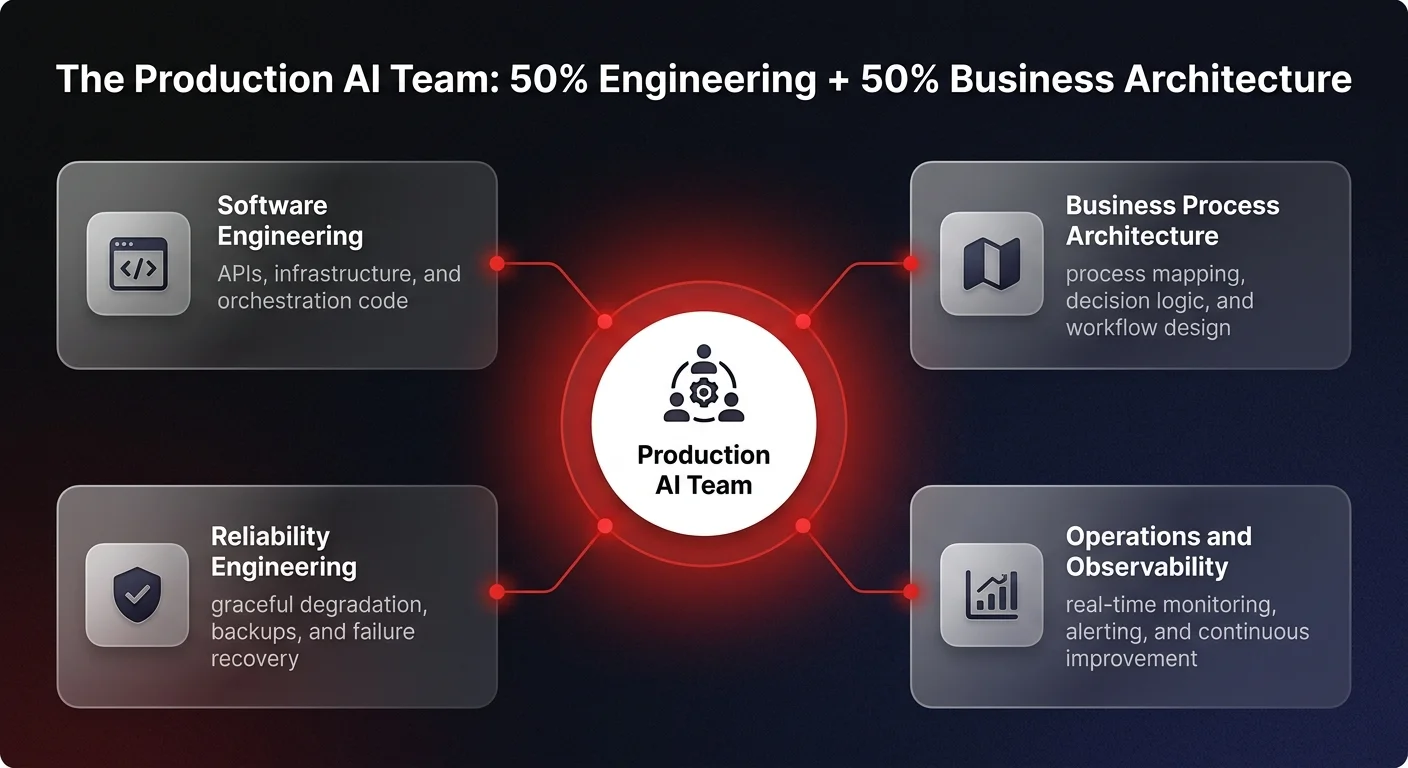
If you want to own this transition, you need a multi-disciplinary approach. You need people who understand the 'stack' not just in terms of Python and databases, but in terms of business logic and process mapping. You need reliability engineering to ensure that when the agent fails - and it will - it fails gracefully without bringing down your operation.
Don't just assign this to an individual and hope for the best. That's setting them up for failure. Instead, build a team or partner with experts who understand that agentic AI is 50% engineering and 50% business process architecture. Amplify your internal talent by giving them the right context and resources, or bring in external partners who have already solved the reliability puzzle — a pattern we evaluate during every AI readiness assessment. The stakes are too high for amateur hour.
Building systems that work
Building reliable AI agents is an existential challenge for modern business. At Ability AI, we don't just write scripts - we build the robust infrastructure required to run agentic systems at scale. Stop relying on hobbyist experiments. If you're ready to move beyond broken pilots and build systems that actually work, let's talk.