

Market shifts are filter mechanisms that separate structured, professional operators from reactive amateurs—creating significant opportunities for those who prepare in advance. Every tax reform or market correction accelerates a transfer of assets from unprepared operators to professional ones. In real estate, the UK's Section 24—which eliminated mortgage interest relief—crushed highly leveraged amateur landlords, flooding the market with distressed inventory that business-oriented investors could acquire at a discount. The question isn't 'how do I survive this?' The question is 'how do I capitalize on the amateurs leaving the field?'
The filter effect
Let's break down what's actually happening. For decades, the 'landlord' game was easy. You bought a property in your personal name, rented it out, and watched the value go up. You didn't need a strategy. You didn't need a structure. You just needed credit.
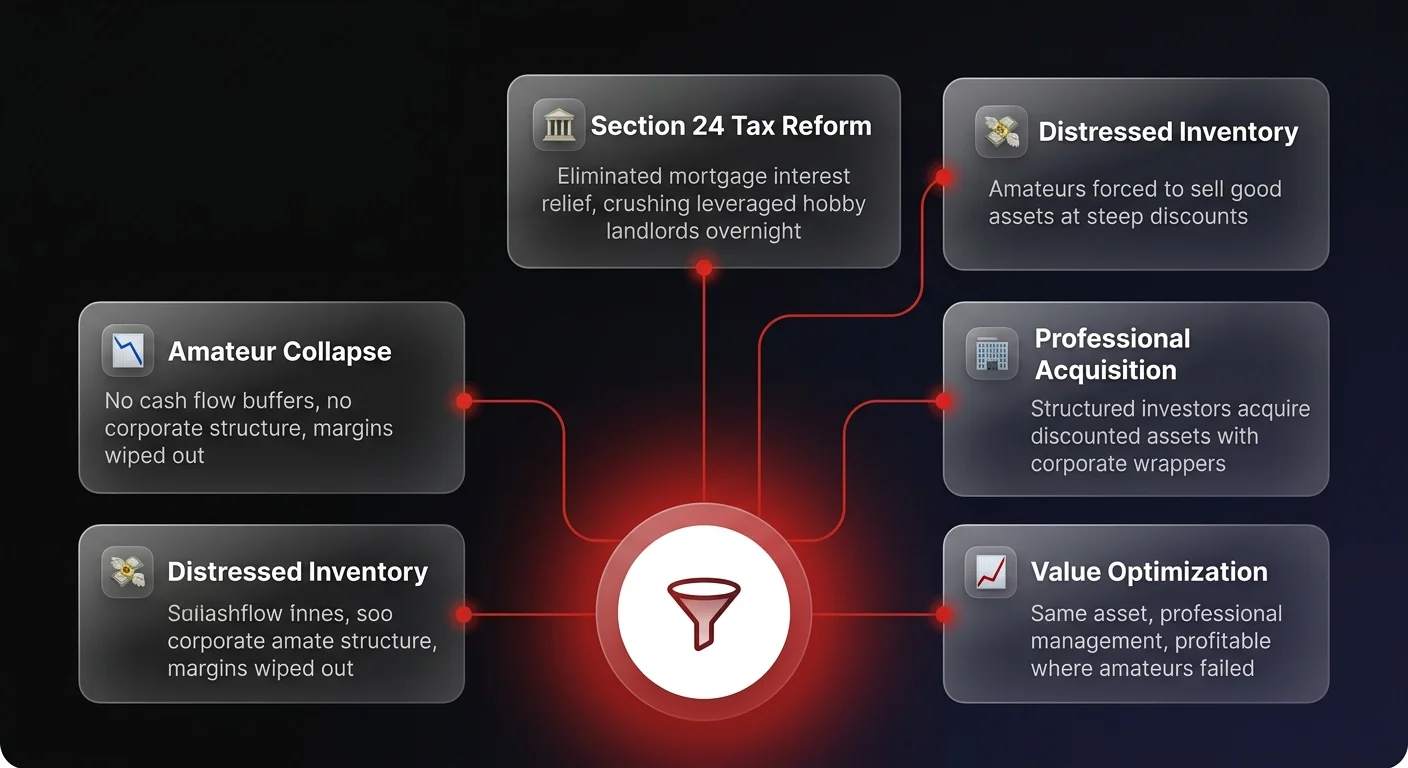
But then the government flipped the script with Section 24. Suddenly, you couldn't deduct mortgage interest from your income. For the people who treated this as a casual hobby - the 'dinner party landlords' with one or two units - this was an existential threat. It killed their margins overnight. They were forced to sell because they hadn't built a business; they had just accumulated assets.
I see this pattern everywhere, but it's brutal in property. You have people who have held assets for years, thinking they were geniuses because the market went up. But when the tide went out with the tax reforms, we saw who was swimming naked. They didn't have the cash flow buffers. They didn't have the corporate wrapper to mitigate the tax hit. They were exposed.
And here is the opportunity. There is now a critical mass of distressed inventory hitting the market - not because the properties are bad, but because the owners are incompetent. As an educated investor, you can pick up these assets at a discount. You can bring them into a proper corporate structure, optimize the operations, and turn a profit where the previous owner saw a loss. It's the same asset, just managed by a professional instead of a hobbyist.
This principle extends far beyond real estate
This principle extends far beyond real estate. It's about the fundamental difference between owning a job and owning a business.
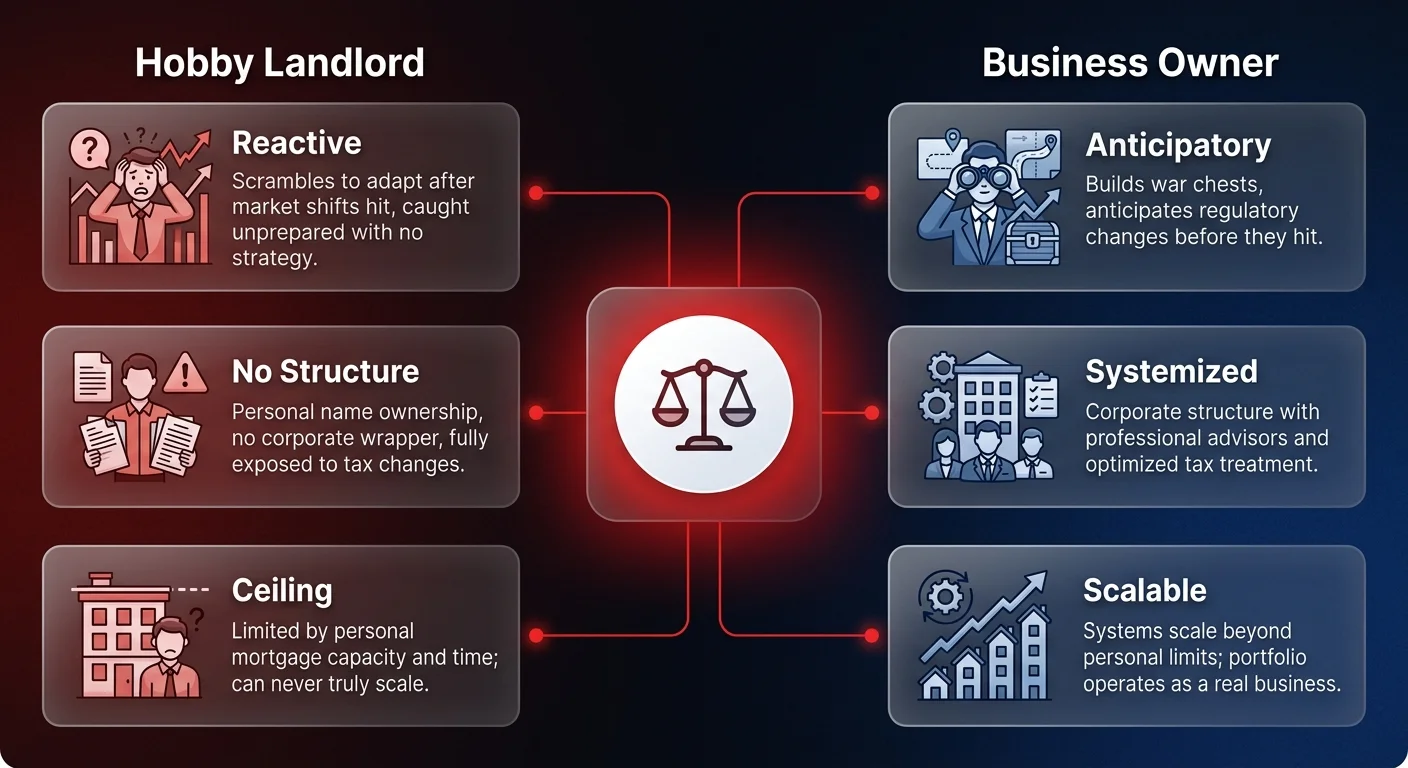
The people getting wiped out right now are the ones who refused to adapt. They clung to the status quo because it was comfortable. They didn't educate themselves on the regulatory environment. They didn't professionalize their operations. And now, they're paying the price.
This isn't just about survival; it's about dominance. When you professionalize your approach, you amplify your ability to scale. The hobbyist hits a ceiling - they run out of personal mortgage capacity, or they run out of time to manage tenants. The business owner, however, builds systems that scale.
Think about it. If you treat your portfolio like a real company, you're not just reacting to tax laws; you're anticipating them. You're building a war chest. You're surrounding yourself with experts - accountants, planners, brokers - who help you navigate the landscape.
The transition from 'landlord' to 'business owner' is radical. It requires you to stop working in the portfolio and start working on the business structure. It means letting go of the ego that says 'I can do it all myself' and embracing the leverage of proper systems and legal entities.
The question isn't whether the market will change again - it will. The question is, will you be the one selling in a panic, or the one buying with confidence?
This same 'adapt or die' dynamic is happening in business operations. Just as tax reforms crush unprepared landlords, the AI revolution is crushing businesses that refuse to modernize. You need a professional structure to handle the new speed of business. At Ability AI, we orchestrate the AI agent workforce that turns your chaotic operations into a scalable machine. Don't be the hobbyist. Let's build your business for the future.