
The Smart Integrator is a business layer that orchestrates multiple specialized AI models rather than betting on a single vendor—treating AI as a fluid ecosystem rather than a static software purchase. The AI landscape has fragmented into hyper-specialized tools: Claude for coding, Gemini for multimodal tasks, OpenAI for general reasoning. The companies winning this next phase won't have the biggest GPU clusters—they'll be the ones who most effectively weave together different strands of intelligence to solve specific business problems.
For enterprises, this fragmentation is a nightmare to manage. But for the agile, it's a massive opportunity. We are witnessing the birth of a new business layer - the 'Smart Integrator.' This isn't about building models. It's about orchestrating them. If you're still betting on a single vendor to solve all your problems, you're already behind.
Let's break down what's actually happening
Let's break down what's actually happening in the market. The days of a single dominant model ruling them all are over. Instead, we're seeing radical specialization. You want rock-solid code? You go to Claude. You need complex multimodal analysis? Gemini might be your best bet. You need general reasoning? OpenAI is still a contender.
This fragmentation creates a massive complexity gap. Most large enterprises simply cannot move fast enough to navigate this. They are stuck in procurement cycles while the technology shifts under their feet. They treat AI like a static software purchase, but the reality is that AI is a fluid, evolving ecosystem.
This is where the 'Smart Integrator' enters the picture.
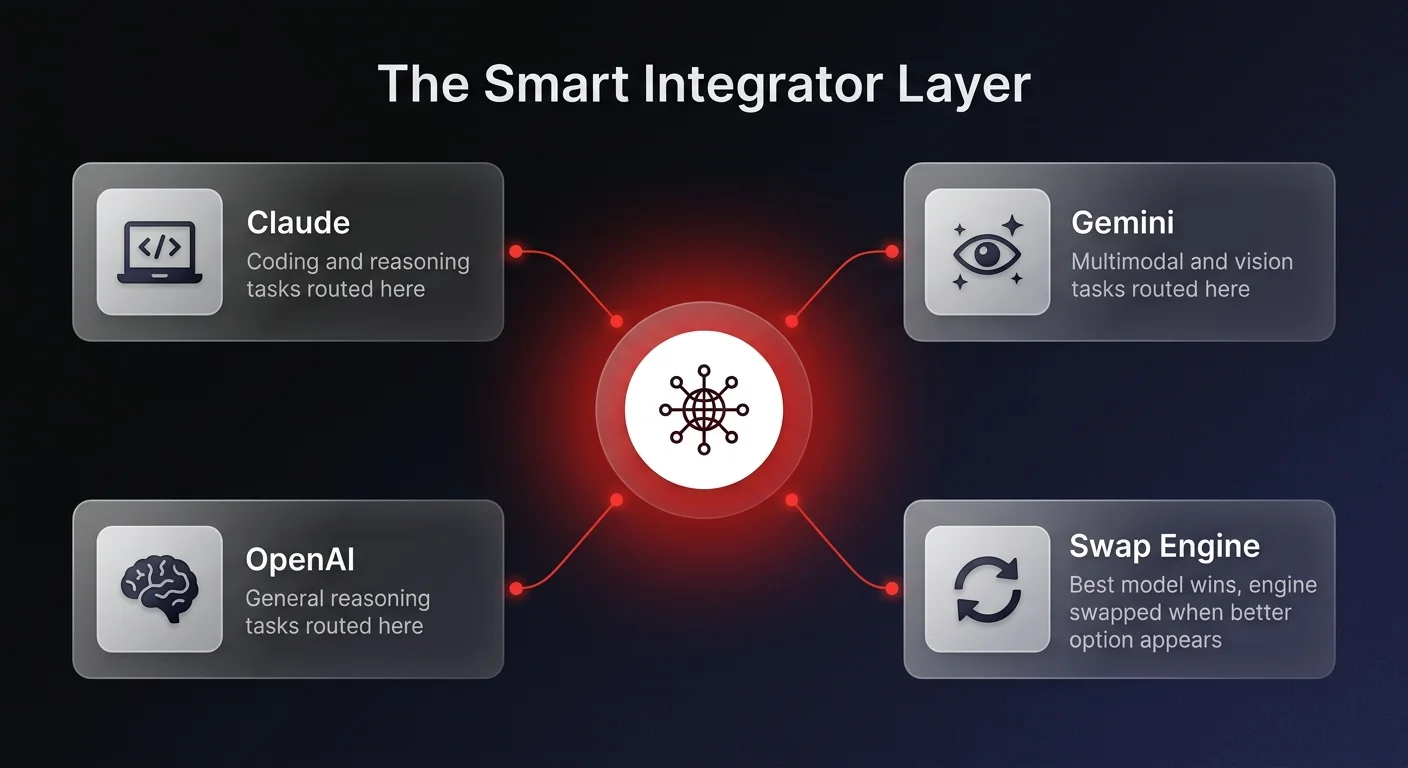
Think of the Smart Integrator not as a vendor, but as an orchestration layer. They don't care which model is 'winning' the benchmark wars this week. They care about effectiveness. They build flexible architectures that allow them to swap engines in and out as needed. If a feature in one model degrades or becomes too expensive, they just switch it off and switch on the superior alternative.
It's a high-signal approach to system architecture. Instead of locking yourself into a single ecosystem that might drift into obsolescence or hallucination, the Smart Integrator maintains a 'multi-cloud' approach to intelligence. They curate the best tools for specific jobs and stitch them into a cohesive workflow. This is the new competitive advantage - agility over raw power.
So what does this mean for your business strategy?
So what does this mean for your business strategy? It means you need to stop acting like a consumer of AI and start acting like an orchestrator.
The winners in this next phase won't be the companies with the biggest GPU clusters. They will be the ones who can most effectively weave together different strands of intelligence to solve actual business problems.
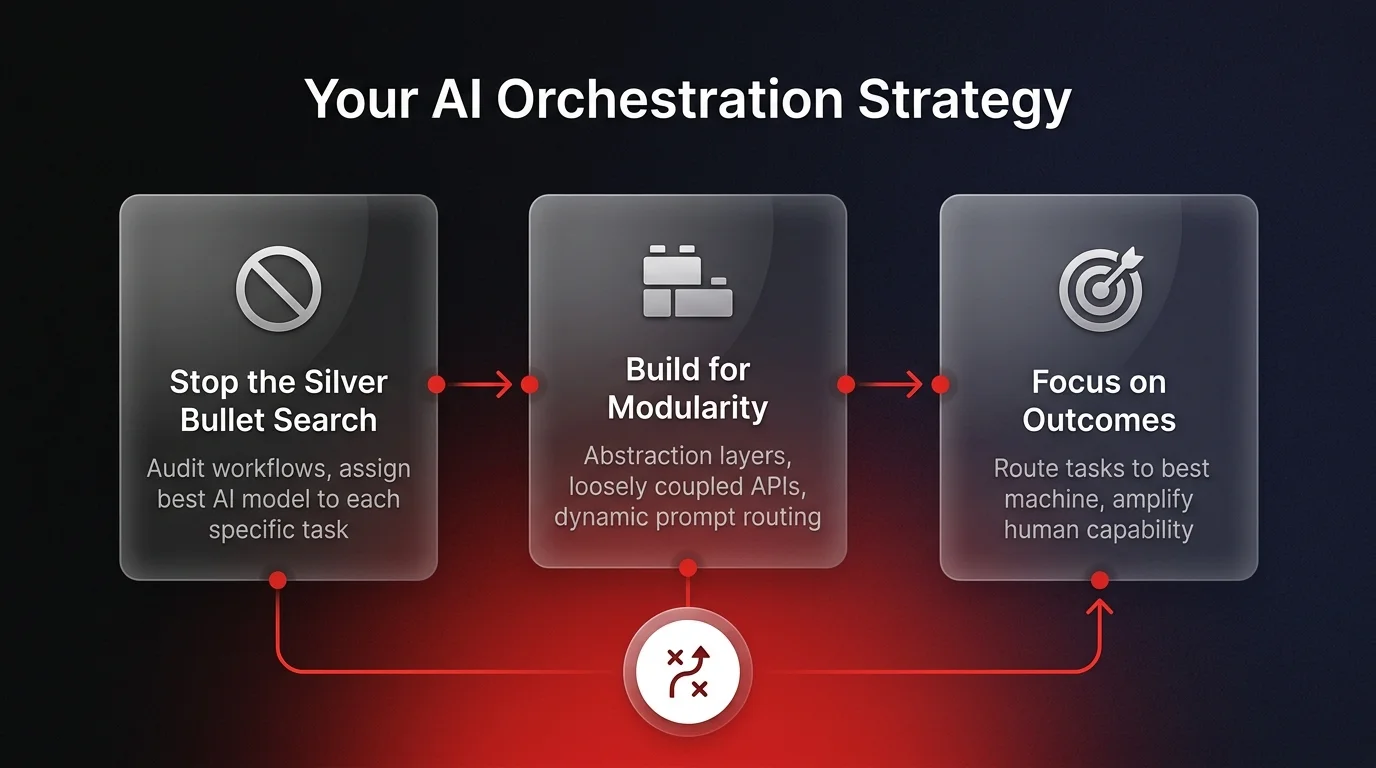
Here is what you need to do. First, stop looking for a silver bullet model. Embrace the fragmentation. Audit your operations workflows and identify which specific model excels at each step. Maybe you use a small, fast model for initial triage and a large, reasoning-heavy model for final decision-making.
Second, build for modularity. Your AI stack needs to be loosely coupled. If you hard-code dependencies on a specific API version from a specific vendor, you are building technical debt from day one. You need an abstraction layer that lets you route prompts dynamically.
Finally, focus on the outcome, not the tool. The Smart Integrator brings value by understanding the business logic, not just the transformer architecture. The goal is to amplify human capability by routing tasks to the machine best suited to handle them.
The reality is simple. You can either drown in the complexity of managing ten different vendor relationships and API changes, or you can build a layer of intelligence that sits above the chaos. That's what ownership looks like in the age of specialized AI.
The era of the Smart Integrator isn't coming - it's already here. At Ability AI, we don't just use AI; we orchestrate it. We help businesses navigate this fragmented landscape to build secure, high-performance AI agent systems. Stop guessing which model to pick and start building a system that uses them all. Let's talk about orchestrating your future.