

Modular AI agent architecture is the practice of separating an AI agent's reasoning engine from its knowledge base, allowing each component to be swapped independently for different tasks. Unlike monolithic agents that bundle logic and data into a single system, this approach treats domain knowledge as an interchangeable 'cartridge' — dramatically reducing rebuild time when switching between specialized functions like coding, research, or content creation.
This is the core philosophy behind Project Cornelius. We aren't just building a better agent. We're building a modular architecture where the brain is just a swappable cartridge. It's time to stop building one-size-fits-all bots and start orchestrating specialized intelligence.
Here's what I mean by modular architecture
Here's what I mean by modular architecture. In the standard setup, your agent's logic and its knowledge are tightly coupled. If you want to change the domain expertise, you often have to rebuild or heavily re-prompt the system. That's inefficient and frankly, it doesn't scale.
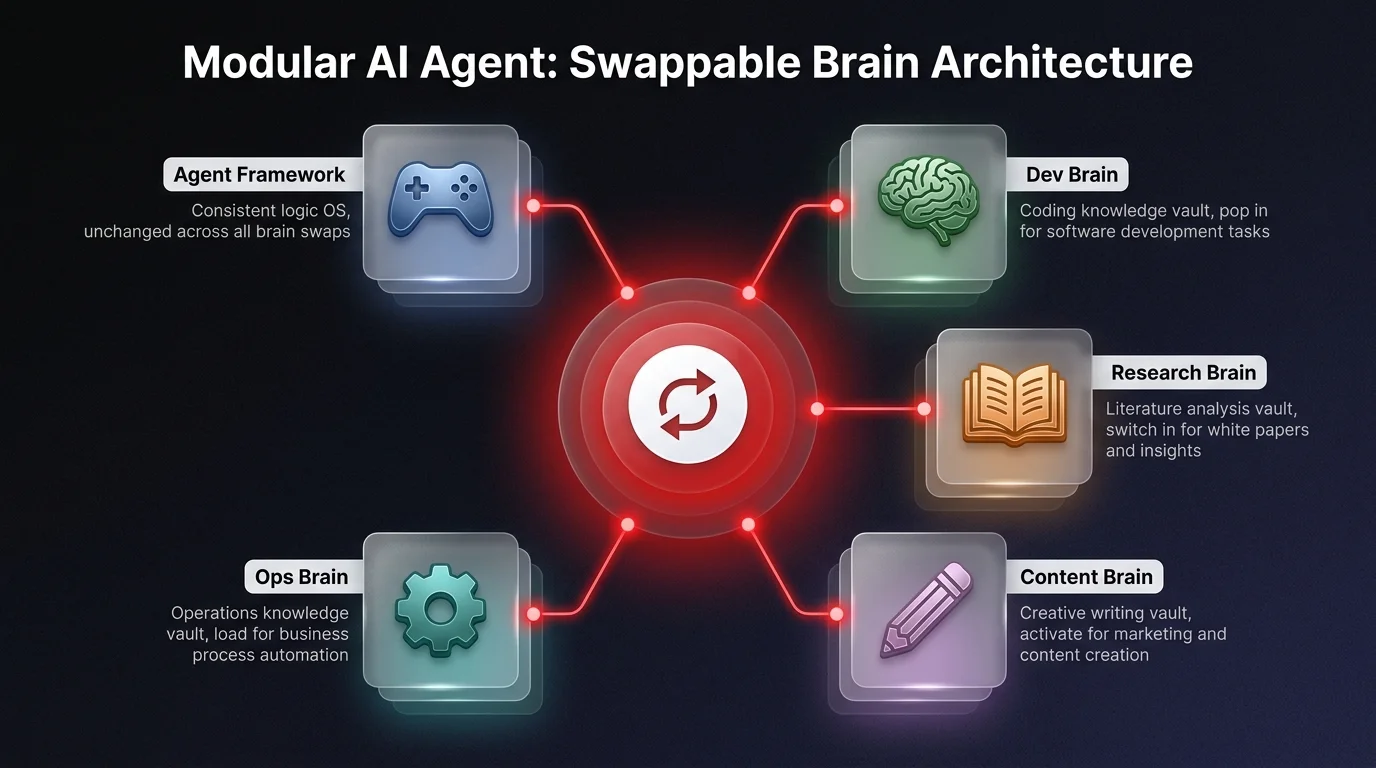
Project Cornelius flips the script. We keep the agent logic - the Claude Code project - completely separate from the 'brains'. The logic acts as a template, a consistent operating system that knows how to think and process tasks. The brains? Those are just Obsidian vaults sitting on your local drive.
The idea of this infrastructural project is that now we can not just have one brain within that, but we can manage multiple brains and switch between them. Think of it like a video game console. The console is your agent framework - it handles the processing, the inputs, and the outputs. The game cartridges are your Obsidian vaults. You want to code? Pop in the 'Dev Brain'. You need to write a white paper? Switch to the 'Research Brain'. The logic remains exactly the same, but the capability shifts instantly.
This is radical because it solves the context window problem by design. Instead of forcing one agent to hold every piece of information you've ever collected, you scope the knowledge to the specific task at hand. You amplify the agent's performance by narrowing its focus.
Let me give you a concrete example
Let me give you a concrete example of how I use this. I needed an agent specifically for high-level content creation and brainstorming. Instead of trying to force my coding assistant to understand nuanced literature, I simply pointed the system to a different folder. I trained a separate brain on a specific set of literature to extract insights.
Technically, this is incredibly lightweight. You have a single cloned GitHub repository for the logic. The brains can be located anywhere on your file system. To switch contexts, you just change a file path in 'settings.md' or use the 'switch_brain' command. That's it. The agent disconnects from one knowledge base and reconnects to another.
This matters because it allows you to orchestrate complex workflows without code bloat. You can have ten different specialists - legal, creative, technical, operational - all running on the same core framework. The game has changed from 'how smart is your model' to 'how organized is your knowledge'. If you can structure your Obsidian vaults effectively, you can build an army of specialized agents that outperform any generalist model — the same principle behind enterprise-grade autonomous agent systems.
Ownership here is key. You own the logic, and more importantly, you own the distinct 'brains' that drive it. That is how you build a defensible AI strategy.
The future belongs to modular systems, not monolithic ones. You need to stop building rigid tools and start orchestrating flexible stacks. At Ability AI, we help businesses implement these exact kinds of agentic architectures, from modular knowledge systems to full operations automation. Ready to build a system that grows with you? Let's talk about how to structure your AI for real ownership.