
A containerized AI agent environment packages the AI agent, project files, and database together within a single Docker image, giving the agent full ownership of its execution context. Unlike standard coding copilots that have no real awareness of the broader system, a containerized agent can autonomously spin up databases, migrate schemas, and refactor code within its isolated sandbox. This fusion of controller and controlled is a fundamentally different — and more powerful — model of AI-assisted development.
I've been experimenting with this approach in depth: containerizing the AI agent, the project files, and the database within a single, isolated Docker image. It's not just a tool assisting the project; the agent is the environment. This fusion provides a level of control and replicability that standard copilot setups can't touch.
We are witnessing the birth of a new methodology
We are witnessing the birth of a new methodology - think of it as Agile for AI agents. When I built the 'Luminous' coaching platform recently, I didn't just open an IDE and start typing. I orchestrated a container where the agent and the application were fused together.
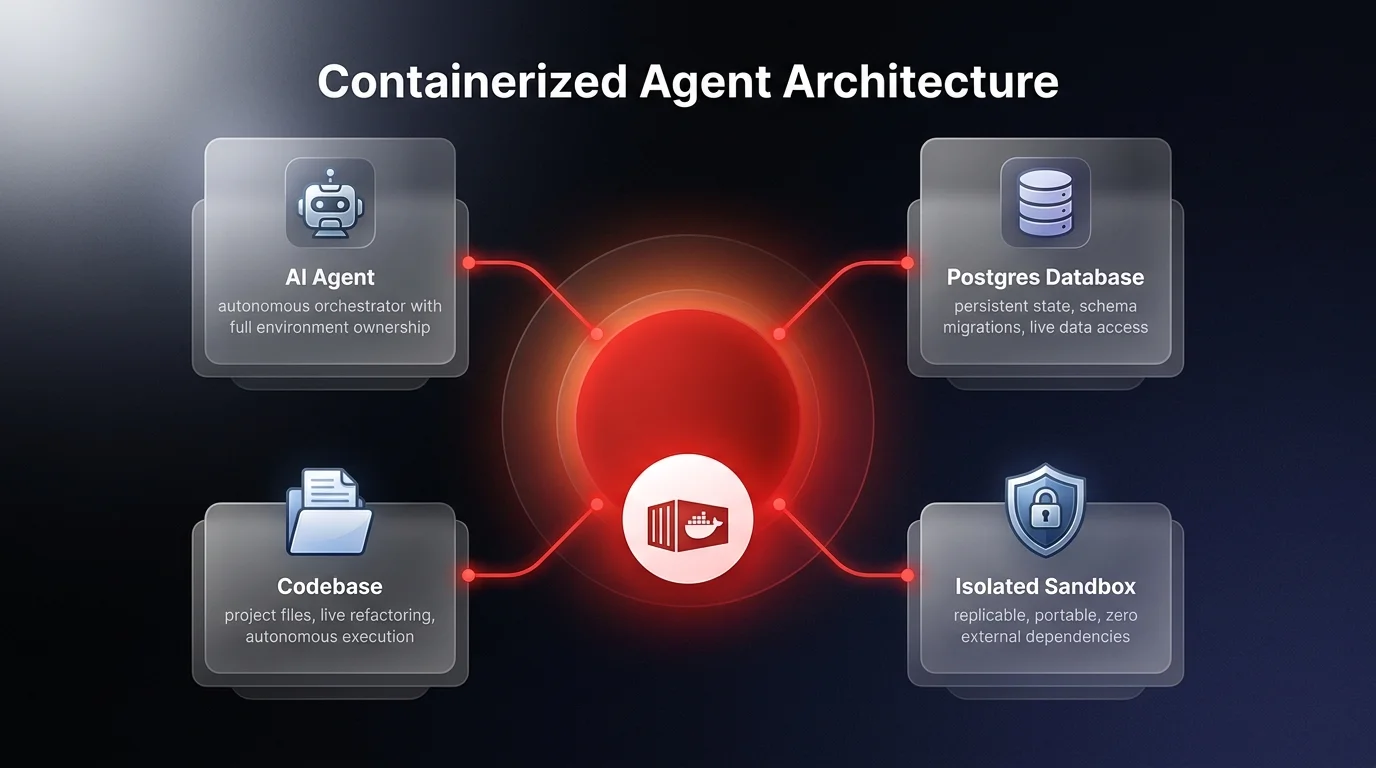
Here's what I mean. By wrapping the agent, the database, and the codebase into one Docker container, you create a self-contained universe for the software to evolve. Cursor is working on the agent, and the agent is working on the project. It's effectively agents building agents building projects. This isn't science fiction - this is the current reality of high-level AI engineering.
The old model was human-centric: we organized processes for people using agile methodologies. Now, we need to organize processes for agents. When you containerize the entire application stack along with the agent working on it, you unlock massive opportunities for autonomy. The agent isn't an external consultant looking in; it has ownership of the environment. It can spin up the database, migrate schemas, and refactor code without leaving its isolated sandbox. This fusion of the controller and the controlled is the future of software architecture.
So how do you actually build this?
So how do you actually build this? It comes down to defining clear 'control surfaces' between you and the agent. In my setup, I use three specific entry points symlinked into the Docker container.
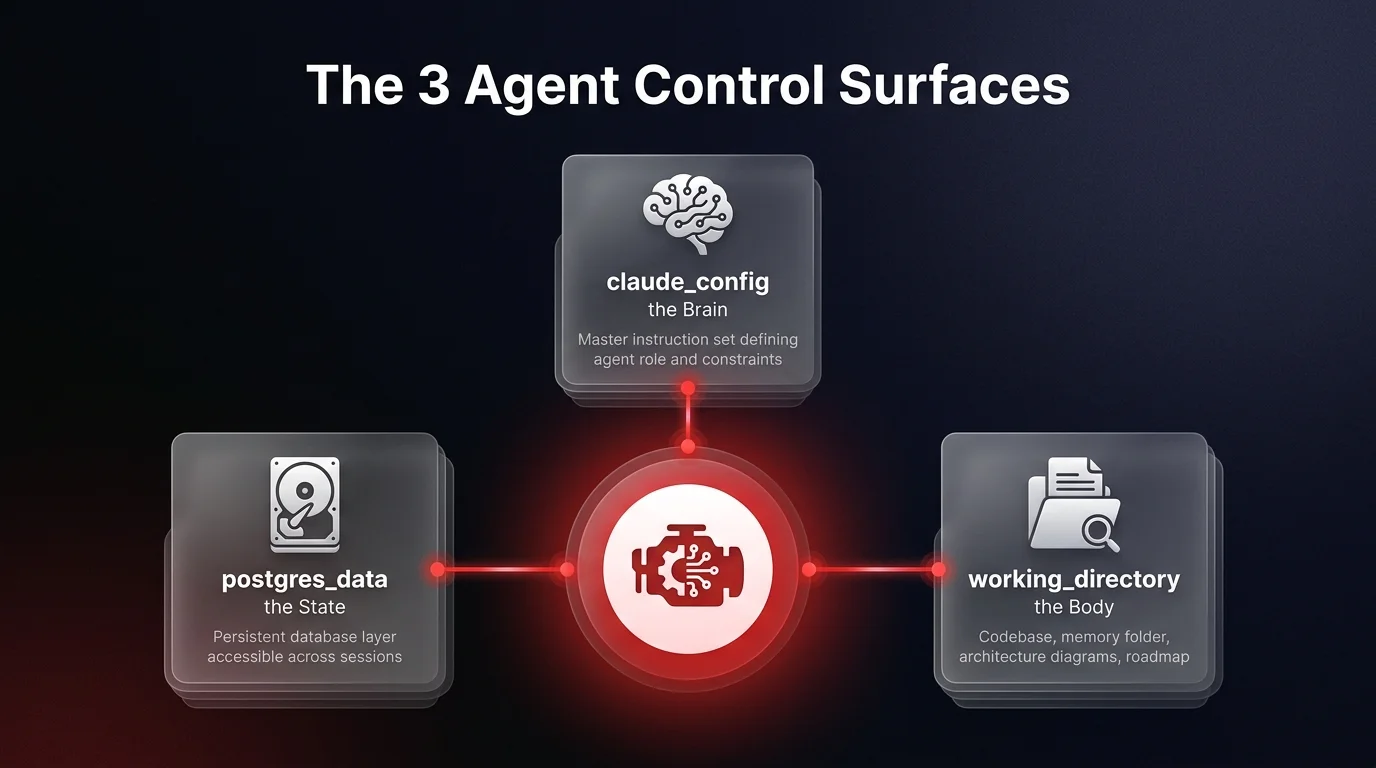
First is the 'claude_config' - the brain. This holds the 'claude.md' master instruction set that defines the agent's role and constraints. Second is the 'postgres_data' - the state. This ensures the database persists and is accessible to the agent. Third is the 'working_directory' - the body. This is where the code lives.
Inside that working directory, I maintain a 'memory' folder containing high-signal documents like architecture diagrams, requirements, and the roadmap. The agent uses this to ground its decisions. I treat the 'run_container.sh' script as the ignition key. It builds the image, starts the database, and drops me into an interactive session with the agent inside the container.
This setup allows you to amplify your output. Instead of micromanaging code syntax, you manage the environment and the memory. You're no longer writing code; you're architecting the system that writes the code. This is how you move from simple prompting to true agentic development — a methodology that pairs naturally with software development automation for teams scaling engineering capacity without scaling headcount.
The future belongs to those who can orchestrate these autonomous environments. It's time to stop treating AI as a plugin and start treating it as the platform. At Ability AI, we help businesses build these kinds of agent-native architectures to scale their development capabilities. Let's start building your autonomous workforce.