
Modular multi-agent automation architecture is the practice of splitting complex workflows across specialized AI agents, each owning a single function — rather than relying on one "god agent" to do everything. In the next 12 months, the winners won't be the ones with the smartest single model — they will be the ones who know how to orchestrate a team of specialized agents. I recently demoed my own internal setup to prove this. We have a modular architecture where distinct agents handle specific stages of the pipeline. One builds the asset, another manages the distribution. This isn't just theory — it's how we scale operations without losing quality.
Here's the hard truth
Here's the hard truth about most automation strategies today. People try to cram content generation, formatting, scheduling, and analytics into a single prompt or workflow. That is a recipe for disaster. When you ask one agent to do five different cognitive tasks, the error rate doesn't just add up - it compounds.
To fix this, you need to flip the script. You need to think like a manager hiring a team, not a user chatting with a bot.
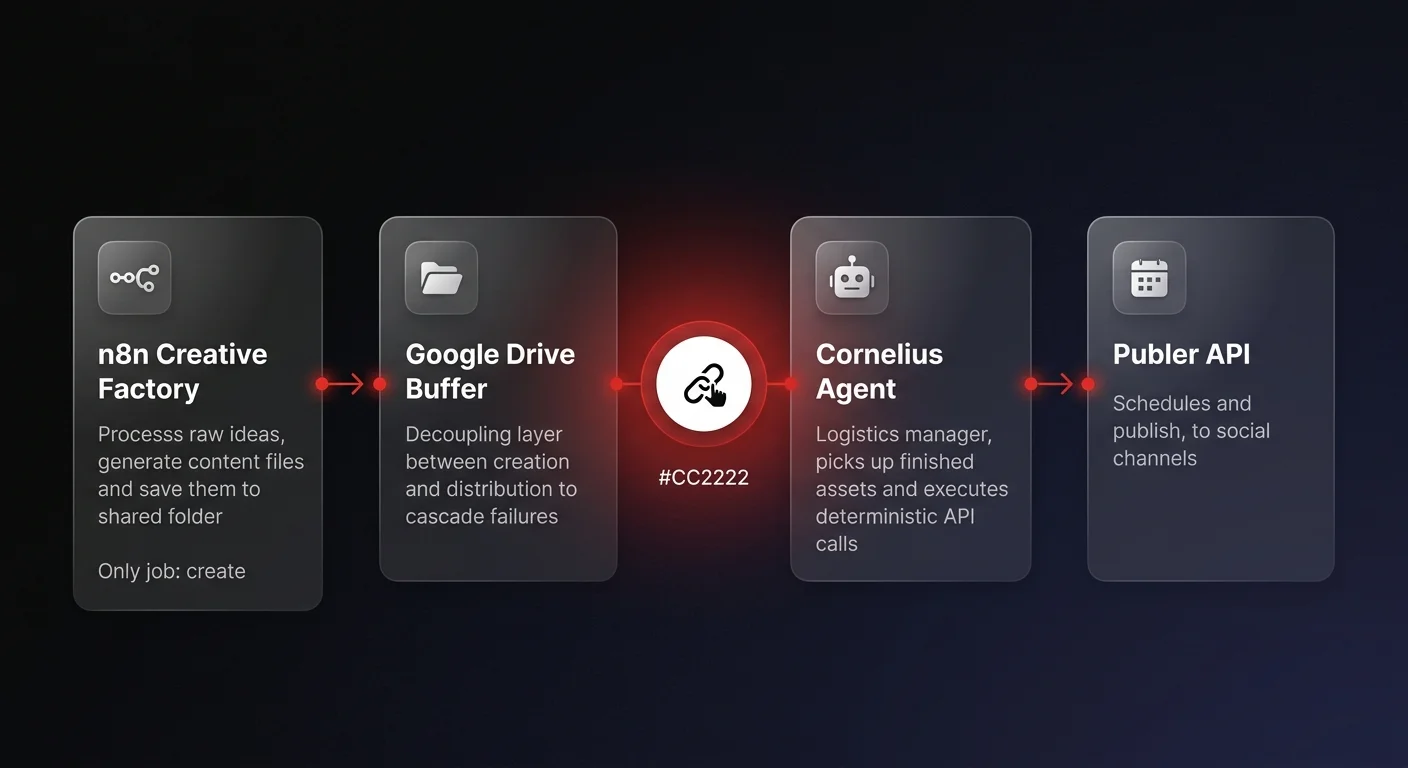
In my own workflow, I separate these concerns completely. I use an n8n workflow running in the background as my 'creative factory'. It processes raw ideas and generates the actual content files. That's its only job. It doesn't know about Twitter, LinkedIn, or scheduling APIs. It just creates and saves to a 'generated content' folder on Google Drive.
Then, I have a completely separate agent - a terminal-based tool I call 'Cornelius'. Cornelius doesn't write content. He's a logistics manager. I give him a command, and he looks into that specific Drive folder, picks up the finished assets, and talks to the Publer API to schedule them.
This handoff point - the Google Drive folder - acts as a buffer. It decouples the creation from the distribution. If the scheduling API breaks, my content generation doesn't stop. If I want to change how I generate content, I don't break my publishing pipeline. This is what I mean when I talk about orchestrating agentic systems rather than just using chatbots.
This modular approach
This modular approach allows for what I call 'radical stability' in your automation stack. When you decouple these functions, you gain the ability to upgrade individual components without tearing down the whole house.
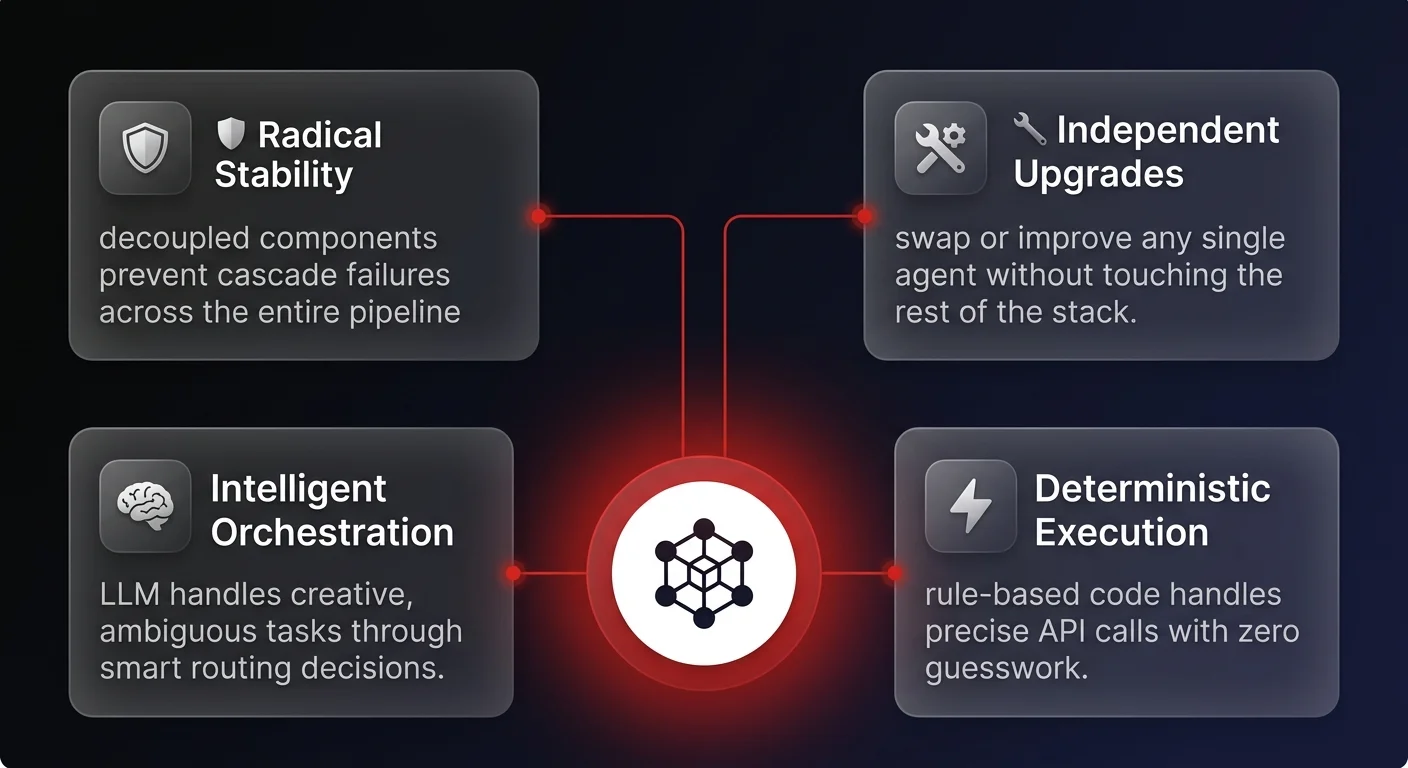
Let's look deeper at the 'Cornelius' agent. It's not just an LLM guessing what to do. It has specific 'hands' - custom scripts that allow it to interact directly with the Publer API. When I tell it to 'post this', it's executing deterministic code to handle the upload and scheduling. The intelligence is in the orchestration, but the execution is reliable code.
This moves us beyond the hype of 'chatting with data'. We are building systems where agents act as intelligent interfaces to complex APIs. The n8n agent handles the messy, creative work of batch processing. The terminal agent handles the precise, rule-based work of distribution.
So the question isn't 'which model is best?' The question is 'how do I architect the handoffs?'
If you want to own your infrastructure, start breaking your processes down. Don't look for a tool that does it all. Look for the friction points between tasks and build specialized agents to bridge them. That is how you amplify your output by 10x without 10x the effort — a result we've documented in our AI content system case study. The game has changed from prompt engineering to system architecture.
This is exactly the kind of multi-agent architecture we help clients build at Ability AI. We don't just implement chatbots; we design robust, scalable automation ecosystems that solve real business problems. If you're ready to move beyond simple prompts and start orchestrating real business value, let's talk about your automation strategy.