
AGI, for builders, is a self-improving, opinionated system with persistent memory that can act and optimize toward a defined goal — a testable engineering specification rather than a philosophical concept. Traditional AGI definitions focus on consciousness or human-level benchmarks, which are untestable and useless for engineering. The builder's definition reframes the question: instead of asking "is it conscious?", ask "can it take a vague instruction, form a plan, execute it, remember the result, and improve next time?" That's buildable. That's ownable.
Let's strip away the hype
Let's strip away the hype and look at why the current definitions fail us. We often hear 'human-level intelligence' as the benchmark. But what does that actually mean? Human intelligence varies wildly. Are we talking about a toddler or a quantum physicist? It's an undefined baseline. Then there's the Turing Test, which measures a machine's ability to deceive, not its ability to solve problems. And don't get me started on 'learning without training.' That is a myth. Even humans require decades of training to become functional.
To build real autonomous systems, we need to flip the script. We need a definition composed of testable engineering components. Here is the definition I use: AGI is a self-improving, opinionated system with memory that can act and optimize towards a defined goal.
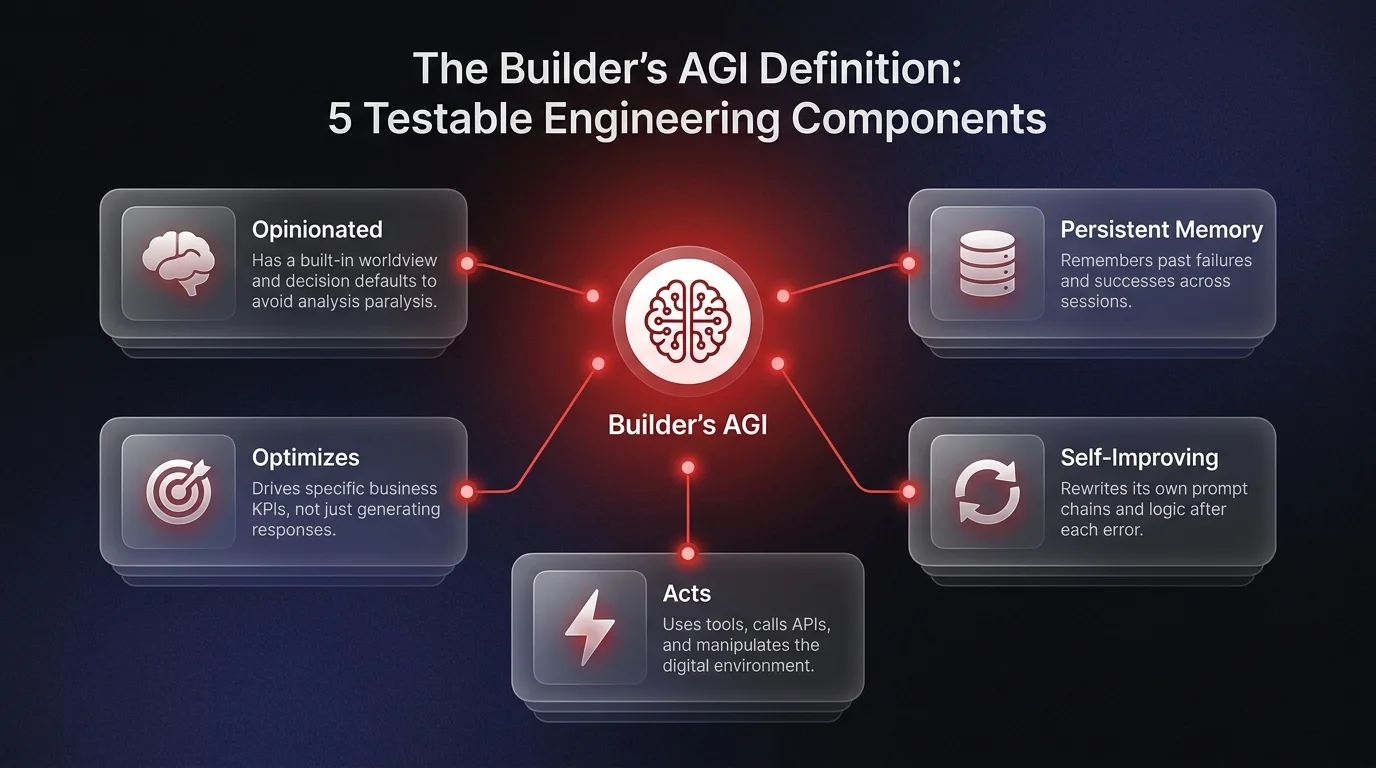
Notice the specific words here. 'Opinionated' matters. A neutral system gets stuck in analysis paralysis. To be agentic, software must have a worldview - a preferred way of solving problems. 'Memory' is equally critical. Most LLMs today are amnesiacs; they reset after every session. True intelligence requires state - the ability to remember past failures and successes to inform future context. Without memory, there is no learning, only processing.
The most radical part
The most radical part of this definition is the requirement for the system to be 'self-improving.' This is where the game has changed. We aren't just building static tools anymore; we are orchestrating AI agents that update their own operating logic. If your agent makes a mistake today, it must be architecturally capable of analyzing that error and rewriting its own prompt chains or logic to avoid it tomorrow. That is high-signal engineering.
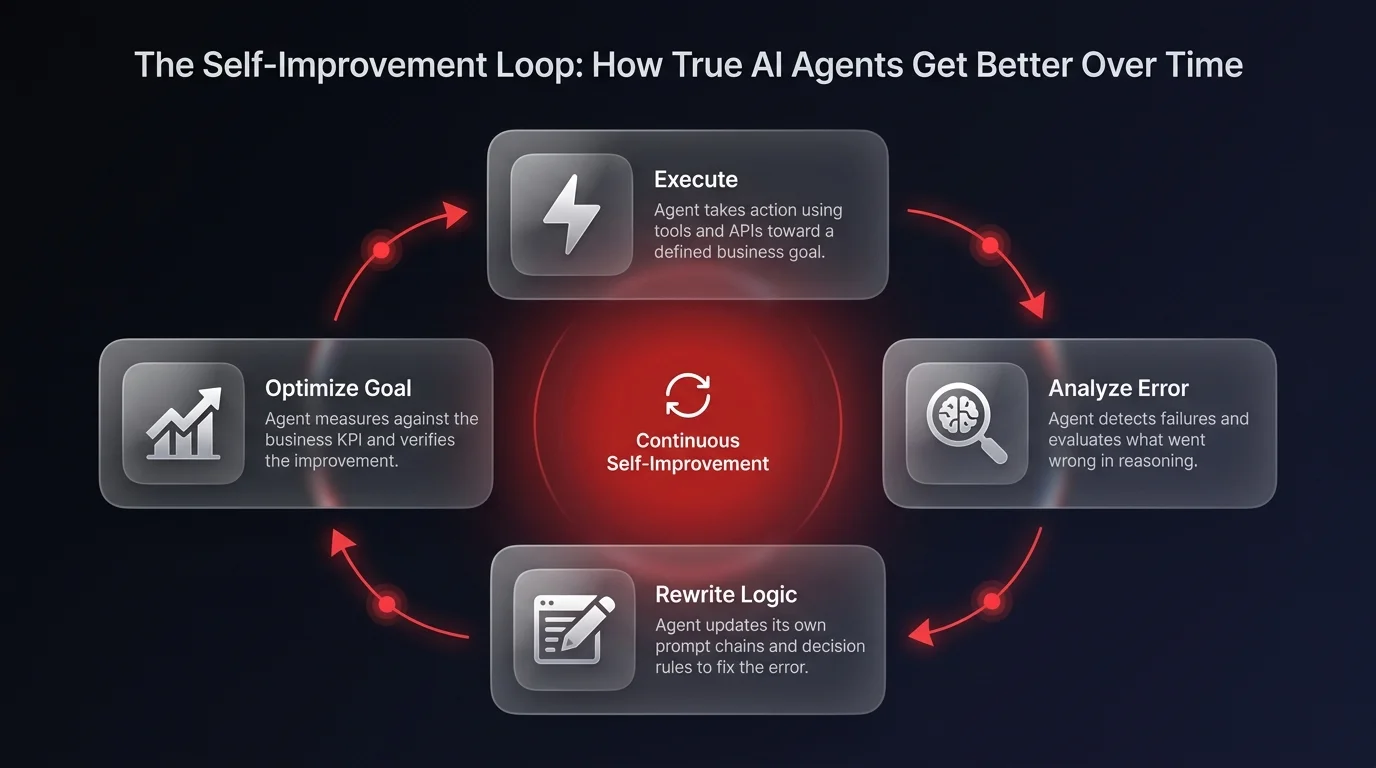
Then we have the ability to 'act.' Intelligence without agency is just a library. A true AGI must be able to use tools, call APIs, and manipulate the digital environment to achieve an outcome. It optimizes towards a goal - not just chatting, but driving a specific business KPI.
This moves the goalposts from 'is it conscious?' to 'does it work?'. Can it take a vague instruction, form a plan, execute it, remember the result, and do it better next time? That is a buildable spec. That is something you can own — and it's the foundation of every operations automation system we architect at Ability AI. When you frame AGI this way, it stops being a distant sci-fi concept and becomes a clear roadmap for your engineering team. Instead of chasing ghosts, you start building systems that actually amplify human potential.
The era of philosophical debate is over. It's time to build. At Ability AI, we use these practical principles to orchestrate secure, autonomous AI agents that actually deliver ROI. If you're ready to move beyond the hype and start implementing self-improving systems that work, we need to talk. Let's build the future, not just discuss it.