
Adaptive AI evaluation is a continuous testing methodology that uses living evaluation agents and active telemetry to monitor, validate, and govern AI systems in production. Unlike static benchmarks that check a fixed dataset once, adaptive evaluation dynamically updates test suites based on real user behavior - closing the gap that causes 20 percent of agent interactions to go unmonitored.
For years, engineering teams have treated artificial intelligence like traditional software - shipping applications, running static unit tests, and assuming the system will behave predictably in production. But modern agentic systems are not static. They are malleable, dynamic, and constantly shifting based on user intent.
Relying on static benchmarks for these living systems creates massive operational blind spots. Industry research across enterprise deployments at organizations like Uber, Netflix, and major financial institutions reveals a growing consensus - traditional AI evaluations are becoming obsolete. As software ships at lightning speed and AI agents continuously adapt to new environments, static testing frameworks simply cannot keep up.
To build resilient, autonomous intelligent systems, organizations must fundamentally shift their perspective. Evaluations can no longer be treated as static, offline datasets. Instead, they must be engineered as living agents equipped with active telemetry to continuously monitor, adapt, and self-correct your AI infrastructure. Organizations already tackling AI agent observability challenges understand that visibility into production behavior is the foundation for this shift.
The evolution of AI steering: from prompts to intent
To understand why static benchmarks are failing, we must first look at how rapidly AI engineering has evolved. The way we steer and control AI models has undergone three distinct phases in a remarkably short timeframe.
The first phase was prompt engineering. This era was characterized by word-smithing instructions - essentially bashing random words into an AI model and hoping the output improved. It was highly unscientific, akin to developing a medication for liver disease, discovering it cures headaches instead, and simply rebranding it as a painkiller. While this approach mostly died out in enterprise environments by 2023, the unpredictability it introduced highlighted the early need for robust testing.
The second phase, context engineering, introduced much-needed structure. With the rise of Retrieval-Augmented Generation (RAG) and tool calling through frameworks like the Model Context Protocol (MCP), developers could steer agents with external data. This made evaluations slightly more manageable because a large, complex agent could be broken down into its component parts. If an agent had a specific MCP tool for querying a sales database, engineers could write targeted tests to ensure that specific tool functioned correctly. Teams building effective AI agent harnesses know that modular architecture is key to testable agent systems.
However, we are now fully entering the third phase - intent engineering. Today, code generation is practically free, and AI tokens are abundant and highly accessible - essentially acting as the "fast food" of the development world. Modern models are exceptionally capable of complex pattern recognition and logic, successfully solving advanced challenges like ARC-AGI 2 puzzles that stump many humans.
Because these models are so capable, modern harnesses are designed to be malleable. They understand user intent and self-optimize to deliver a better outcome. The machine actively adapts its behavior based on the specific goal of the user. But when a system automatically shifts its processes to optimize for intent, how do you evaluate it? When every user's experience is dynamically tailored, static benchmarks become useless.
Eval calcification and why adaptive AI evaluation replaces static testing
In traditional software engineering, we rely on robust methodologies to measure reliability. We write unit tests, run manual regression suites to ensure feature A does not break feature B, and build extensive CI/CD pipelines. More importantly, mature engineering teams utilize chaos engineering and observability - actively breaking systems in unpredictable ways to see where they stretch and fail.
Currently, the AI and data science space is severely lacking this chaos engineering mindset. The industry is hyper-fixated on offline evaluations and static benchmarks. For example, a bank might handcraft a dataset of 500 questions to ensure their AI does not offer illegal financial advice. They will run this offline test, tune the model until it passes perfectly, and then deploy it to production.
We call this phenomenon "eval calcification." You end up with a humongous set of rigid datasets attempting to explain a dynamic agent. This approach works perfectly - right up until the moment it fails in production.
Static benchmarks fail because they treat an adaptive application as if it were immutable code. If your agent's underlying harness is actively shifting its skills and adapting to real-time interactions, a static test written three months ago offers a false sense of security. It is only a matter of time before an unexpected interaction bypasses your static defenses, forcing your team back to the drawing board to figure out what went wrong. Understanding agent reliability metrics and governance is the first step toward building evaluation systems that keep pace with production reality.
The 20 percent danger zone: where businesses break
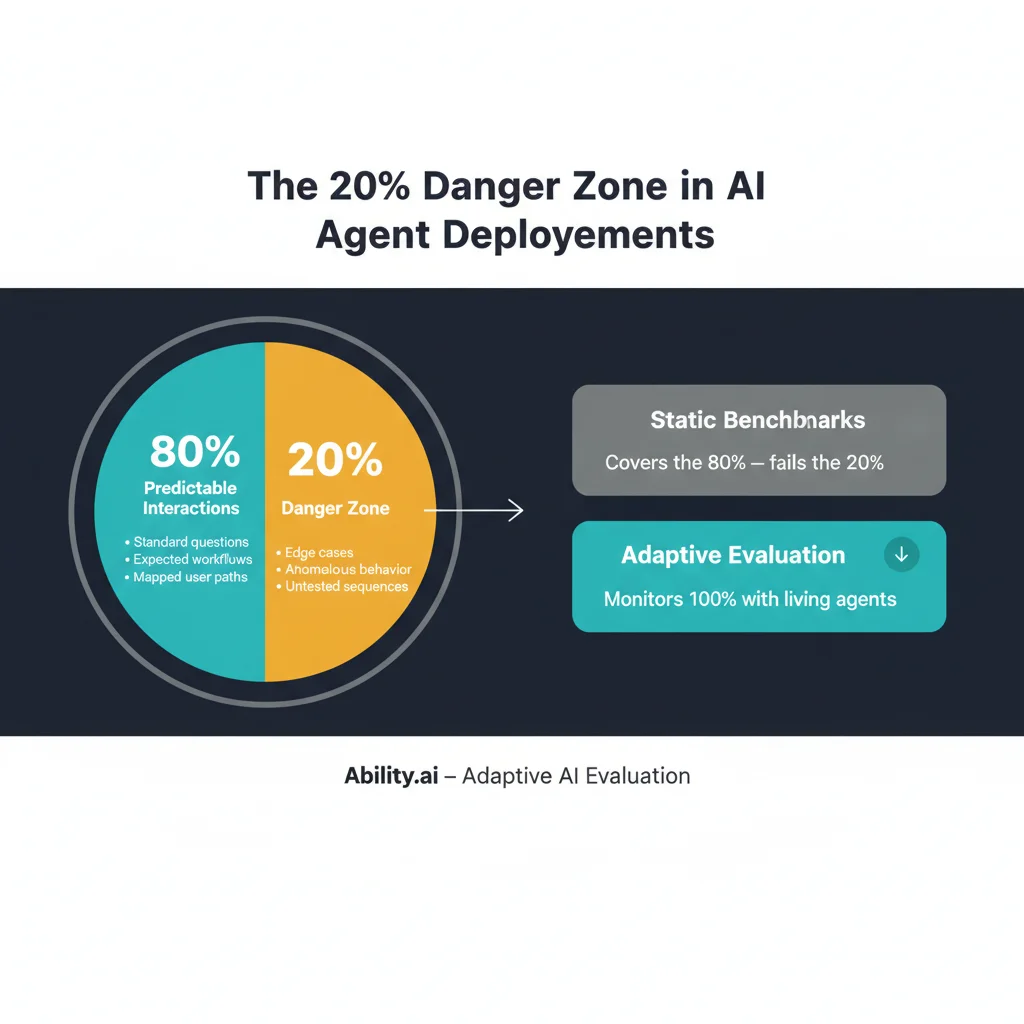
When deploying AI infrastructure, unpredictability is your greatest liability. In a typical production environment, roughly 80 percent of agent interactions are highly predictable. Users will ask standard questions, trigger expected workflows, and follow the paths your intent engineering was designed to handle. Static benchmarks can validate this 80 percent effectively.
However, the remaining 20 percent is a dangerous operational blind spot. This 20 percent consists of edge cases, anomalous user behavior, and highly ambiguous requests. It is the user who asks a bizarre question, chains commands together in an unforeseen sequence, or pushes the agent into a completely untested conversational territory.
This 20 percent will mess up your business. It is where brand damage occurs, where data leaks happen, and where unmonitored agents execute costly, erroneous tool calls.
Managing this danger zone requires adaptive testing. If your customer base shifts and begins interacting with your agent differently, your evaluations must recognize that shift immediately. A robust AI architecture does not just evaluate the predicted path; it deploys specialized agents to monitor the 20 percent, analyze the variance, and automatically adapt the testing suite to cover the new behavior.
Telemetry in the loop: building self-healing AI infrastructure
To safely deploy autonomous intelligent systems, organizations need more than basic workflow glue or fragile prompt wrappers. They require true production-grade infrastructure. For CTOs and internal AI champions tasked with scaling agentic workflows, the solution lies in active observability and telemetry.
Advanced AI harnesses are increasingly aware of their own telemetry. When an agent executes a task, the surrounding infrastructure monitors the live traces, tracks the exact compute cost, and logs any errors encountered. By keeping telemetry in the loop, the system can enforce strict conditions and self-correct in real-time. Organizations building agent self-correction loops are already seeing how telemetry-aware systems dramatically reduce production incidents.
If an agent experiences an error while calling an API, a telemetry-aware harness does not just fail and alert a human operator - it analyzes the error state, adjusts its approach, and attempts to heal itself to continue the process.
This level of operability requires a dedicated, governed environment. See how DeepX achieved governed AI operations by deploying agents within a sovereign infrastructure layer that provides persistent shared state, auditable logs, and role-based access control. Treating agents as core company infrastructure - not disposable scripts - is what separates reliable deployments from the 3 AM pager alerts that plague fragile, ungoverned AI systems.
Moving toward living agentic evaluations
To conquer eval calcification, organizations must treat their evaluations as code, or better yet, as living software.
Instead of starting with a static dataset, your evaluations should define the ultimate intent or end-state. Using automated optimization techniques - similar to auto-research algorithms that autonomously tune Python code to hit a specific target variable - your evaluation agents can continuously test your production agents against shifting user behaviors.
Here is what living evaluations look like in practice:
- Self-curating test suites: By analyzing production traces, evaluation agents identify when 80 percent of user behavior changes. The agent automatically writes new tests based on these live interactions, ensuring your benchmarks are always aligned with real-world usage.
- Always-on optimization: Evaluations are no longer a step in the CI/CD pipeline before deployment; they are persistent, parallel processes running constantly against the production system.
- Defining ambiguity: Instead of binary pass/fail tests, robust rubrics allow agents to grade the personality, tone, and ambiguity handling of other agents, providing nuanced quality metrics.
Your evaluations must become as dynamic as the applications they are testing. Teams already managing AI agent architecture and governance at scale recognize that living evaluations are the natural next step in operational maturity.
Securing your AI architecture for the adaptive evaluation era
As AI models continue to advance and token costs plummet, the velocity of agentic development will only increase. Your agents will shift, optimize, and adapt on their own. Attempting to govern these systems with static, point-in-time benchmarks is a recipe for operational failure.
The future of AI governance requires a fundamental mindset shift. CTOs and AI builders must stop predicting what might go wrong and instead build infrastructure capable of responding to reality.
This shift demands a sovereign runtime environment that supports multi-user access, active telemetry, and persistent state. By deploying your agents within a governed operations automation framework, you ensure that even as your AI adapts to user intent, it remains strictly governed, auditable, and secure.
By treating your AI agents - and the agents that evaluate them - as living company infrastructure, you can confidently deploy autonomous systems that drive business value without exposing your organization to the unpredictable risks of the 20 percent danger zone.