
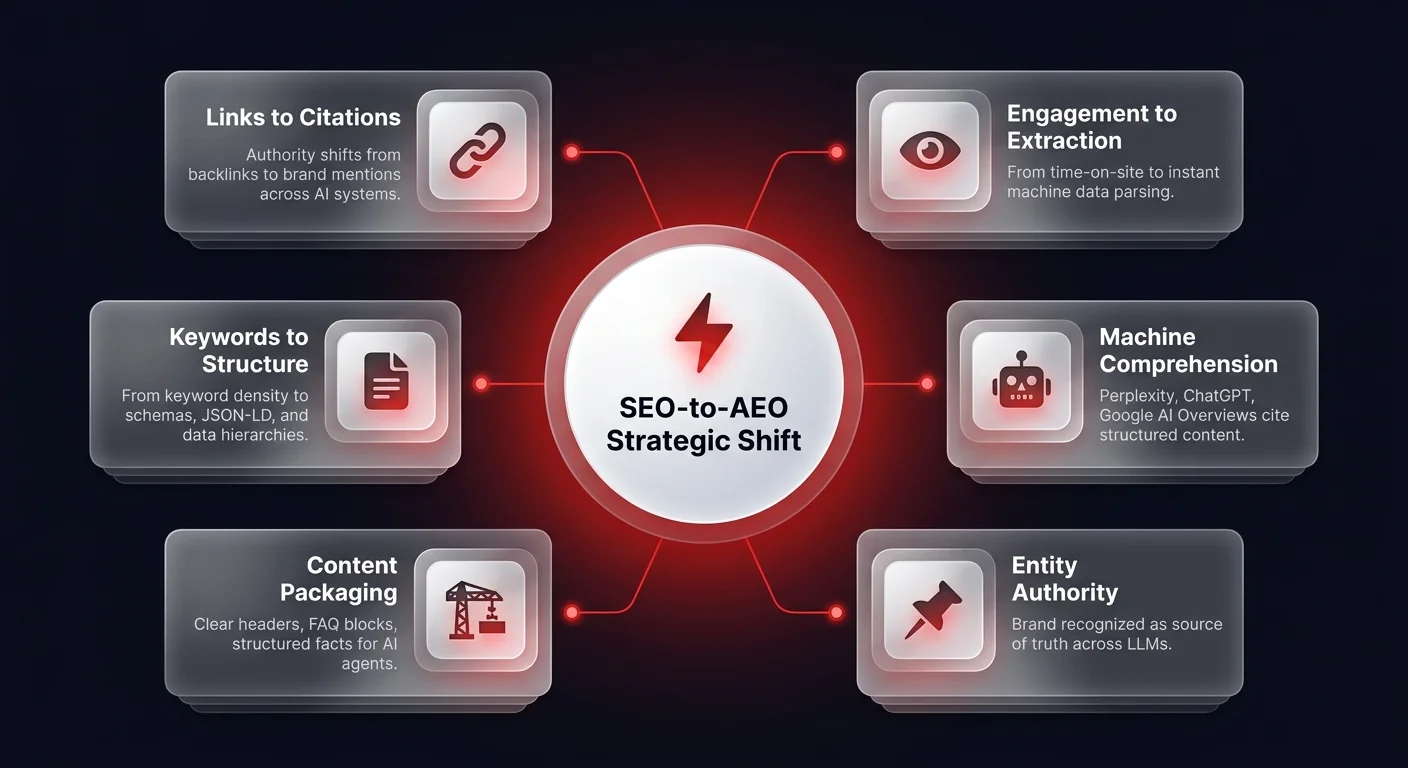
AEO (Answer Engine Optimization) vs SEO is the defining content strategy shift of 2026 — where traditional SEO optimized for human click-through rates, AEO structures content for AI systems like Perplexity, ChatGPT, and Google AI Overviews to parse, understand, and cite directly. As these AI-driven answer engines increasingly replace traditional search for information discovery, companies that package their content for machine comprehension — not just human engagement — will win visibility in the next era of search.
At the heart of this shift is a concept that moves beyond keywords and backlinks. As highlighted in recent industry analysis, the core distinction lies in how machines consume your data. While SEO was a game played for human eyeballs and click-through rates, Answer Engine Optimization (AEO) is a game played for machine comprehension. The expert insight is clear: "You create content in today's world for humans, but you package it for AI."
For operations leaders and COOs, this distinction is vital. It suggests that your company's public data is no longer just marketing material - it is a database being queried by autonomous agents. If that data isn't structured correctly, your business effectively becomes invisible to the AI systems that your customers are using to find answers.
The decline of links and the rise of citations
To understand the operational impact of AEO, we must first look at the metrics that defined the previous era. Traditional SEO relied heavily on a web of connectivity. As noted in the analysis, "Things like links really matter in SEO." The logic was simple: if many reputable sites linked to you, you were authoritative.
However, AI models operate differently. They do not necessarily navigate the web by clicking from link to link in the way a human browser does. Instead, they ingest vast amounts of information and synthesize answers based on probability and verified facts. Consequently, the metric for authority has shifted.
The transcript notes a critical pivot: "AEO really only cares about citations versus links." This is a subtle but profound difference. A link is a navigational pathway; a citation is a verification of fact. For an AI agent to trust your content enough to serve it as an answer, it doesn't just need to see that others link to you; it needs to see that your brand is cited as the source of truth across the data ecosystem.
For operational teams, this changes how you measure brand authority. It moves the goalpost from "link building" to "entity establishment." You need to ensure that your business is recognized as a distinct, authoritative entity by the Large Language Models (LLMs) processing the web. This requires a level of consistency in your public data that goes far beyond standard marketing copy.
Structure is the new king
Perhaps the most actionable insight from the comparison of AEO vs SEO is the emphasis on technical formatting. In the traditional SEO world, success was often determined by user engagement metrics. The analysis points out that SEO prioritized "content and quality and length in some cases" and metrics like "time on site."
These are human engagement metrics. A search engine wanted to know if a human stayed on the page long enough to find value. AI agents, however, are ruthless efficiency machines. They do not want to spend time on a site; they want to extract data and leave.
This leads to the defining characteristic of the new era: "AEO cares a lot about how the content is structured." This statement underscores a massive operational gap for many mid-market companies. You might have excellent thought leadership articles, comprehensive white papers, and detailed case studies. But if that content exists as unstructured text blocks, it is difficult for an AI to parse.
"Structuring" in this context refers to the technical packaging of information - schemas, JSON-LD, clear headers, and logical data hierarchies. It is the difference between a paragraph of text describing a product's price and a structured data field explicitly tagging that price for a machine to read. If your operations and marketing teams are not collaborating to implement these technical structures, you are failing the "packaging" test of AEO.
The human-robot hybrid workflow
The transition to AEO does not mean abandoning human readers. In fact, the quality of information matters more than ever. The challenge lies in a dual-mandate workflow. As the expert insight summarizes: "We made content just for humans, then now we're making it for humans and robots."
This "human-robot" hybrid model requires a change in internal processes. Historically, content creation was a linear path: a writer drafts copy, an editor reviews it, and a CMS manager publishes it. In an AEO-centric world, this workflow must evolve to include a "structuring" phase.
Operationalizing the packaging process:
- Creation: Subject matter experts create high-value content solving specific problems (for humans).
- Structuring: Technical teams or AI agents apply schema markup and structural tags to key data points (for robots).
- Verification: The output is tested against AI search tools to ensure the "answer" is retrieved correctly.
This effectively turns your content management strategy into a data governance strategy — the same shift driving demand for AI-powered marketing content systems that automate both the creation and structured packaging of content. The goal is to ensure that when an external AI agent queries your site, it finds a clean, well-ordered structure that makes it easy to cite your business as the answer.
Why AEO readiness equals agent readiness
At Ability.ai, we view the rise of AEO as a precursor to a broader shift toward agent-based operations automation. The principles that help you win at AEO - clean data, structured outputs, and clear citations - are the same principles that allow internal AI agents to function effectively within your enterprise.
If your external content is unstructured and messy, it is likely that your internal documentation suffers from the same issues. By treating AEO as a forcing function to structure your business information, you are solving two problems at once:
- Market Visibility: You ensure your company remains visible in AI-driven search results (Perplexity, SearchGPT).
- Operational Readiness: You prepare your knowledge base for sovereign AI agents that can automate internal tasks.
The concept of "packaging for AI" extends beyond marketing. It is about making your business logic observable and consumable by machines. Whether that machine is a search engine crawling your site or a governed agent executing a sales workflow, the requirement is the same: structure matters.
Strategic takeaways for operations leaders
The move from SEO to AEO is not a trend to be delegated solely to the marketing department. It represents a fundamental change in the digital infrastructure of business. To stay competitive, leaders must look at their data through the lens of machine readability.
Key operational steps:
- Audit your digital footprint: Is your high-value information locked in PDFs or unstructured blog posts? Move it to structured formats.
- Prioritize citations: Shift focus from acquiring links to ensuring your brand is accurately cited as a source of truth in your industry.
- Adopt the "packaging" mindset: Make it a standard operating procedure that every piece of content produced is both readable by humans and structured for agents.
The secret to winning the AI search war is realizing that the war isn't about search at all - it is about data accessibility. By structuring your knowledge for the machine age, you secure your place in the answers of tomorrow.