

AGI is not a single superintelligent model — it is a design pattern built from orchestrated ecosystems of specialized agents, shared memory, and meta-cognitive coordination that businesses can build today. Rather than waiting for a 'god model' breakthrough, forward-thinking teams are assembling autonomous agent ecosystems where specialized AI agents spawn sub-agents, maintain shared memory states, and operate self-improvement loops — delivering emergent intelligence through composition, not brute-force capability. The game has changed, and most people are still looking at the scoreboard instead of the field.
The myth of the god model
Let's break down the myth of the 'God Model.' The industry is obsessed with waiting for one giant, magical neural network to solve every problem. We treat models like oracles, expecting one prompt to yield one perfect answer. But that's low-leverage thinking. The reality is that the 'general' in AGI doesn't come from one general-purpose system. It comes from composition. From how the pieces work together.
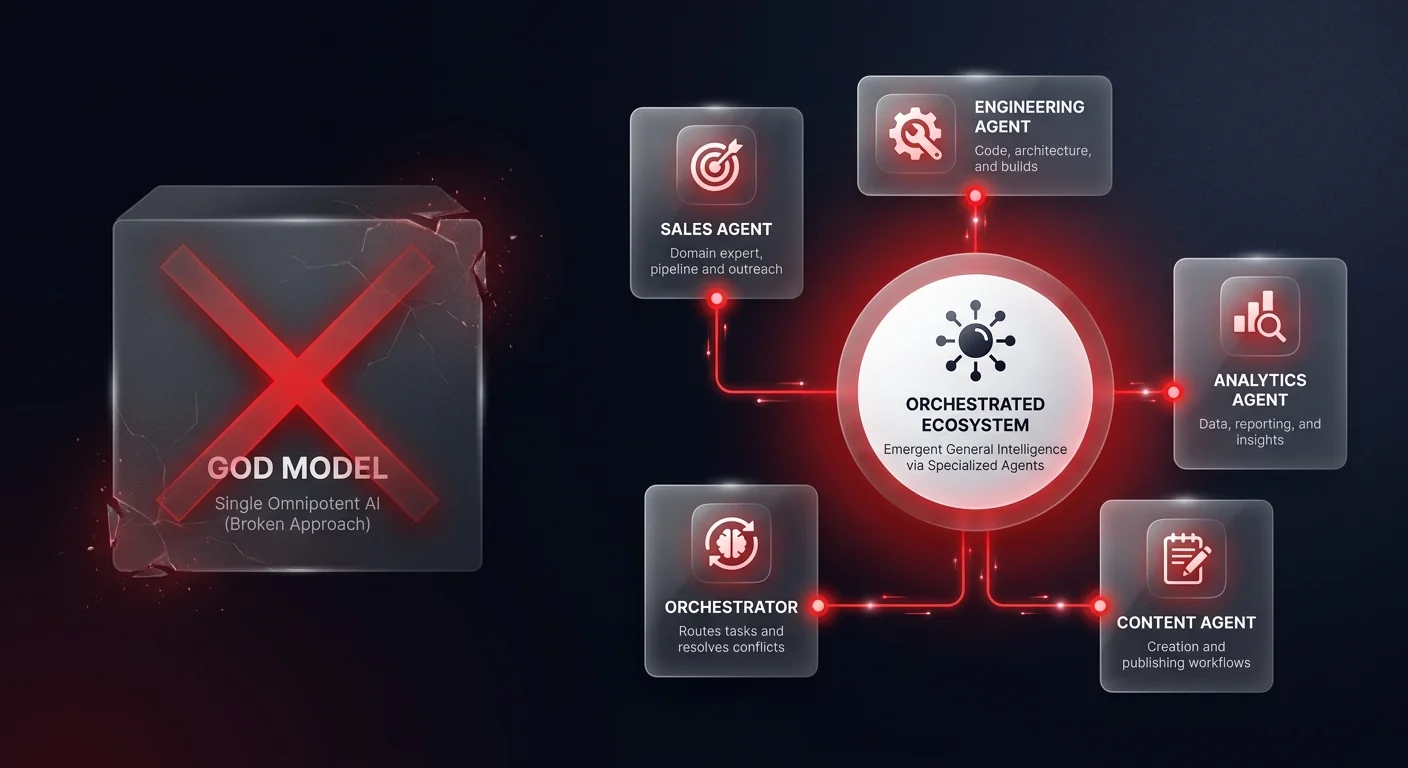
I don't think AGI is going to be a single model. I think AGI is an orchestrated ecosystem of AI agents.
Think about how high-functioning teams work. You don't hire one person to do sales, engineering, legal, and HR simultaneously. You hire specialists and orchestrate their collaboration. That's exactly how we need to build AI. In my own work, I have agents that spawn other agents. I have event-driven reactive systems that wake up, solve a problem, update a shared memory state, and go back to sleep. They have self-improvement loops. They are all orchestrated. They are all autonomous.
When you stop looking for magic and start looking at architecture, you realize the tools are already in your hands. This is about flipping the script from 'model capability' to 'system capability.' The magic isn't in the node; it's in the network. It's in the hand-offs between specialized agents that create a sum far greater than its parts.
The components of AGI
So if AGI is a design pattern, what are the components? It's not just a chat interface. It requires a radical shift in how we architect software.
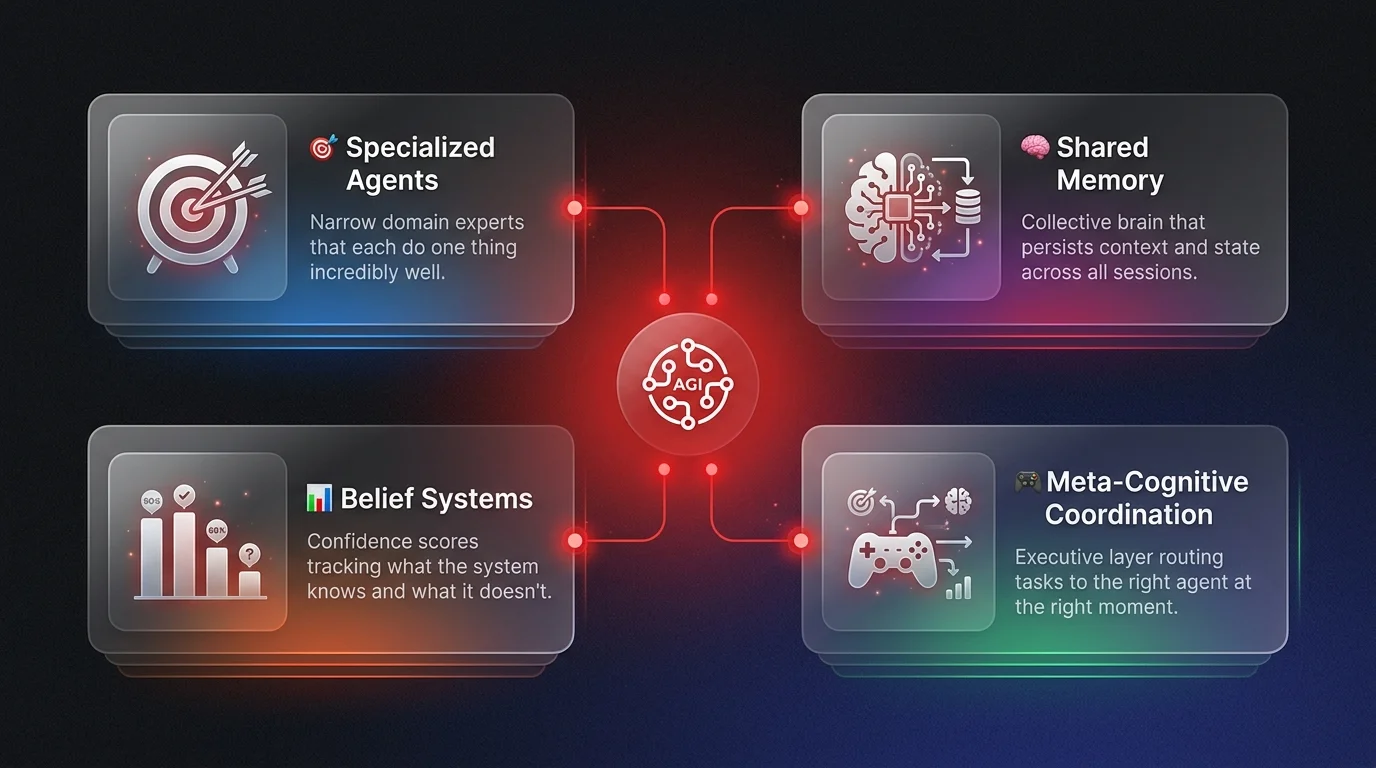
You need specialized agents - experts in narrow domains that do one thing incredibly well. You need shared memory - a collective brain that persists across sessions so context isn't lost. You need belief systems with confidence scores so the system knows what it knows and, more importantly, what it doesn't. And you need meta-cognitive coordination - an 'executive' layer that decides which agent does what and when.
This is high signal work. When you strip away the hype, you're left with engineering challenges. How do agents share context without degrading performance? How do you resolve conflicts between two agents with different directives? These are the actual problems worth solving.
Maybe it's not an event. Maybe it's not a threshold you cross. Maybe it's a design pattern. When you orchestrate these elements correctly, you get emergent behavior that looks, feels, and acts like General Intelligence. The bottleneck right now isn't the underlying models. It's our imagination in how we wire them together. Stop waiting for OpenAI to save you with GPT-6. Start orchestrating your own ecosystem. That's where the real ownership lies.
Building the future today
The future belongs to those who orchestrate, not those who wait. At Ability AI, we aren't waiting for AGI to arrive - we're building the architectures that make it possible today. If you're ready to move beyond simple chatbots and build real, autonomous agent ecosystems, explore our operations automation solutions or let's talk.