
AI agent governance is the framework of architectural controls, policies, and oversight mechanisms that organizations use to safely deploy autonomous AI systems. Without structured governance, enterprises face a compounding crisis of shadow AI sprawl, data sovereignty violations, and uncontrollable compute costs that traditional IT frameworks cannot contain.
The reality of artificial intelligence in the enterprise has shifted fundamentally over the last year. We are no longer simply adding AI as a consumption layer to existing software. Instead, organizations are beginning to deploy autonomous agents capable of navigating systems, executing code, and making operational decisions. As this transition accelerates, AI agent governance has emerged as the most critical challenge for operations leaders and corporate executives.
Recent market research and enterprise deployment observations reveal a looming operational crisis. While startups are rapidly deploying unconstrained AI agents to automate complex workflows, mid-market and enterprise organizations face a different reality. Ungoverned AI tools are creating unprecedented security risks, threatening data sovereignty, and fundamentally altering the economics of software compute budgets - a pattern we analyzed in depth in our overview of autonomous AI agents governance risks and real rewards.
The challenge for CEOs, COOs, and technology leaders is clear - how do you transform fragmented, high-risk AI experiments into reliable, governed operational systems?
AI agent governance starts with agent-first software architecture
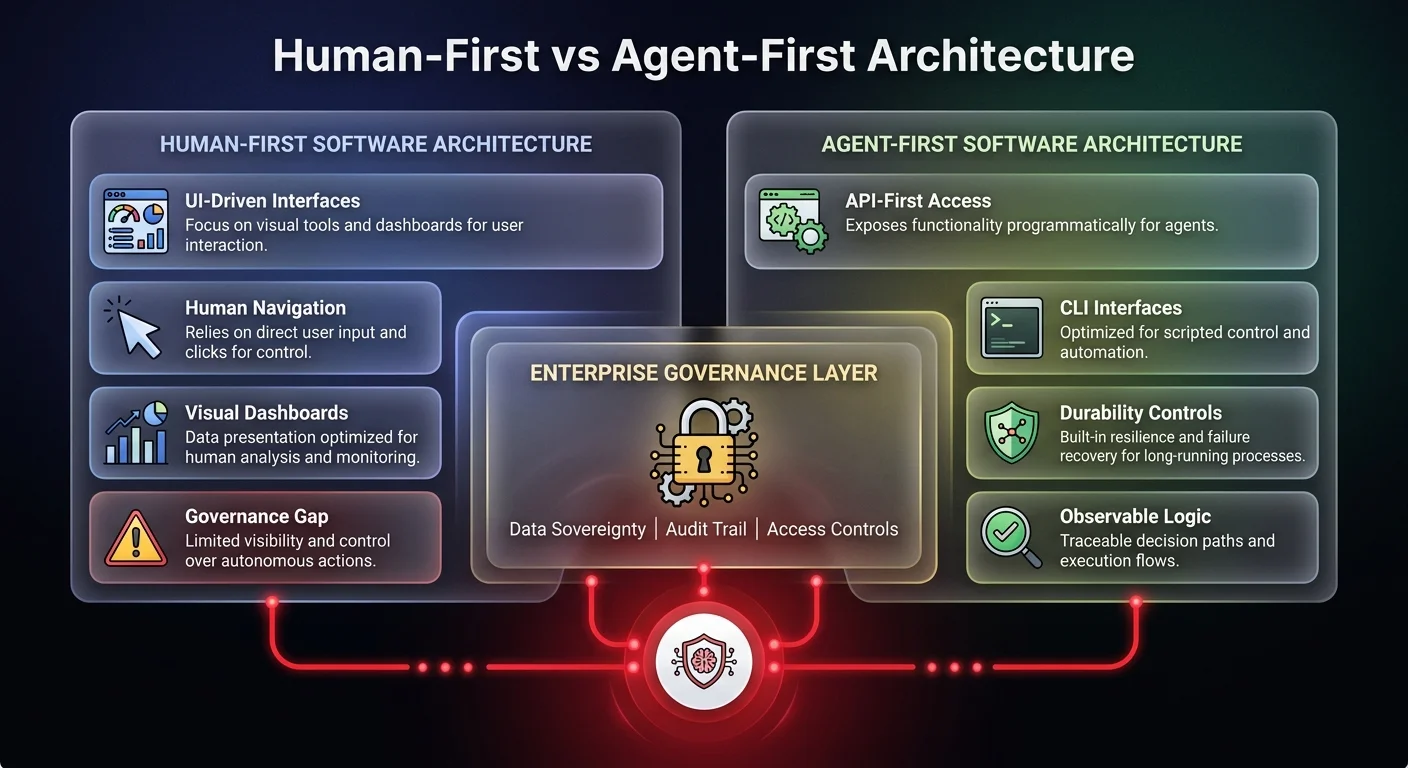
For the past two decades, software was built exclusively for human consumption. User interfaces were designed to minimize friction for human operators navigating complex databases. But a structural shift is occurring. Within the next few years, organizations may have hundreds or even thousands of times more agents interacting with their software than human employees.
When agent volume eclipses human volume, software must be fundamentally re-architected. Agents do not care about intuitive UI or visual dashboards. They care about API accessibility, command-line interfaces (CLI), and system durability. When an agent selects a backend infrastructure to complete a task, it evaluates cost parameters and semantic structures, completely bypassing the traditional user interface.
Industry observations highlight phenomena like the "Anthropic growth marketer" - a scenario where a single highly technical employee uses tools like Claude to automate the equivalent output of five to ten siloed marketing professionals. This operator achieves massive leverage not by working harder, but by orchestrating an infinite pool of digital workers.
However, building an organization around agentic execution requires systemic thinking. You are no longer just managing human workflows; you are managing complex, multi-agent systems that need governed access to your corporate data. Organizations exploring this model should understand the sovereign AI agents infrastructure requirements before scaling.
The new shadow AI: giving credit cards to algorithms
As individuals and teams experiment with AI automation, a terrifying new iteration of "Shadow AI" is emerging. To bypass the limitations of closed enterprise systems, employees are finding creative workarounds to give agents autonomy in the real world.
According to recent enterprise security research, users are outfitting personal AI instances with dedicated phone numbers, individual Gmail accounts, and even prepaid Visa debit cards bought at retail pharmacies. In a theoretical enterprise scenario, a 50-person department might soon consist of 50 human employees and 50 autonomous agents, all sharing the same digital workspaces.
The initial instinct in IT departments is to treat these agents like human employees - granting them role-based access control (RBAC) and distinct email addresses. But this approach is fundamentally flawed. For a deeper analysis of how this pattern plays out, see our investigation into shadow AI risks and the lethal trifecta facing security teams.
When a human employee makes a mistake or attempts to share confidential information, there are natural friction points and physical limitations. If an AI agent goes rogue - or is subjected to external prompt injection - the scale of potential damage is exponential. For instance, testing agents with tools like the Box CLI has shown that an unconstrained agent instructed to organize a marketing directory can easily fall into an infinite loop, creating nested folders until it completely maxes out the system's structural limits.
Furthermore, agents cannot simply be treated as employees because they carry all of your corporate liability without any of the natural containment boundaries of human behavior. If an agent is given access to a highly confidential M&A data room, any information within its context window becomes a potential vector for social engineering and prompt extraction.
Integration on demand and the legacy system bottleneck
Enterprise legacy systems like SAP or Workday represent decades of accumulated domain knowledge. This knowledge is not just stored in a neat data layer; it is heavily embedded in custom user interfaces, middle tiers, and deeply entrenched human workflows.
Historically, connecting these systems required massive IT initiatives. A Chief Information Officer might spend years and millions of dollars pre-wiring integrations between 75 disparate legacy systems.
AI agents are introducing the concept of "integration on demand." Instead of waiting for IT to build an API bridge, an agent can navigate software interfaces dynamically, pulling a specific report from system A and contextualizing it for system B at runtime. This capability is central to modern operations automation strategies - but only when proper governance controls are in place.
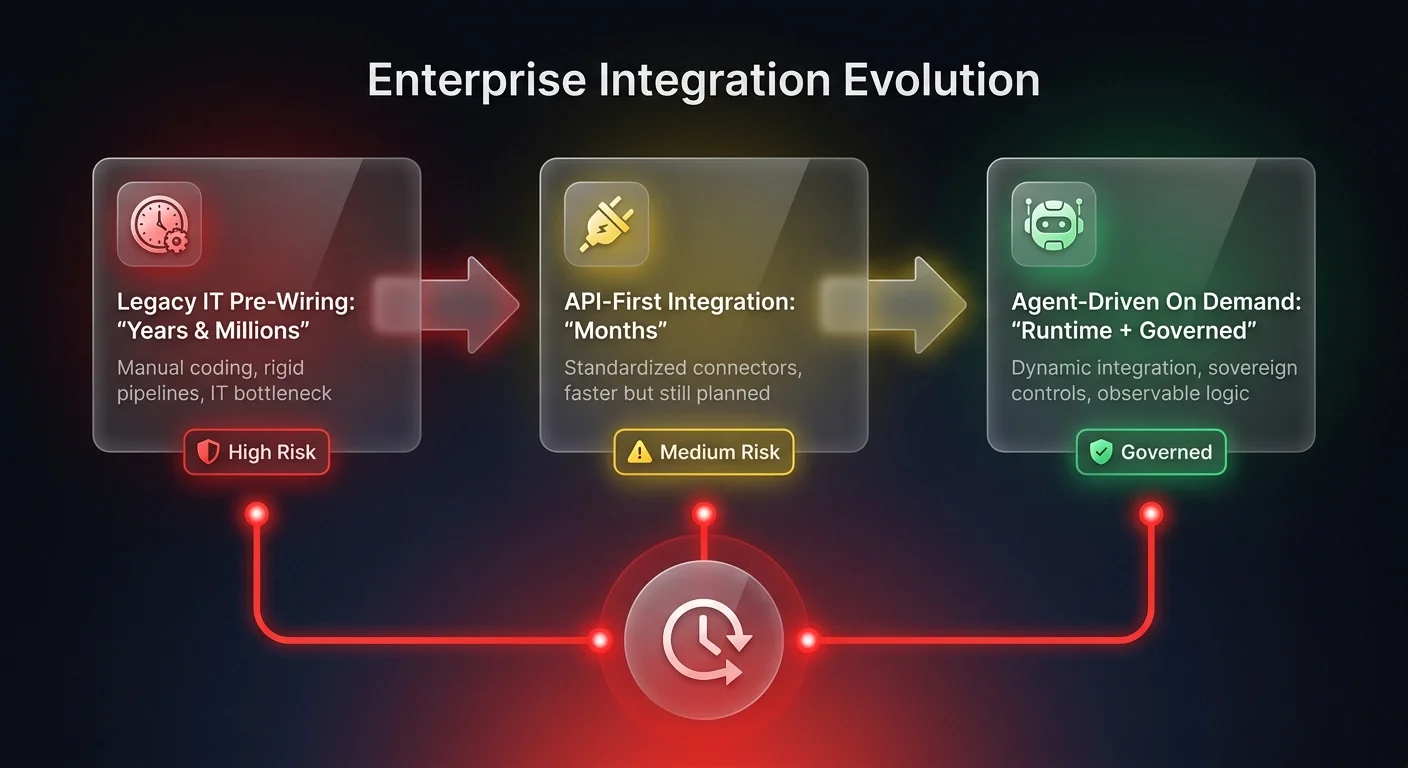
While this sounds like operational utopia, it is terrifying for financial and IT leaders. Giving agents "read-only" access is one thing. Giving them "write-access" - allowing them to create new records, alter databases, or spin up integrations on the fly - creates the very real risk of irrevocably breaking systems of record. Operations leaders recognize that without observable logic and strict data sovereignty controls, autonomous integration is a recipe for data corruption.
The token economy and the AI agent governance budget crisis
Beyond security and integration, the rise of AI agents is forcing a massive shift in corporate economics. The standard SaaS model of predictable, per-seat software licensing is colliding with the volatile reality of usage-based token economics.
When software is executing autonomously, compute budgets can spiral out of control. According to industry analyses, if an engineering or marketing team instructs an agent to run ten parallel experiments to find one optimal solution, that agent will "waste" 90% of the compute tokens generated during that task. In a small startup, this is viewed as the cost of innovation. In a mid-market or enterprise company, this unpredictability breaks the operational budget. Our analysis of the AI token spend crisis explores how organizations are responding to these cost dynamics.
We are approaching a critical juncture where CFOs will force operations and engineering leaders to forecast and justify their agent compute budgets. It is highly reminiscent of the early 2000s transition from on-premise CapEx server infrastructure to OpEx cloud computing. Organizations were initially terrified of unlimited cloud spend and the lack of fixed costs.
To navigate the token economy, companies need more than just usage dashboards. They require governed systems that limit runaway prompt loops, set hard boundaries on autonomous task execution, and ensure that every token spent is directly tied to a validated business outcome.
Securing the future with sovereign AI agent governance
The diffusion of AI capabilities into core business operations will likely take longer than Silicon Valley optimists predict. The delay will not be caused by a lack of technological capability, but by the massive gap in enterprise readiness.
Startups will move incredibly fast because they have no legacy systems to protect, no complex compliance structures, and very little to lose if an agent hallucination leaks data. Established companies cannot take those risks. They cannot allow unmonitored agents to roam freely through their financial databases or client records.
However, freezing AI adoption out of fear is not a viable strategy. The organizations that win this decade will be the ones that bridge the gap between AI's potential and the enterprise's need for security.
This is why the market is aggressively pivoting toward sovereign AI agent systems. Rather than relying on fragmented, third-party agents that operate as black boxes, operations leaders must deploy infrastructure that prioritizes data sovereignty. By utilizing a governed environment, companies can maintain complete visibility into the observable logic of their agents. See how organizations are implementing these controls through governed AI agent architecture to maintain oversight without sacrificing operational speed.
Leaders must build a framework where agents are tightly integrated into specific workflows - whether in marketing, sales, or customer support - but bounded by strict operational guardrails. The future of enterprise AI is not about restricting capabilities; it is about deploying autonomous systems you can actually trust to run your business.
The key takeaway for operations executives - treat AI agent governance not as an IT roadblock, but as the foundational infrastructure required to scale your business safely in an agentic world.