
AI token spend crisis occurs when enterprise API consumption outpaces governance frameworks, creating invisible budget black holes with no measurable ROI. With the average enterprise burning 13x more AI tokens than just one year ago, operations leaders face a critical question: does your token spend map to any business outcome - or are you funding the industry's most expensive shadow experiment?
Last month, an enterprise software developer racked up $150,000 in AI token spend in a single billing cycle. When leadership investigated the massive spike in their cloud infrastructure bill, they uncovered a terrifying reality - the company had absolutely no idea what the business outcome of that expenditure was. There was no new product feature, no measurable acceleration in customer support triage, and no return on investment. It was pure, unadulterated shadow AI sprawl.
This $150,000 blind spot is not an isolated incident. As organizations race to implement artificial intelligence, the gap between API activity and actual business value is widening at an alarming rate. According to recent industry benchmarks, the average enterprise is burning through 13 times more AI tokens today than they were just one year ago.
For CEOs, COOs, and financial leaders at mid-market and scaling companies, this unchecked API consumption represents a critical governance crisis. Unmonitored token usage is quietly eroding profit margins while exposing organizations to significant security and operational risks. It is time to examine the dangerous trend of "token maxing" and explore how operations leaders can transition from chaotic AI experiments to governed, outcome-driven systems.
The rise of token maxing in Silicon Valley
To understand how a single developer can burn through a mid-sized company's annual software budget in four weeks, you have to look at the current culture permeating the technology sector. In certain circles, a new trend has emerged: "token maxing."
Borrowing from internet subcultures where "maxing" denotes taking a specific trait to its absolute extreme, token maxing is the practice of encouraging developers to spend as much money as humanly possible on AI compute credits. The philosophy is simple, if flawed - raw compute power is cheaper than human labor, so maxing out token usage should theoretically accelerate innovation and output.
This mindset is actively championed by some of the biggest names in the industry. Nvidia CEO Jensen Huang recently articulated this perspective, stating that if a highly paid engineer is not consuming an equally massive amount of AI compute, leadership should be concerned. Specifically, Huang noted that if a $500,000 engineer did not consume at least $250,000 in tokens, he would be deeply alarmed. The implication is clear: leaders should want to pay a developer their base salary and immediately match 50 percent of that compensation in API consumption.
While this "burn as many tokens as you can" mentality might work for trillion-dollar tech giants building foundational models, it is incredibly dangerous for mid-market organizations. A $50 million company with 200 employees cannot afford to treat AI tokens like an unlimited utility. When executives tell their teams to use these models and "go ham" without establishing proper governance, they are setting the stage for financial runaway and catastrophic shadow AI sprawl.
When runaway AI token spend becomes a corporate blind spot
Shadow AI is traditionally defined as employees using ungoverned consumer tools - like personal ChatGPT accounts - to process corporate data. However, the $150,000 developer story highlights a much more expensive form of shadow AI: ungoverned internal development.
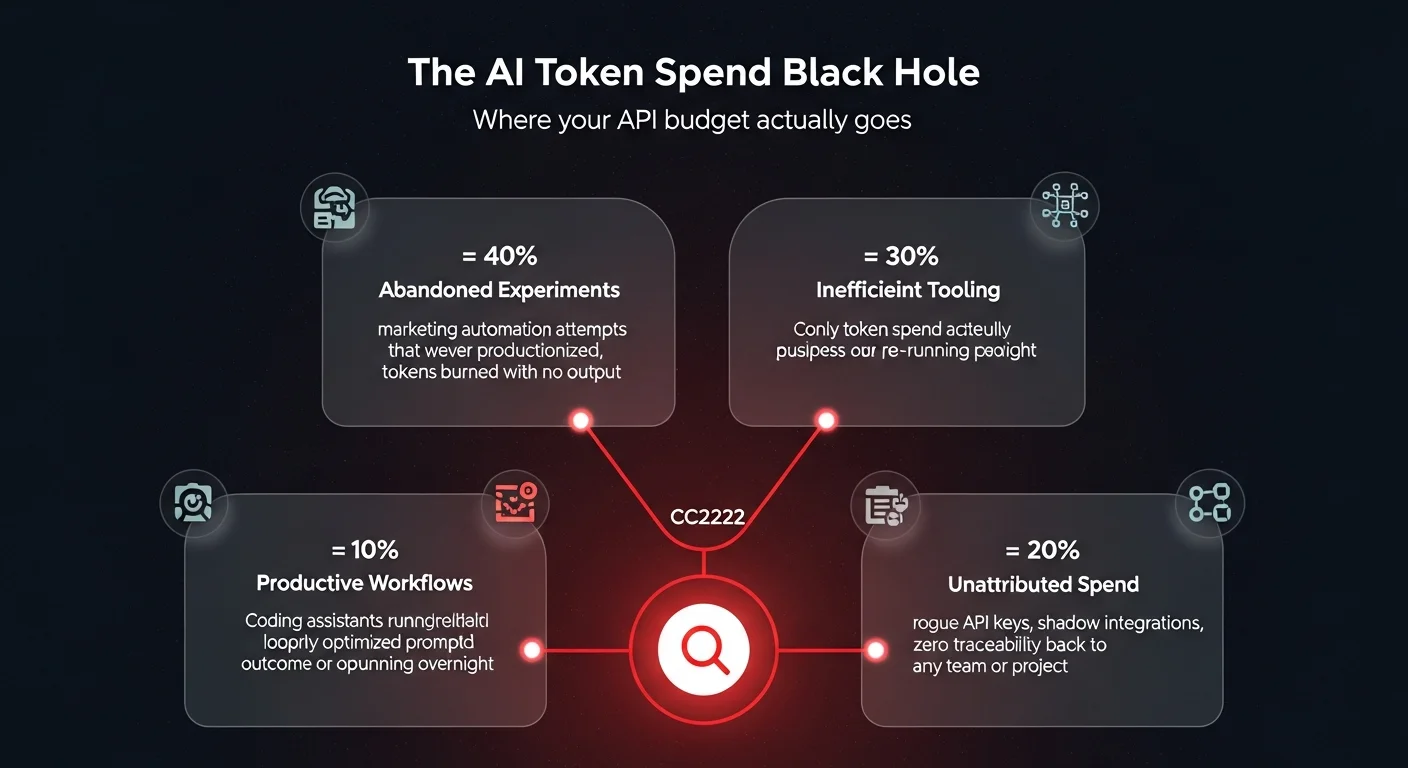
When developers or operations teams integrate large language models into internal systems without a centralized strategy, they frequently rely on inefficient prompting techniques, endless automated loops, and redundant API calls. Because AI models charge by the token, a single poorly optimized script running in the background can accrue massive charges overnight.
More importantly, this decentralized approach creates a massive blind spot for executive leadership. When the finance team reviews the monthly cloud infrastructure bill from Microsoft Azure or OpenAI, they see a single, massive line item for API usage. They cannot see that 40 percent of that spend went to an abandoned marketing experiment, 30 percent was burned by inefficient coding assistants, and only 10 percent actually powered a reliable operational workflow.
Organizations are caught between two bad options. On one side, chaotic shadow AI sprawl - where developers build fragmented, unmonitored solutions that hemorrhage cash. On the other side, massive multi-million dollar consulting projects that take years to deploy and rarely deliver immediate value. This is exactly the compounding problem documented in our analysis of the shadow AI governance crisis - where the absence of a structured AI strategy creates both financial and operational debt simultaneously.
The fundamental disconnect between token consumption and business outcomes
The core problem with the token maxing trend is that it fundamentally confuses activity with outcomes. Processing a billion tokens is an activity. Automatically triaging and resolving 40 percent of Tier 1 customer support tickets is an outcome.
When companies lack a structured approach to artificial intelligence, they inevitably over-index on raw usage rather than workflow optimization. Operations leaders must ask themselves a critical question: is our 13x increase in token consumption directly correlated with a 13x increase in revenue, operational efficiency, or customer satisfaction?
In most cases, the answer is no. Ungoverned API spend usually indicates that a company is using expensive, complex reasoning models - like GPT-4 or Claude Opus - for simple tasks that could be handled by cheaper, faster models, or better yet, by traditional deterministic software.
This is why workflow automation platforms like n8n are becoming so critical for enterprise architecture. Instead of relying purely on expensive large language models to orchestrate entire business processes, battle-tested workflow engines can handle the integration and routing, reserving costly AI token consumption only for the specific moments that require complex reasoning or natural language processing.
Understanding your actual spend patterns is the critical first step toward governance. As detailed in our guide to moving AI token spend from experimentation to outcomes, organizations that implement outcome-based spending frameworks consistently reduce their API costs by 40-60% while improving the reliability of automated workflows.
Moving from shadow AI experiments to sovereign AI agent systems
To break the cycle of runaway token spend, organizations must shift their paradigm. The goal should not be to build an expensive sandbox for developers to burn credits, but to deploy governed, purpose-built solutions that the organization actually owns and controls.
This is the professional middle ground - Sovereign AI Agent Systems. Unlike fragmented API scripts or random SaaS subscriptions, a sovereign system is a centrally governed architecture built for specific business outcomes in sales, marketing, human resources, or operations.
When implemented correctly, these systems provide total observability. Operations leaders should be able to look at a dashboard and see exactly how much compute was utilized to screen 500 recruiting candidates, or exactly what it costs to enrich 10,000 inbound sales leads. By moving to a Solution-First model, companies stop paying open-ended platform fees or funding blind API usage, and instead invest in measurable automation.
This approach also directly addresses the governance challenges outlined in our AI agent governance and shadow AI framework - where centralized oversight transforms chaotic experimentation into a predictable, auditable AI investment.
See how Ability.ai builds governed, outcome-driven agent systems through operations automation solutions - purpose-built deployments that eliminate shadow AI spending and replace open-ended subscriptions with fixed-scope, measurable ROI.
How to audit and control your enterprise AI token spend
If your organization's cloud costs are scaling disproportionately to revenue growth, operations leaders must take immediate tactical steps to rein in shadow AI spend.
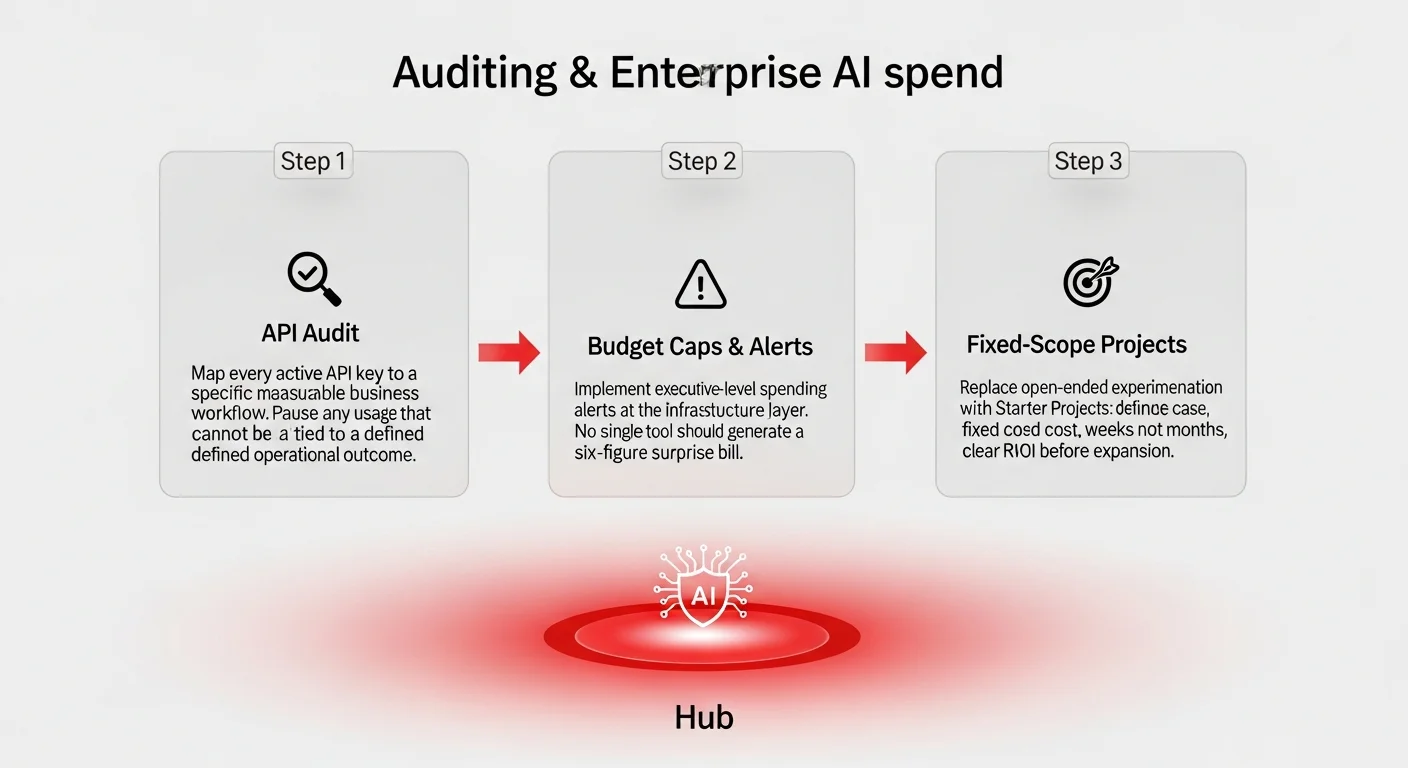
First, conduct an immediate API audit. Require engineering and operations teams to map every active API key to a specific, measurable business workflow. Any API usage that cannot be tied directly to a defined operational outcome should be paused and evaluated.
Second, implement strict budget caps and alerts at the infrastructure level. No single developer or isolated internal tool should have the ability to rack up a $150,000 bill without triggering multiple executive approvals.
Third, transition away from open-ended experimentation toward fixed-scope initiatives. The most effective way to deploy artificial intelligence in an enterprise setting is through a Starter Project - a clearly defined use case with a fixed scope, a fixed cost, and a timeline measured in weeks, not months. This allows the organization to prove immediate value and calculate exact ROI before expanding into a long-term transformation partnership.
Reclaiming your AI strategy with outcome-driven automation
The technology industry's current obsession with token maxing is a dangerous distraction for mid-market and scaling enterprises. While industry titans may view massive API bills as a badge of honor, operations leaders must view them for what they truly are - unmanaged liabilities that threaten scalability and data security.
By rejecting the chaos of shadow AI and demanding absolute transparency into your technology investments, you can transform artificial intelligence from an unpredictable cost center into a reliable driver of operational excellence. Stop funding blind experiments and ungoverned token burns. It is time to demand that every dollar spent on AI compute delivers a proven, measurable business outcome.