
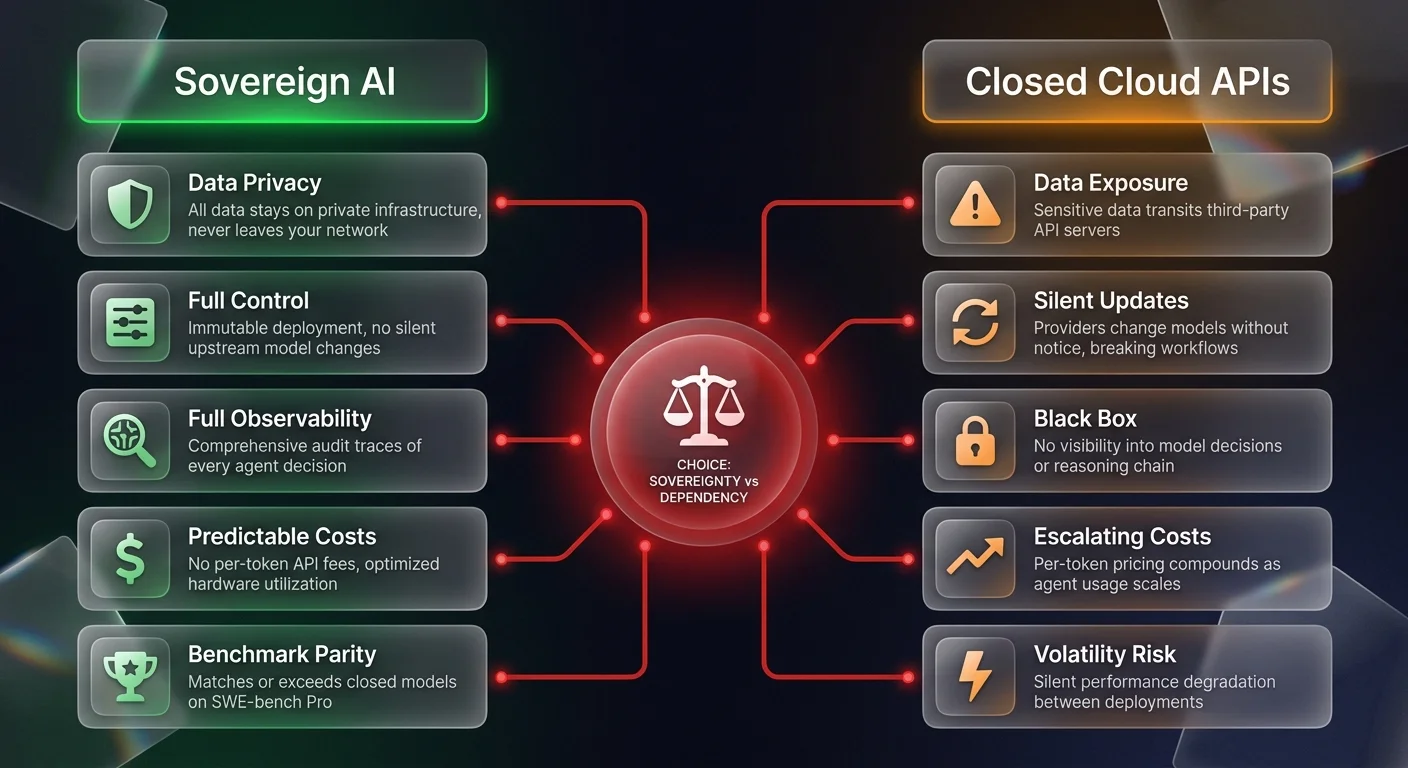
Sovereign AI agents are autonomous systems built on open-weight models that run entirely on private infrastructure, giving enterprises full control over their AI operations. According to recent benchmarks, open-weight models now match or exceed closed proprietary systems on frameworks like SWE-bench Pro - eliminating the last excuse for cloud-model dependency.
For technical leaders navigating the rapidly shifting AI landscape, reliance on closed-model APIs has introduced a critical vulnerability into enterprise operations. When commercial cloud providers update their models behind closed doors, downstream enterprise applications frequently experience silent performance degradation. Sovereign AI agents solve this by running on infrastructure you own and control - workflows that executed perfectly on Friday no longer fail on Monday due to invisible upstream changes.
Organizations are rapidly adopting sovereign AI agents - intelligent autonomous systems built on open-weight models that run entirely on private, controlled infrastructure. This shift mirrors the broader movement toward local AI infrastructure that prioritizes operational reliability over cloud convenience.
Recent developments in the open-source ecosystem have effectively erased the performance gap between closed proprietary systems and open models. By leveraging these advancements, technical operators can deploy highly capable, visually aware AI agents that pass enterprise procurement requirements, guarantee data privacy, and serve as permanent, reliable company infrastructure.
<!-- INFOGRAPHIC: Comparison chart showing open-weight vs closed model capabilities across SWE-bench Pro, Humanities Last Exam, and enterprise deployment metrics including uptime, data sovereignty, and update control -->The hidden cost of closed AI infrastructure for sovereign AI agents
For years, a pervasive myth suggested that open-source models simply could not match the reasoning capabilities of their closed-source counterparts. Industry benchmark data proves this is no longer the case. On rigorous evaluation frameworks like SWE-bench Pro and the Humanities Last Exam, open models are now routinely matching or exceeding closed proprietary systems.
Models like GLM 5.1 and recent releases from DeepSeek carry permissive open-source licenses (such as MIT or Apache 2.0) or open-weight designations. This accessibility fundamentally shifts the power dynamic from the model provider back to the enterprise.
The primary advantage of the open ecosystem is observability and control. When an organization hosts its own agentic models, no arbitrary updates occur in the background. The infrastructure remains immutable until internal teams explicitly decide to upgrade. This eliminates the operational risk of unannounced cloud degradation, ensuring that complex automation pipelines perform identically day after day. For organizations already struggling with AI observability challenges, sovereign deployment provides a clear path to full transparency.
Furthermore, the ecosystem supporting these models has matured significantly. Modern inference routing allows organizations to easily evaluate the vast open ecosystem - which now includes nearly 3 million models hosted on platforms like Hugging Face - to automatically benchmark performance and route tasks to the most efficient provider based on cost, speed, and specialized tool-use capabilities.
Vision LLMs and the new era of computer use
A critical evolution in agent infrastructure is the shift toward native vision capabilities. Historically, providing an AI agent with visual context required complex, multi-step integrations involving separate optical character recognition (OCR) systems and text-only logic models.
Today, advanced models like Gemma 4 and Qwen 3.5 are launching as omnimodal systems with vision capabilities built in from day zero. These Vision LLMs (V-LLMs) represent a massive breakthrough for operations-heavy organizations. Because they inherently understand visual space, these models can act directly as "computer use" agents. They can analyze screenshots, map user interfaces, and determine exactly where to click to execute a workflow.
For organizations heavily reliant on legacy ERPs, customized CRMs, or outdated software lacking modern APIs, vision-capable agents bypass the integration bottleneck entirely. They interact with software exactly as a human operator would - via the graphical user interface - making it possible to automate historically untouchable processes.
Autonomous provisioning: sovereign AI agents managing compute
The maturity of the open ecosystem extends far beyond the models themselves - it encompasses the tools used to govern and deploy them. Through frameworks like Model Context Protocol (MCP) and specialized server skills, we are entering an era where AI agents can autonomously manage other AI models and the underlying cloud infrastructure.
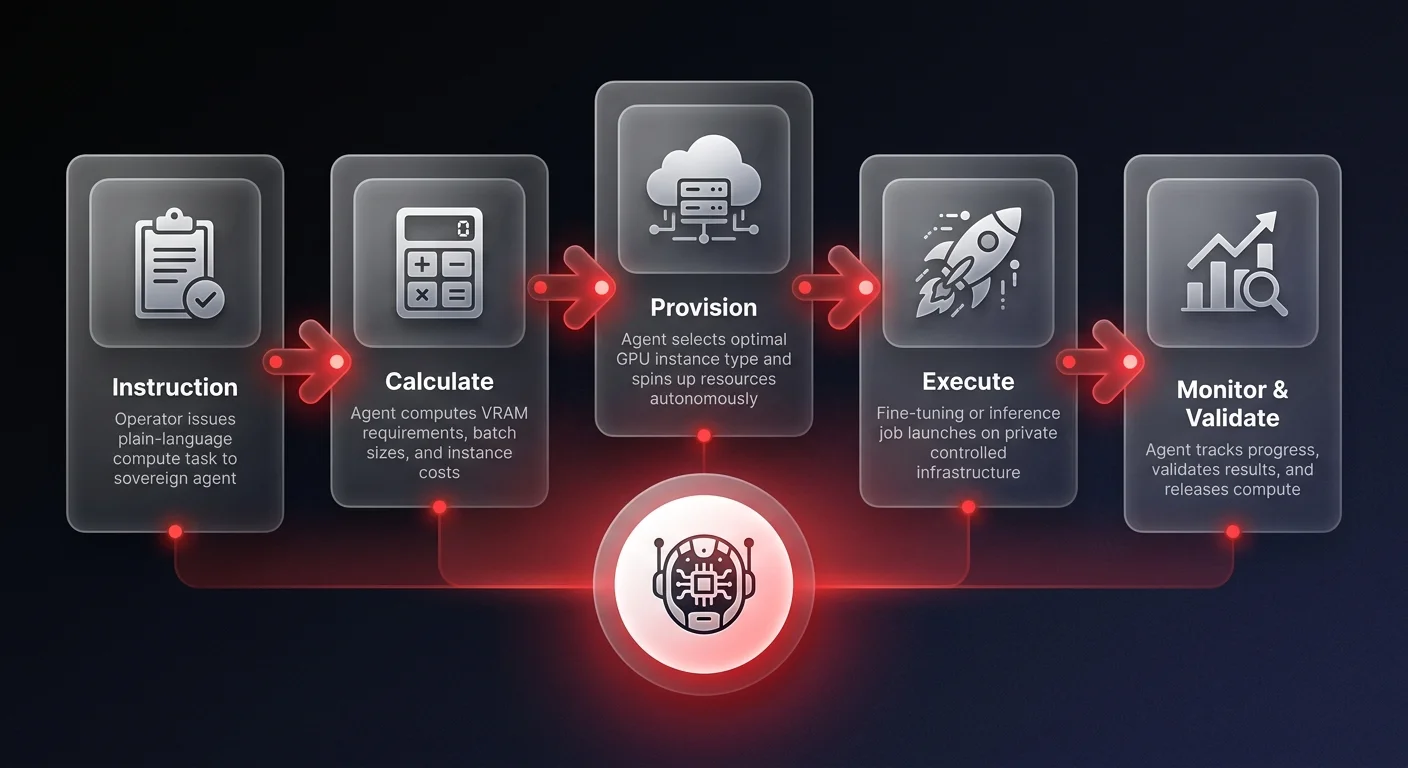
Consider the complexity of training a new vision-language model. Traditionally, this required an AI engineer to manually calculate the necessary VRAM, determine appropriate batch sizes, provision the correct cloud GPU instances, and monitor the job.
Modern agentic workflows automate this entirely. By connecting an agent to local infrastructure via command-line skills, an operator can simply instruct the system to "train Qwen2-VL on the LLaVA-Instruct-Mix dataset." The sovereign agent takes over the operational burden. It autonomously performs the napkin math required to calculate exact compute costs, selects the most efficient instance type, partitions the validation splits, and launches the fine-tuning job.
This capability scales to massive data processing tasks. In a recent industry benchmark, an autonomous agent successfully managed the OCR processing of 30,000 complex research papers. The agent autonomously evaluated OCR benchmarks to select a highly performant, cost-effective model (Chandra OCR), wrote the execution script, calculated the required cloud instances, and orchestrated the execution across high-speed storage buckets. This is not experimental scaffolding - it is production-grade infrastructure orchestration.
Agent traces and the demand for sovereign AI observability
One of the most significant objections to AI agent adoption from enterprise procurement and security teams is the "black box" problem. When an agent executes a multi-step workflow, makes a decision, or accesses a database, organizations need an auditable record of why that action was taken. Ungoverned shadow AI - where employees plug data into random consumer AI tools - creates massive compliance and security risks. The shadow AI governance crisis is already one of the most pressing challenges facing enterprise leadership.
To solve this, modern sovereign AI deployments utilize formalized trace repositories. A "trace" acts as a permanent, searchable audit log of an agent's memory, code acts, tool calls, and decision trees.
By capturing comprehensive traces of locally running agents (using frameworks like Hermes Agent or Pie), organizations achieve true observability. If an agent executes an unexpected action, operators can parse the trace to understand the exact logical failure. Furthermore, these successful trace logs can be aggregated and used to fine-tune future, highly specialized models tailored explicitly to the organization's unique workflows. Agents are no longer ephemeral chat sessions - they are auditable, persistent company infrastructure.
<!-- INFOGRAPHIC: Flowchart showing agent trace architecture with steps from agent action to trace capture to audit log to model fine-tuning feedback loop -->Hardware realities of sovereign AI deployments
The push for data sovereignty has driven incredible optimization in how AI models interact with hardware. Organizations no longer need million-dollar server clusters to achieve absolute data privacy.
Through advanced quantization techniques - shrinking the model weights into highly efficient file formats like GGUF - massive models can be compressed to run on highly accessible hardware. For example, a deeply quantized 4-bit version of the large Gemma 4 model can now fit comfortably inside a single L4 GPU with just 24GB of VRAM. Tools like Llama.cpp and MLX allow these compressed models to run cleanly on edge devices, local servers, and even within secure browsers.
This hardware efficiency enables absolute data sovereignty. Because the model operates entirely within the organization's controlled environment, no sensitive customer data, proprietary source code, or internal communications ever transit across the public internet to a third-party API provider. It is the ultimate safeguard against data leakage, guaranteeing that the end user's privacy is rigorously protected. Organizations exploring sovereign execution architectures are already seeing measurable improvements in compliance posture and data security.
Moving to a sovereign AI architecture
The transition from experimental AI to reliable enterprise automation requires a fundamental shift in architecture. The tools and open-weight models exist to build powerful, secure systems, but wiring these components together requires robust, production-grade infrastructure.
This is the precise gap that purpose-built agent orchestration platforms fill. Rather than brittle workflow glue or experimental agent factories, organizations need persistent, scheduled, and auditable runtime environments to operate sovereign AI agents at enterprise scale.
For CTOs and technical operators looking to consolidate fragmented AI experiments, managed infrastructure with privacy guarantees equivalent to running on your own bare metal - secured via VPN-only access - is now achievable. The key procurement requirements are native Role-Based Access Control (RBAC), single-tenant isolation, and comprehensive audit logs that make agents safe for corporate environments. If you are evaluating whether your organization is ready for this transition, an AI readiness assessment can identify the highest-impact starting points.
Sovereign AI is no longer a theoretical ideal reserved for companies with massive machine learning engineering teams. By combining the power of the open-source model ecosystem with purpose-built agent infrastructure, organizations can deploy intelligent systems that reduce operational headcount while ensuring total ownership over their data, their logic, and their infrastructure. The era of closed-model volatility is ending - it is time to take control of your AI operations.