
AI copyright risk is the legal and financial liability businesses face when using AI tools trained on unlicensed or stolen intellectual property. Legal frameworks governing AI are dangerously lagging behind technological advancement — creating a 'Wild West' environment where 20th-century laws collide with 21st-century code, threatening not just artists, but any company trying to build on top of these tools.
The reality is: if we don't fix the foundation of how AI is trained and regulated, we risk collapsing the entire ecosystem. This isn't just an ethics seminar topic - it's an existential risk to the commercial viability of AI.
The digital wild west
Here's the hard truth about the current state of AI - we're building the plane while it's in mid-air. The technology has accelerated at a radical pace, leaving legal and ethical frameworks in the dust. We are currently operating in a digital Wild West where the rules are undefined, and the risks are massive.
The central conflict is obvious but often ignored in the rush to ship products. On one side, you have the disruptive force of tech companies pushing the boundaries of what's possible. On the other, you have individual creators and rights holders whose work is being ingested at industrial scales without consent.
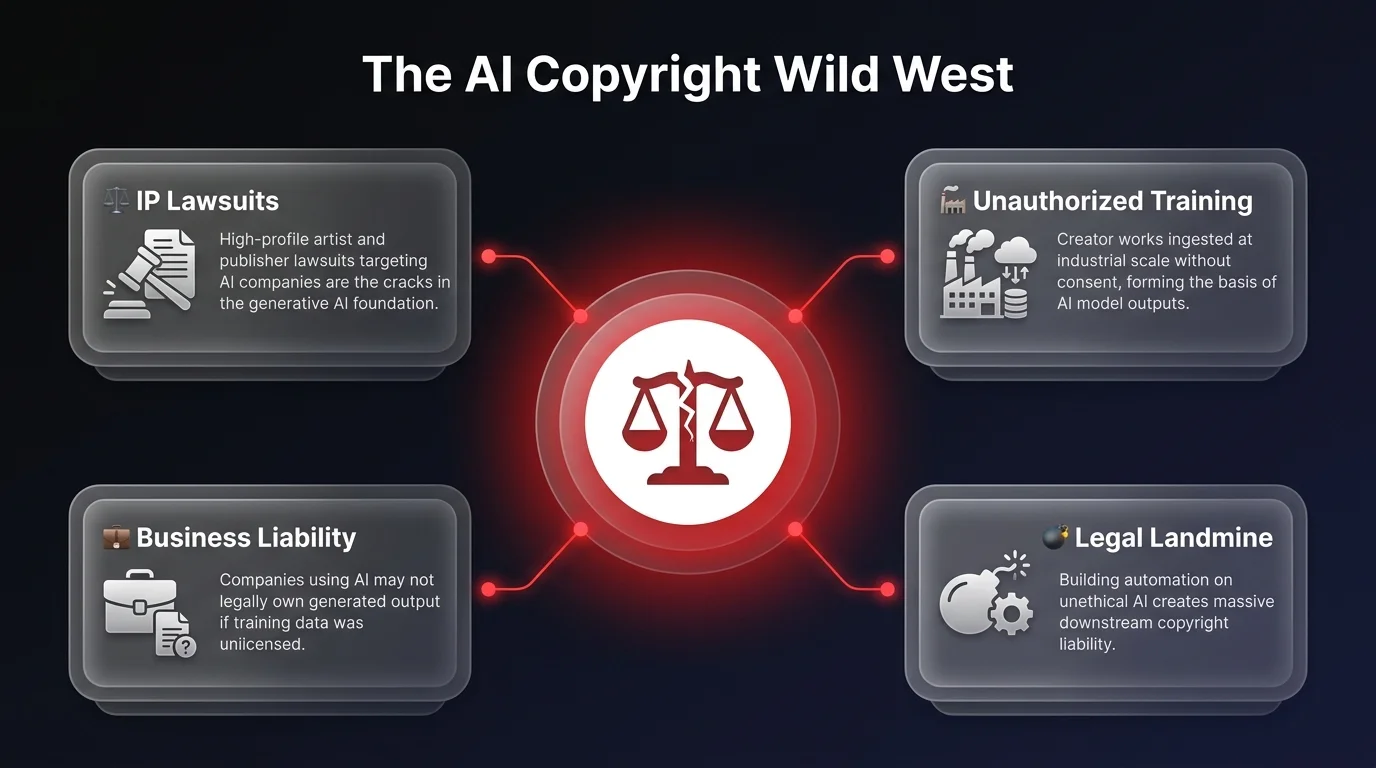
If the data used to train these models is sourced unethically, the creative output is built on a foundation of theft. It's that simple. We are seeing high-profile lawsuits where artists are rightfully suing AI companies. These aren't just minor legal skirmishes - they are the cracks in the foundation of the entire generative AI economy.
For businesses adopting AI, this presents a hidden liability. If your AI stack relies on models trained on stolen IP, do you actually own the output? Or are you building your company's automation on a legal landmine waiting to explode? Starting with an AI readiness assessment can help identify these risks before they become costly liabilities. The status quo of 'move fast and break things' doesn't work when what you're breaking is the fundamental concept of intellectual property.
So what's the solution?
So what's the solution? We can't put the genie back in the bottle, but we can - and must - orchestrate a better system.
The question isn't whether AI will continue to grow. The question is how we build the infrastructure to support it sustainably. We need a radical shift toward transparency in training data. The current 'black box' approach is unsustainable for enterprise adoption.
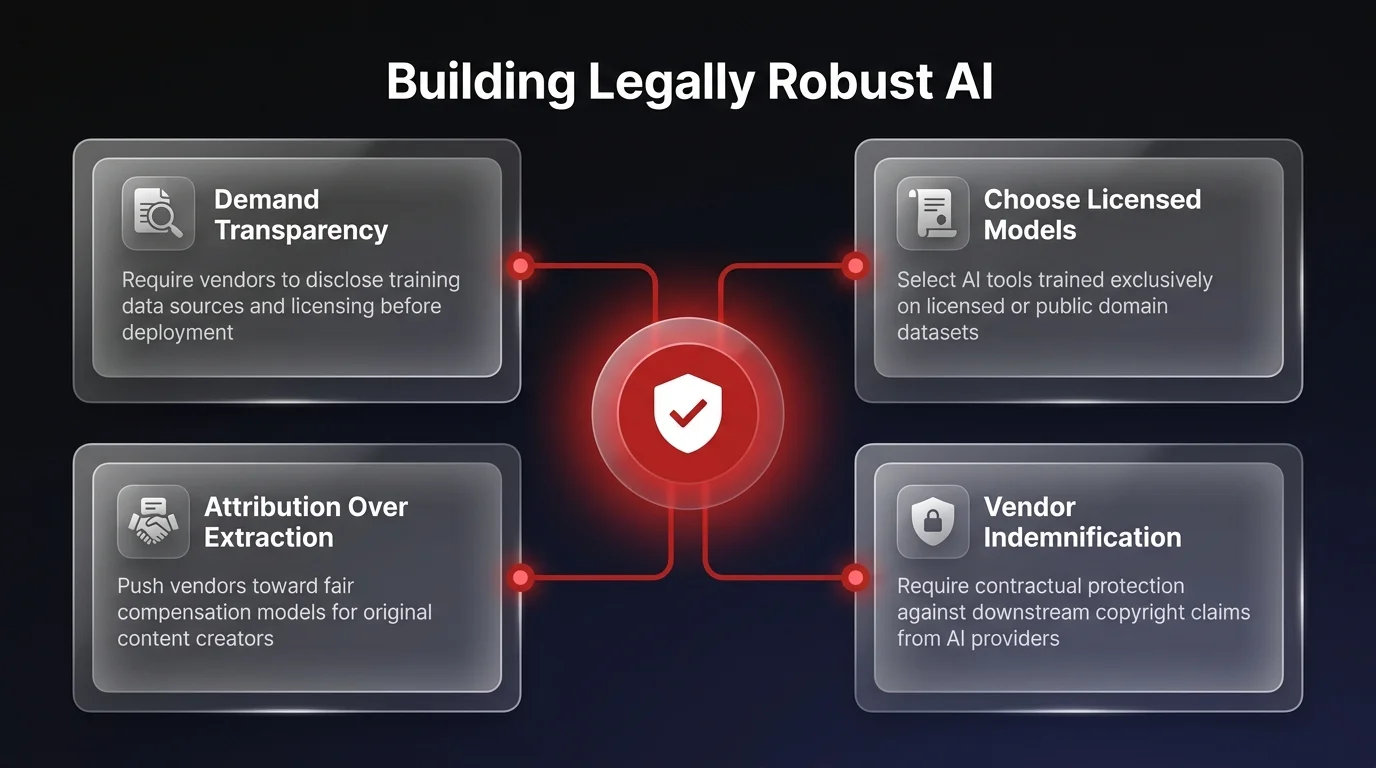
Policymakers, developers, and the creative community need to collaborate on establishing clear, enforceable standards. We need to move from a model of extraction to a model of attribution and fair compensation. True ownership in the AI age requires that the value chain is clean from the start.
For business leaders, the game has changed. You can no longer blindly trust that the models you use are legally safe. You need to demand transparency. You need to ensure that the tools you use to amplify your workforce — from operations automation to content generation — aren't creating massive downstream liabilities.
We need to reach a critical mass of companies demanding ethical data sourcing. This will force vendors to clean up their act. The future of AI isn't just about who has the biggest model - it's about who has the most legally robust, ethically sound, and reliable system. That is high signal. Everything else is just noise and risk.
At Ability AI, we don't just build agents that work; we build systems designed for the enterprise reality. We help you orchestrate AI architectures that prioritize security, compliance, and genuine ownership. Don't build your future on a legal gray area. Let's build it right.