
The AI POC graveyard is where 95% of companies get stuck — running endless pilots that never reach production and deliver no measurable P&L impact. According to research from McKinsey, Gartner, and MIT, 42% of AI initiatives are scrapped before leaving the pilot stage (a 3x increase year-over-year), and 72% of companies report barely breaking even on their AI investments. But the top 5% are seeing extraordinary, historically unparalleled returns — and the gap between winners and losers is widening fast.
The POC graveyard
I've spent months synthesizing research from McKinsey, Gartner, and MIT, and the picture is clear. We are seeing a massive divergence in the market. On one side, you have the 95% - the vast majority who are struggling. Data shows that 42% of AI initiatives are now being scrubbed and shut down before they ever go beyond a pilot. That is a 3x increase from last year. Even worse, 72% of companies report they are barely breaking even or actively losing money on their AI investments.
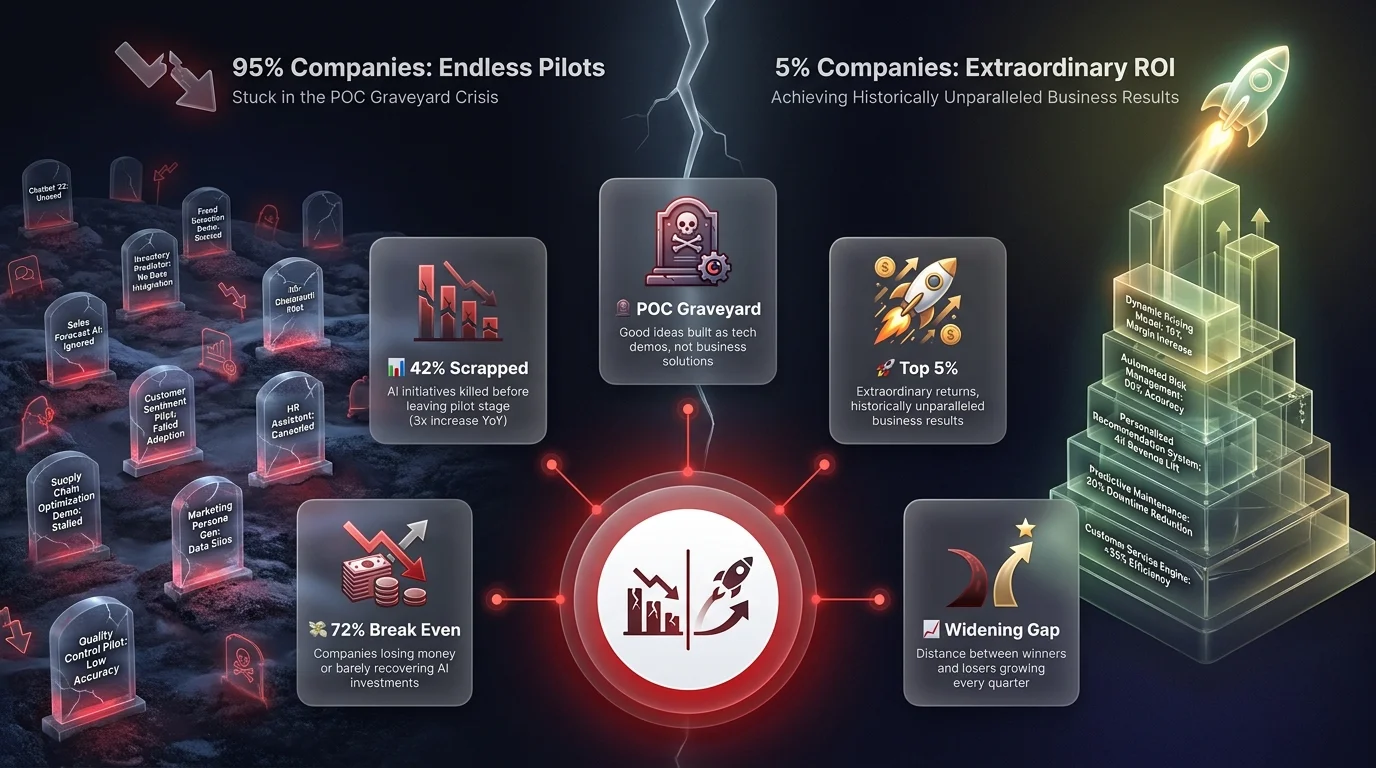
This is the 'POC graveyard.' It's where good ideas go to die because they were built as tech demos, not business solutions. The game has changed. You can no longer afford to treat AI as a novelty or an R&D experiment. The cost of capital is too high, and the technology is moving too fast.
But here's the other side of the coin - and it's why this matters so much. The top 5% of companies aren't just succeeding; they are seeing extraordinary results. These aren't incremental gains. We are talking about returns that are unparalleled in modern business history. These leaders have figured out how to move beyond the hype and orchestrate systems that deliver genuine value. They understand that AI isn't magic - it's an engineering discipline that requires radical ownership of the outcome.
So, how do you flip the script?
So, how do you flip the script? How do you move from the failing 95% to the elite 5%?
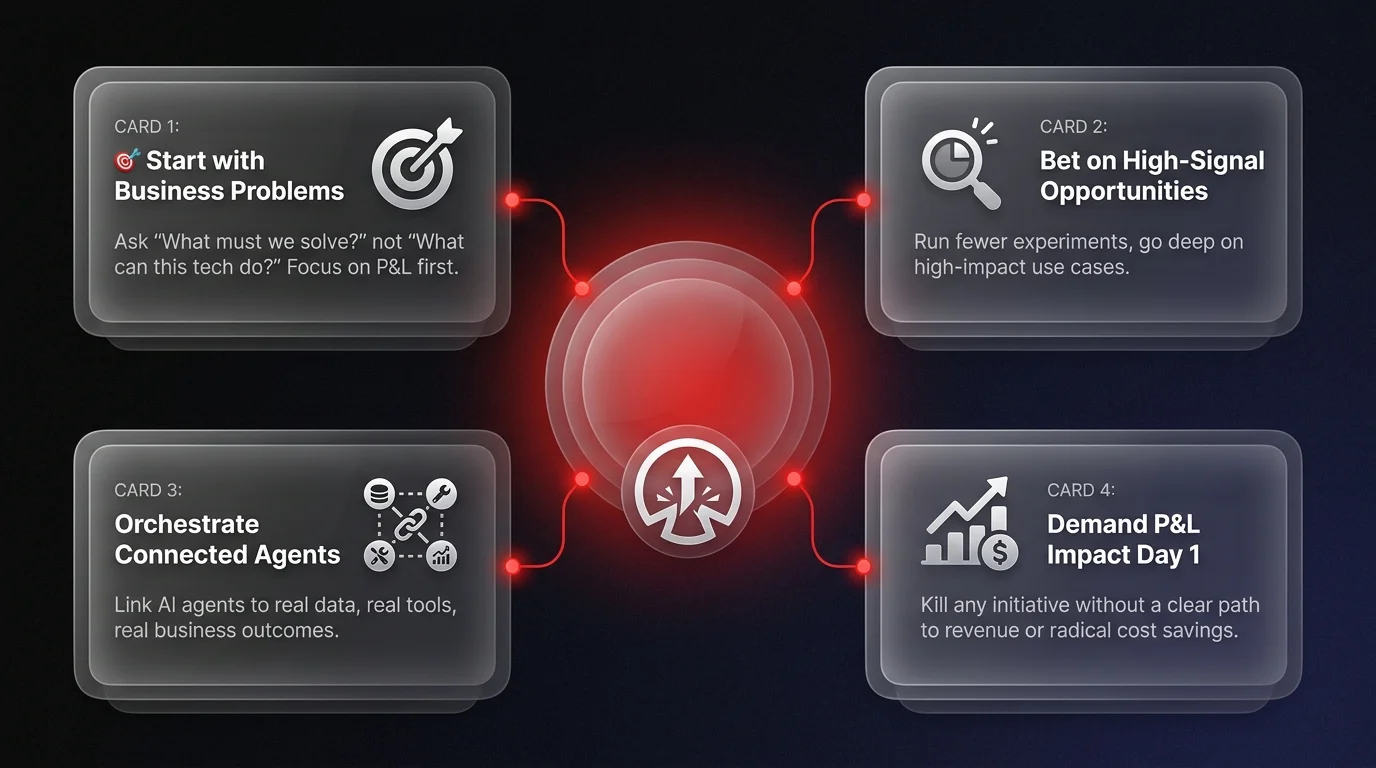
The difference lies in intent and execution. The companies winning with AI aren't just deploying models; they are redesigning workflows. They don't ask 'What can this tech do?' They ask 'What business problem must we solve?' and then they build the operations automation architecture to solve it.
Instead of running twenty disconnected experiments, they bet big on high-signal opportunities. They focus on orchestration — connecting AI agents to real data, real tools, and real outcomes. They demand P&L impact from day one.
The 5% realize that AI agents are here to amplify human capability, not just automate tasks. They look at the full stack and ensure that every piece of the architecture contributes to the bottom line. If your AI initiative doesn't have a clear path to revenue or radical cost savings, kill it. Stop wasting time in the graveyard.
The companies that crack this code are building a competitive moat that will be impossible to cross in a few years. The question isn't whether AI works. The question is whether you have the discipline to make it work for your P&L.
You don't have to be part of the 95% statistic. At Ability AI, we specialize in helping businesses escape the POC graveyard by building AI agent systems that drive real, measurable revenue. We don't do science experiments; we build production-grade solutions. Let's talk about how to get you into that top 5%.