
AI as a creative co-pilot means using AI to amplify human vision and execution — not as an automated replacement for human creativity, but as the most powerful collaborative tool ever invented. Left to itself, AI produces generic noise; the magic happens in the dialogue between human and machine. Like the synthesizer that didn't kill music but created entirely new genres, AI doesn't replace creative capability — it expands what is possible for those who learn to orchestrate it.
We need a radical shift in perspective. Stop thinking of AI as an automated artist that renders you obsolete. Start thinking of it as the most powerful paintbrush ever invented. It's a creative co-pilot that demands a skilled pilot to orchestrate it.
Let's look at history
Let's look at history to understand where we are right now. When the synthesizer was introduced, the music industry had a collective meltdown. Musicians were convinced it was the end of 'real' music. They thought machines were replacing the human soul.
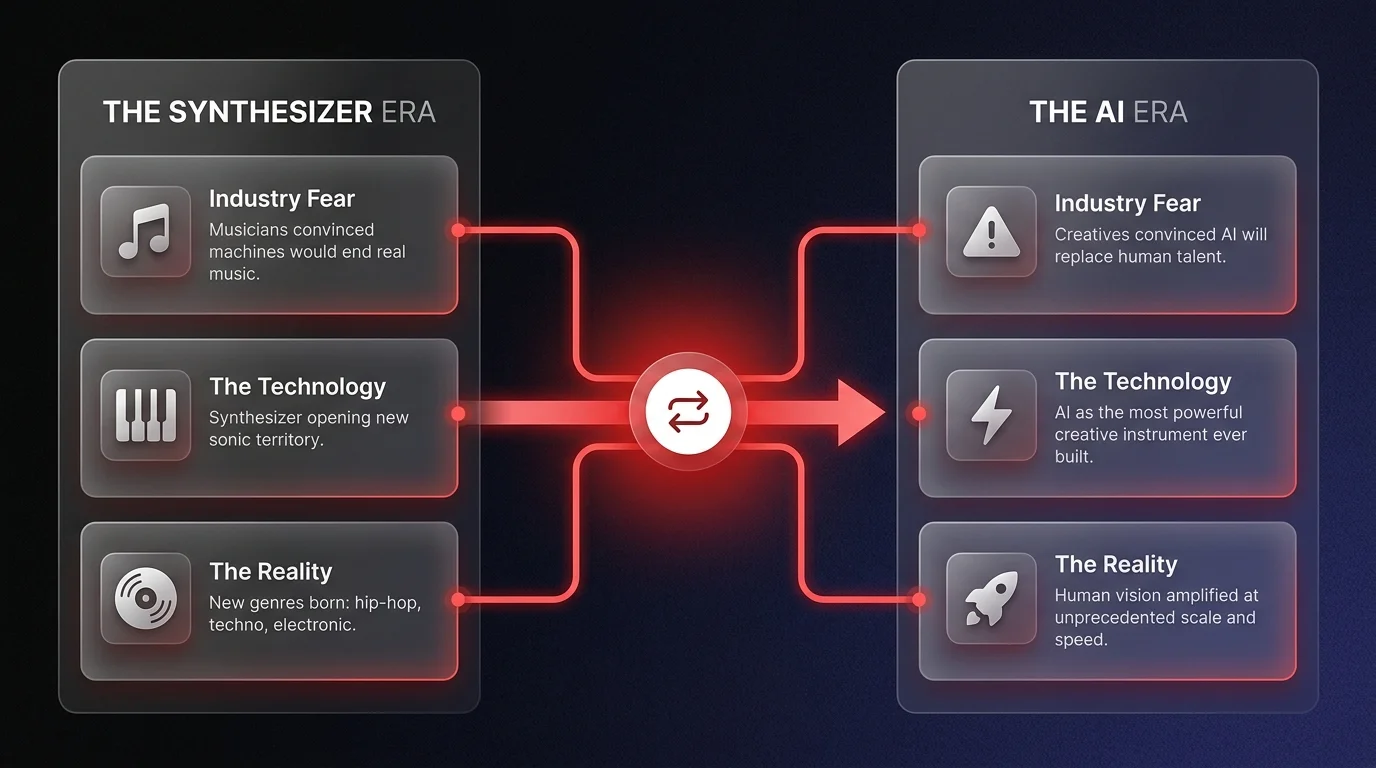
But what actually happened? The synthesizer didn't kill music. It exploded the sonic palette. It gave birth to entirely new genres - hip-hop, techno, electronic - that were physically impossible to create before. It didn't replace the musician; it empowered them to do things they couldn't dream of previously.
We are at that exact same moment with AI.
The reality is that the most interesting results don't come from the AI alone. Left to its own devices, AI produces generic, average, high-volume noise. The magic happens in the dialogue between the creator and the machine. It's about the friction, the iteration, and the guiding hand of a human who knows exactly what they want.
This is about ownership. When you use AI correctly, you aren't outsourcing your creativity. You are orchestrating a complex stack of tools to execute your vision faster and with higher fidelity than ever before — exactly what we documented in our AI content production case study. You are the director; the AI is just the crew.
So how do you actually apply this?
So how do you actually apply this? You need to flip the script on how you work.
Instead of asking 'Will AI do this for me?', ask 'How can AI help me explore this idea deeper?'
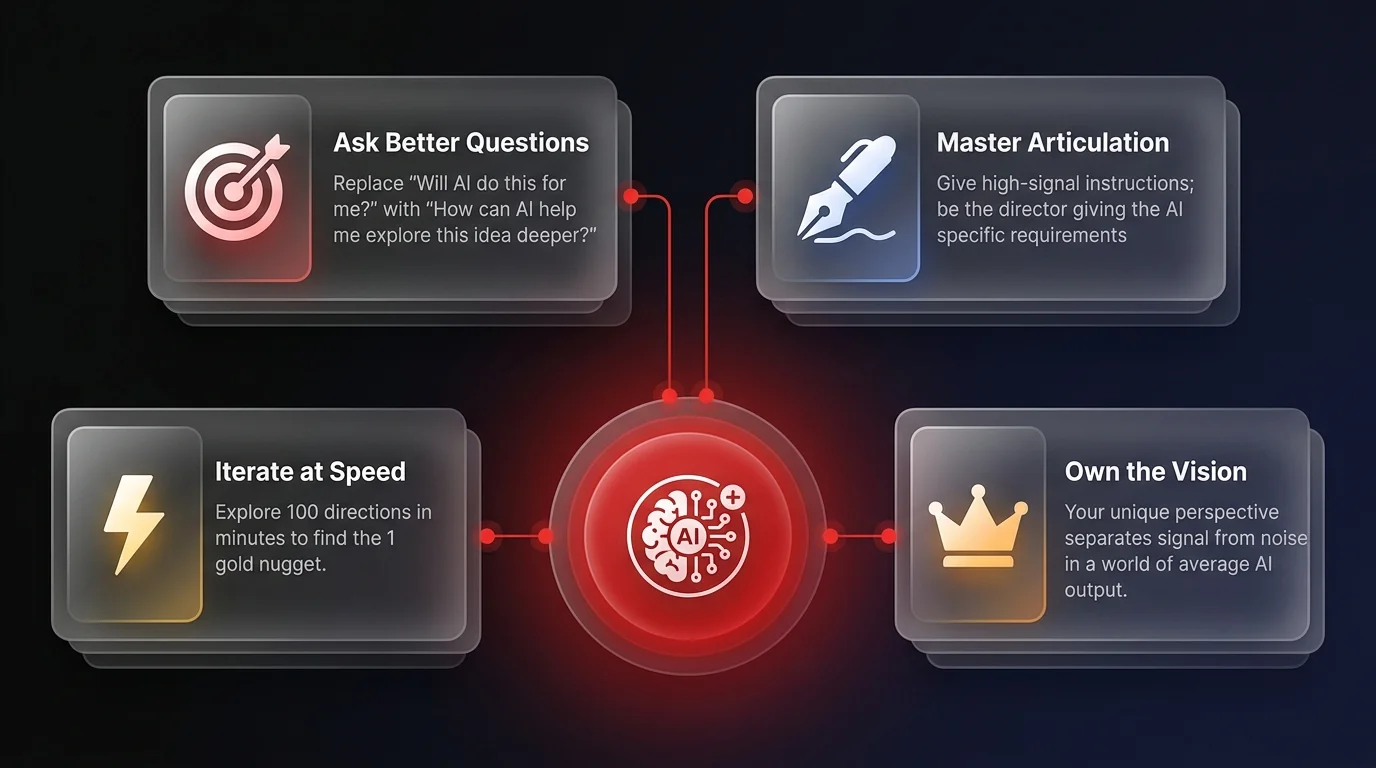
The artists and operators who win in this new era won't be the ones who just type a prompt and hit enter. It will be the ones who treat AI as an extension of their own mind — the foundation of AI-powered marketing content that actually converts. They use it to iterate through a hundred bad ideas in minutes to find the one gold nugget. They use it to handle the execution gap, closing the distance between the idea in their head and the final product.
This requires a new set of skills. You need to become an expert at articulation. You need to know how to give high-signal instructions. You need to understand the limitations of the tool so you can push it right to the edge of what it can do.
The status quo is gone. We are entering a period of exploration where the barriers to creation are effectively zero. That doesn't mean creativity is cheap - it means your unique perspective is more valuable than ever. The tools are available to everyone. The vision is what separates the noise from the signal. Don't let fear keep you on the sidelines.
At Ability AI, we don't build AI to replace humans. We build agentic workflows that remove the drudgery and let your team focus on high-value creative problem solving. If you're ready to stop fearing the future and start orchestrating it, we should talk. Let's build a system that amplifies your best work.
Amplifying your best work
At Ability AI, we build agentic workflows that remove the drudgery and let your team focus on high-value creative problem solving.