
AI layoffs are most often a strategic cover story - not proof that AI is replacing workers at scale. Most announced workforce reductions hiding behind the AI label actually reflect sector recessions, capital reallocation to GPU infrastructure, or corporate theater by leaders who lack a coherent automation roadmap. Understanding which driver is at play is the key intelligence advantage for any operations leader right now.
The term AI layoffs has become one of the most pervasive, yet frequently misunderstood, labels in the modern business landscape. As organizations across the globe announce significant reductions in force, many leaders have been quick to point toward automation and large language models as the primary catalysts for these changes. However, research into the underlying mechanics of these corporate shifts suggests that the story is far more complex than a simple replacement of humans with machines. By peeling back the label, we can see that AI is often being used as a convenient catch-all for a variety of strategic pressures, ranging from localized economic shifts to massive capital reallocations toward hardware.
For operations leaders and executives in mid-market and scaling companies, understanding the true nature of these workforce changes is critical. A layoff is more than just a reduction in headcount; it is a high-stake strategy signifier - a public declaration of where a company is going and what it values. When a company cites artificial intelligence as the reason for downsizing, it is providing a window into its strategic intent, or in some cases, its strategic confusion. To build a resilient organization, leaders must move past the headlines and analyze the three distinct business situations currently hiding behind the AI layoffs narrative.
The three hidden drivers behind the AI layoffs label
When we analyze the data behind recent workforce reductions, we find that the label is being used simultaneously as an excuse for sectors experiencing specific economic challenges and as a signal for those making massive bets on infrastructure. Our research identifies three primary drivers that organizations are bundling under the banner of AI-driven change.
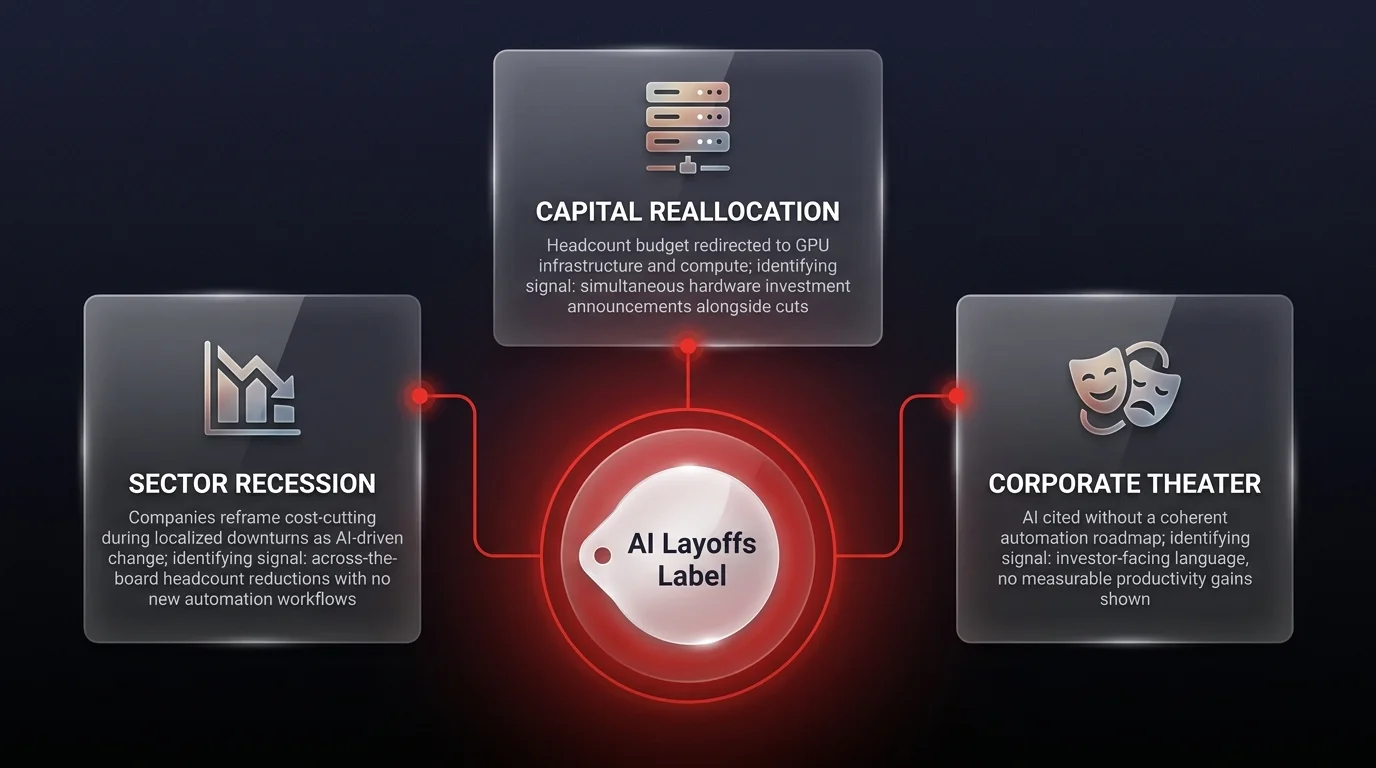
First, many companies are currently navigating a localized recession within their specific sectors. This is particularly prevalent in the technology and software-as-a-service (SaaS) industries, which saw unprecedented growth during the previous decade. As market conditions tighten and capital becomes more expensive, these organizations must find ways to reduce costs and return to profitability. Branding these necessary cuts as AI layoffs allows leadership to frame a reactive economic necessity as a proactive, forward-looking strategic shift. It suggests that the company is not struggling, but rather evolving into a more efficient, tech-driven version of itself.
Second, there is the reality of capital reallocation. We are seeing a massive shift in how organizations spend their primary investment dollars. In many cases, money that was previously allocated to payroll and headcount is being redirected toward expensive hardware and infrastructure - specifically high-end GPUs and computing power. This is not necessarily a story of an AI agent replacing a person's tasks; it is a story of a company deciding that its competitive advantage now lies in its compute capacity rather than its human capital. For these firms, reducing the workforce is a prerequisite to affording the massive capital expenditure required to train or run sophisticated internal models.
Third, and perhaps most concerning, is the use of the term by leaders who lack a coherent AI strategy. For companies that do not yet know how to effectively deploy autonomous systems or governed agents, claiming AI layoffs serves as a useful "AI story" for investors and boards. It projects an image of innovation and digital transformation without requiring the company to show the actual results or workflows that have been improved. It is, essentially, a form of corporate theater designed to buy time while the organization struggles to figure out its long-term technological roadmap. Leaders who want to avoid this trap should read why most AI proof-of-concept projects end up in the graveyard before committing to any workforce reduction strategy.
Why AI layoffs serve as a high-stake strategy signifier
To understand the future of the market, one must look at where organizations are cutting and where they are doubling down. There is no more definitive signal of a company's true priorities than a large-scale layoff. While a press release can claim any number of strategic goals, the movement of human capital and financial resources reveals the actual path.
When a competitor or a peer organization announces a reduction in force due to AI, they are publicly admitting their strategic direction. If they are cutting their customer support tier to invest in GPUs, they are betting on a fully automated service model. If they are cutting across the board while citing AI, they may be admitting to a lack of AI agent governance and a reactive approach to the market. For leaders watching from the sidelines, these signifiers offer an opportunity to identify gaps in the market.
If a competitor is divesting from human talent before they have a reliable, governed system in place to pick up the slack, they are creating a massive risk for their brand and customer experience. This creates an opening for organizations that take a more measured, solution-first approach. Rather than making a sudden, high-stakes move based on hype, successful organizations are focusing on proving value through focused projects that deliver immediate, measurable outcomes.
The danger of the professional middle ground: Shadow AI vs. governance
Many organizations currently find themselves caught between two equally risky options. On one hand, there is the sprawl of Shadow AI - a situation where employees are using unmanaged tools like ChatGPT or various random integrations to handle sensitive tasks. This creates a nightmare for security and data sovereignty, as ungoverned data sharing puts the organization's proprietary information at risk. The shadow AI governance crisis is accelerating as employees adopt tools faster than compliance teams can audit them.
On the other hand, some companies are attempting to avoid this sprawl by launching massive, slow-moving consulting projects. These projects often take months or years to deliver value, by which time the technological landscape has already shifted. This "all or nothing" approach is exactly what leads to the strategic confusion that often results in poorly planned layoffs.
There is a professional middle ground: the deployment of sovereign AI agent systems that the organization owns and controls. Instead of letting Shadow AI run rampant or waiting for a multi-year transformation, leaders can implement focused starter projects. These are fixed-scope, fixed-cost initiatives that prove value in weeks rather than months. By focusing on specific outcomes - such as automating a high-volume sales process or a recruiting workflow - companies can build a foundation of reliable, centrally governed AI without the need for panicked workforce reductions. Explore how sovereign AI automation works in practice to see what a governed deployment looks like for mid-market organizations.
Capital reallocation: shifting from headcount to infrastructure
The research indicates that for many large enterprises, the move toward AI is a move toward a new type of balance sheet. When a company cuts headcount to afford GPUs, they are effectively moving from a labor-heavy model to an infrastructure-heavy model. However, for mid-market and scaling companies, this massive capital expenditure on hardware is often neither necessary nor wise.
Investing millions into hardware before you have established the necessary orchestration layer is a recipe for wasted capital. The goal should not be to simply own the hardware, but to own the solutions and outcomes. This is where the distinction between infrastructure and autonomous reasoning becomes vital. Modern managed platforms provide the infrastructure for autonomous intelligent systems without requiring the client to become a hardware manager.
By utilizing a managed instance or a sovereign runtime, organizations can achieve the same results as the giants - auditability, persistence, and shared memory - without the massive speculative cost of a GPU farm. This allows for a more predictable operational expense model where you pay for solutions and agents that act as synthetic labor units, rather than betting the company's future on hardware that may be obsolete in two years.
Sovereignty and the transition to autonomous agent systems
True strategic advantage in the age of AI does not come from using the same public tools as everyone else. It comes from sovereignty - the ability to own and control the agent systems that run your business. When an organization relies on generic SaaS platforms for their AI needs, they are often subject to platform fees, changing terms of service, and a lack of transparency.
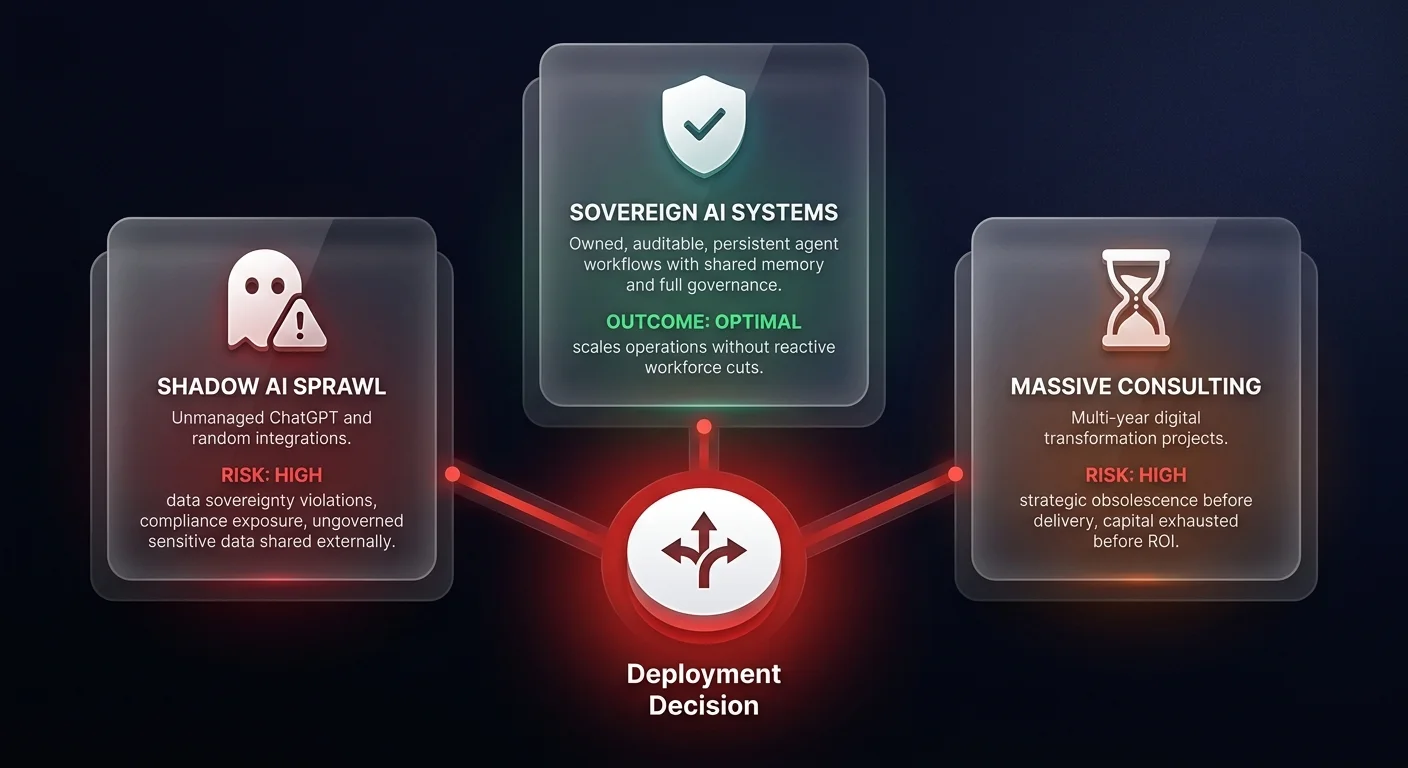
Sovereign AI agent systems built on open-source runtimes offer a different path. These systems are persistent, scheduled, and fully auditable. They allow a company to create a team memory and a shared state across multiple users and agents. This is a fundamental shift from the "assistant" model of AI, where a person asks a chatbot a question, to an "operator" model, where an autonomous system manages a process from start to finish.
For a CTO or an internal AI champion, the goal should be to move the conversation away from "how many people can we replace?" and toward "how can we build an infrastructure that changes how many people we need for the next level of growth?" This shift in perspective moves the organization away from the negative cycle of AI layoffs and toward a positive cycle of AI-enabled scaling.
Escaping the AI theater: building a real operational plan
To avoid the trap of using AI as an excuse for strategic failure, leaders must focus on concrete operational challenges. The most effective way to do this is to start small and expand based on proven success. A starter project focused on a specific business outcome - such as a demand generation engine or a sovereign research agent - provides the data points needed to make informed decisions about future staffing and investment.
This "land and expand" partnership model ensures that the organization is not making blind bets. Each phase of the partnership should deliver a solution that is reliable, governed, and integrated into the company's existing stack, whether that is Microsoft Azure, n8n for workflow automation, or custom-built solutions. This approach eliminates the need for the "AI story" because the results speak for themselves. You aren't cutting staff because you hope AI will work; you are evolving your workforce because you have already proven that your sovereign agent systems are handling specific, high-volume tasks with consistency and security.
Conclusion: the path forward for operations leaders
The phenomenon of AI layoffs is less about the inherent power of the technology to replace humans and more about the strategic choices leaders are making today. While some organizations use the label to hide economic struggles or to justify massive hardware bets, the most successful companies will be those that treat AI as a core component of their long-term governance and operational infrastructure.
For the operations leader at a scaling company, the takeaways are clear. First, do not be distracted by the headlines of competitors; look at their layoffs as signifiers of their true strategic intent and potential vulnerabilities. Second, avoid the risks of Shadow AI by implementing a governed, sovereign system that you control. Third, prioritize outcomes over infrastructure - start with a focused project that proves ROI before making massive capital shifts.
By moving from fragmented AI experiments to a professional, solution-first model, you can build an organization that is not defined by its reductions, but by its ability to scale through synthetic labor and autonomous reasoning. The goal is not to have an AI story for the board; it is to have a sovereign AI system that works for the business.