
Using project documentation as your AI agent's brain means structuring files like changelog.md, architecture.md, and requirements.md so the agent understands the past, present, and future state of your project — not just what to type, but how to think. Most developers treat documentation as a chore, but for AI agents, it is the cognitive architecture that transforms a simple code generator into a partner that understands time, state, and intent.
The cognitive architecture
Let's break down what this cognitive architecture looks like. In my recent experiments, I realized that an agent needs to understand three distinct dimensions of reality: the past, the present, and the future. Without this temporal framework, your AI is just guessing at context.
Here is the radical shift in how we structure files to create this mental model.
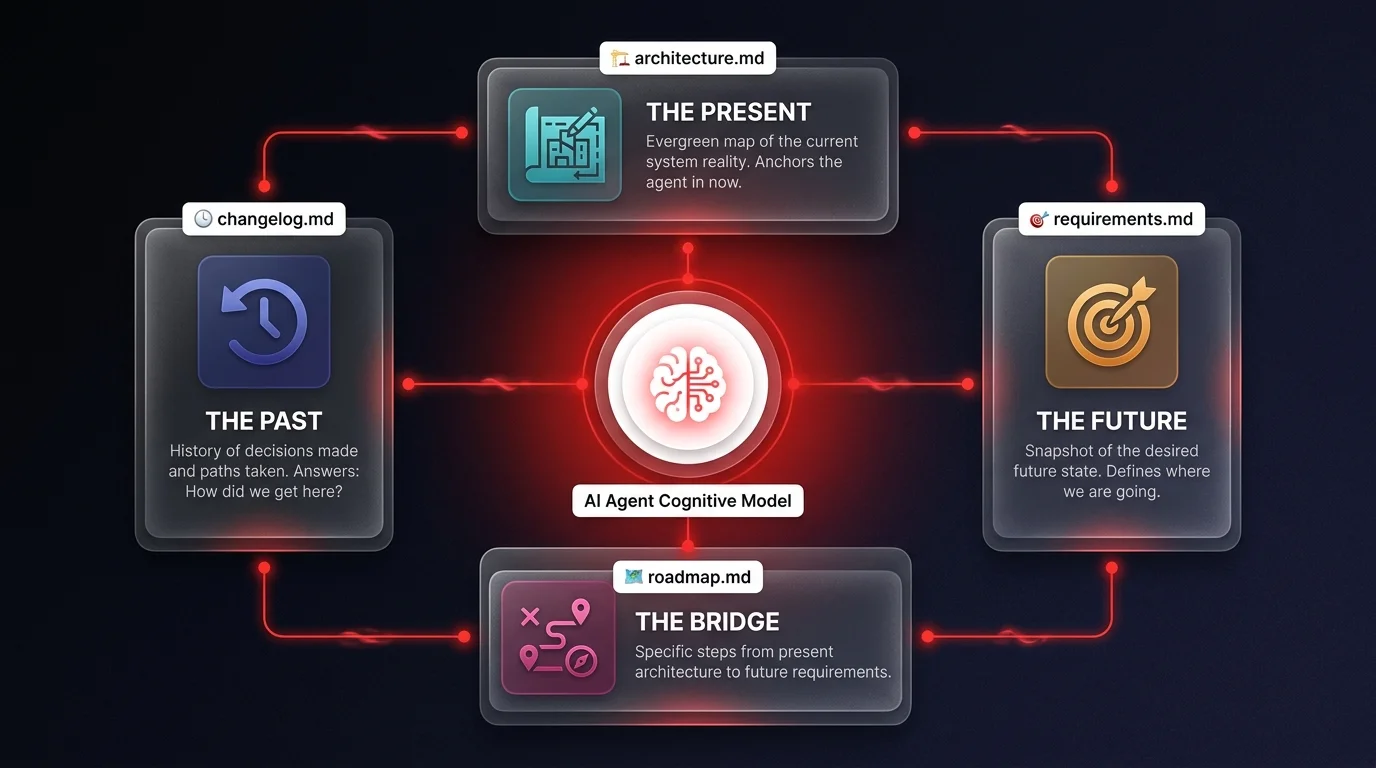
First, changelog.md represents the past. It is the history of what has happened, giving the agent critical context on decisions made and paths taken. It answers the question: "How did we get here?"
Second, architecture.md represents the present. This is not a stagnant file sitting in a dusty folder. It is an evergreen representation of the system's current reality. When the code changes, this file must reflect that immediate truth. It anchors the agent in the "now."
Third, requirements.md represents the future. Originally, we used this for static MVP lists, but now it serves as a snapshot of the desired future state. It tells the agent exactly where we are going.
Finally, roadmap.md is the bridge. It represents the plan - the specific steps required to get from the present architecture to the future requirements.
When you organize your project this way, you aren't just filing documents. You are giving the agent a framework for reasoning. You are enabling it to look at the "now," compare it to the "future," and orchestrate the steps to close the gap. This is how you move from prompt engineering to system engineering.
Orchestrating in practice
This approach fundamentally changes the workflow. It is not about throwing prompts at a chat window anymore. It is about maintaining a living system where the agent actively participates in the evolution of the project.
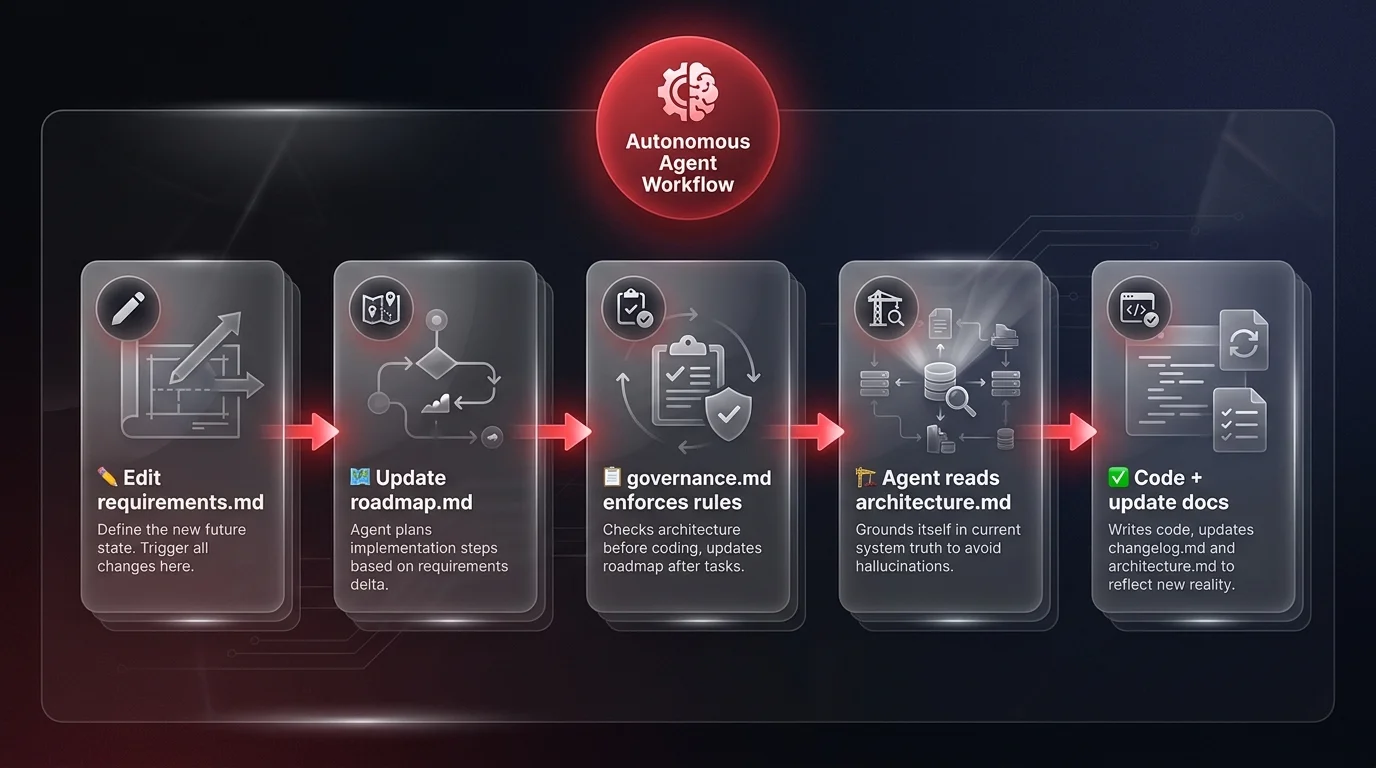
Here is how you orchestrate this in practice. When you want to make a change, you don't just ask for code. You edit the requirements.md first. You define the new future state. This change then trickles down to the roadmap.md, where the agent plans the implementation.
To make this stick, you need a governance file - let's call it claude.md or rules.md. This file enforces the workflow, ensuring the agent checks the architecture before writing code and updates the roadmap after finishing a task. It acts as the superego, enforcing the rules of engagement.
This is high signal work. By separating the "what" (requirements) from the "how" (roadmap) and the "is" (architecture), you reduce semantic noise. You stop getting hallucinations because the agent is not trying to hold the entire context in a vacuum. It has a structured memory — a key principle behind how AI software development automation maintains coherent output across long, complex sessions.
The reality is that agents are only as smart as the context we give them. If you treat your docs as a cognitive model, you amplify the agent's ability to operate with autonomy. This is how you move from simple automation to true autonomous agent ownership. Use your docs to teach the agent how to think, not just what to type.
Building autonomous systems
Building high-performance AI agents requires more than just good prompts - it requires a fundamental rethink of your project structure. At Ability AI, we are obsessively focused on these architectural patterns. If you are ready to stop playing with chat bots and start building autonomous systems that actually deliver, let's talk.