
Automated AI marketing risks arise when companies deploy autonomous agents to post comments, generate leads, or engage audiences on social platforms without human oversight or brand guardrails. Tools that promise to "replace a marketing team" by autonomously posting on Reddit, LinkedIn, and other platforms are triggering platform bans, audience distrust, and "Dead Internet" dynamics — where bots interact with bots rather than real humans, destroying the marketing channel entirely.
At the heart of the issue is a fundamental misunderstanding of where AI adds value in a workflow. When companies deploy agents to autonomously interact with humans - without governance, observability, or human sign-off - they risk turning their legitimate business presence into what industry observers are calling "shitty spammy stuff." This analysis dissects the specific operational failures of autonomous engagement tools and outlines how organizations can deploy safe, governed agent architectures that enhance human craft rather than replacing it.
The dead internet theory and brand liability
To understand the operational risk, we must look at the specific functionality that caused the industry uproar. The tool in question, Astral, markets itself as a "marketing agent" capable of replacing a team. Its workflow involves spinning up agents that scour platforms like LinkedIn and Reddit for relevant conversations, drafting comments, and then - crucially - posting those comments to drive leads.
This specific workflow triggers what internet theorists call the "Dead Internet Theory" - a dystopian future where the web is populated primarily by bots talking to bots. As noted in the analysis of the tool, the immediate reaction from seasoned professionals was visceral: "Jesus, is this marketing? Is this what marketers do? This is brutal."
For a mid-market company, the risk here is not just poor engagement; it is the destruction of trust. The analysis highlighted a terrifying inevitable outcome: "The second you outsource conversations to robots completely, the robots are just going to go back and forth with each other and like, then it's just going to become unusable to humans."
From a governance perspective, this represents a loss of control over the company narrative. If an unmonitored agent enters a Reddit thread and posts, "Hello human, that is a very interesting question," it immediately signals to the community that the brand is disingenuous. The transcript notes that on platforms like Reddit, which have strict community norms, this behavior leads to immediate blacklisting. "You will get blackballed from Reddit if you're trying to convert people in Reddit comments," the speakers warned.
If your marketing operations rely on tools that require you to "set up my 60th Reddit account today because the first 59 have been blackballed," you are not building a business; you are building a spam operation. This creates a massive liability for reputable companies whose employees might be using these tools in the shadows to hit volume targets.
Shadow AI and the governance crisis
The allure of tools like Astral is undeniable for resource-strapped teams. The promise of having one person "outperform a team of 10" is a powerful hook for efficiency-minded leaders. However, this creates a significant "Shadow AI" problem. Operations leaders must recognize that if they do not provide governed, sanctioned infrastructure, their teams will seek out these low-cost automation tools independently.
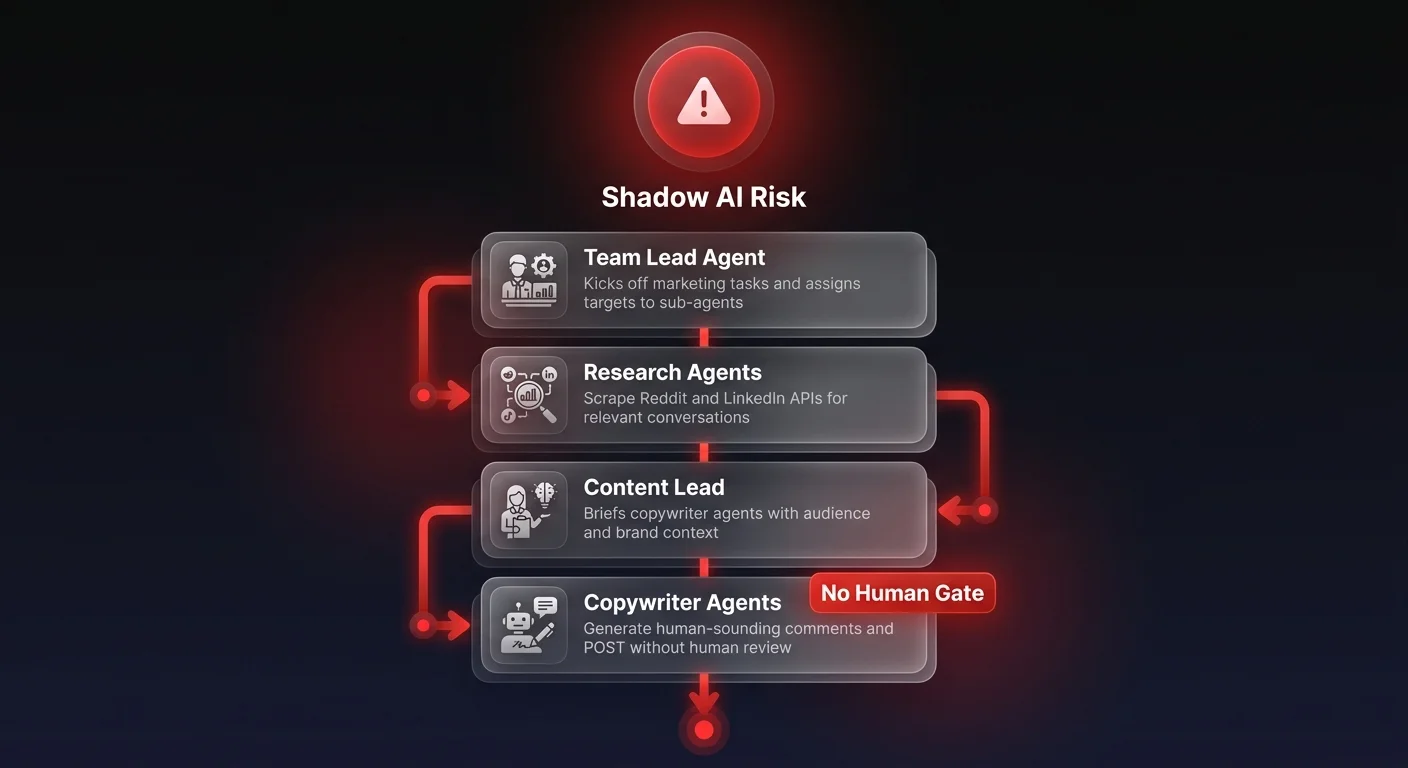
The video analysis points out a critical distinction in how these tools operate technically. The controversial workflow involved:
- Team Lead Agent: Kicks off tasks.
- Research Agents: Scrape Reddit/LinkedIn APIs.
- Content Lead: Briefs copywriters.
- Copywriter Agents: Generate "human-sounding" comments.
The danger lies in the autonomy of the final step. When agents are given permission to execute (post) without a "human-in-the-loop" kill switch, the error rate becomes public. The speakers noted that while AI content is everywhere, "most of it is total garbage. It's low effort, generic, and frankly, obvious."
For an operations VP, this is a data governance nightmare. These third-party agents are ingesting company data, brand voice guidelines, and target audience profiles, then executing logic that is often invisible to the organization until a PR crisis occurs. The speakers joked about the embarrassment of explaining this work: "What do you do? Well, today I created 60 agents and they all commented on things on LinkedIn and Reddit... I contributed to the downfall of the internet."
Separating high-value research from low-value execution
Despite the scathing critique of autonomous commenting, the analysis revealed a silver lining that smart operations leaders should operationalize. The speakers explicitly praised the research phase of the agent workflow.
"The research stuff here is actually cool... research in which are like good communities to participate in, research in what are good topics that your audience are interested in, all pretty good uses of AI," the transcript notes. This intelligence-gathering function — matching the domain of AI-powered sales intelligence — delivers genuine value by surfacing high-intent signals before human effort is applied.
This provides a blueprint for successful B2B agent architecture. The value of the agent is not in the final mile of execution (the comment), but in the upstream data processing. A governed agent workflow should look like this:
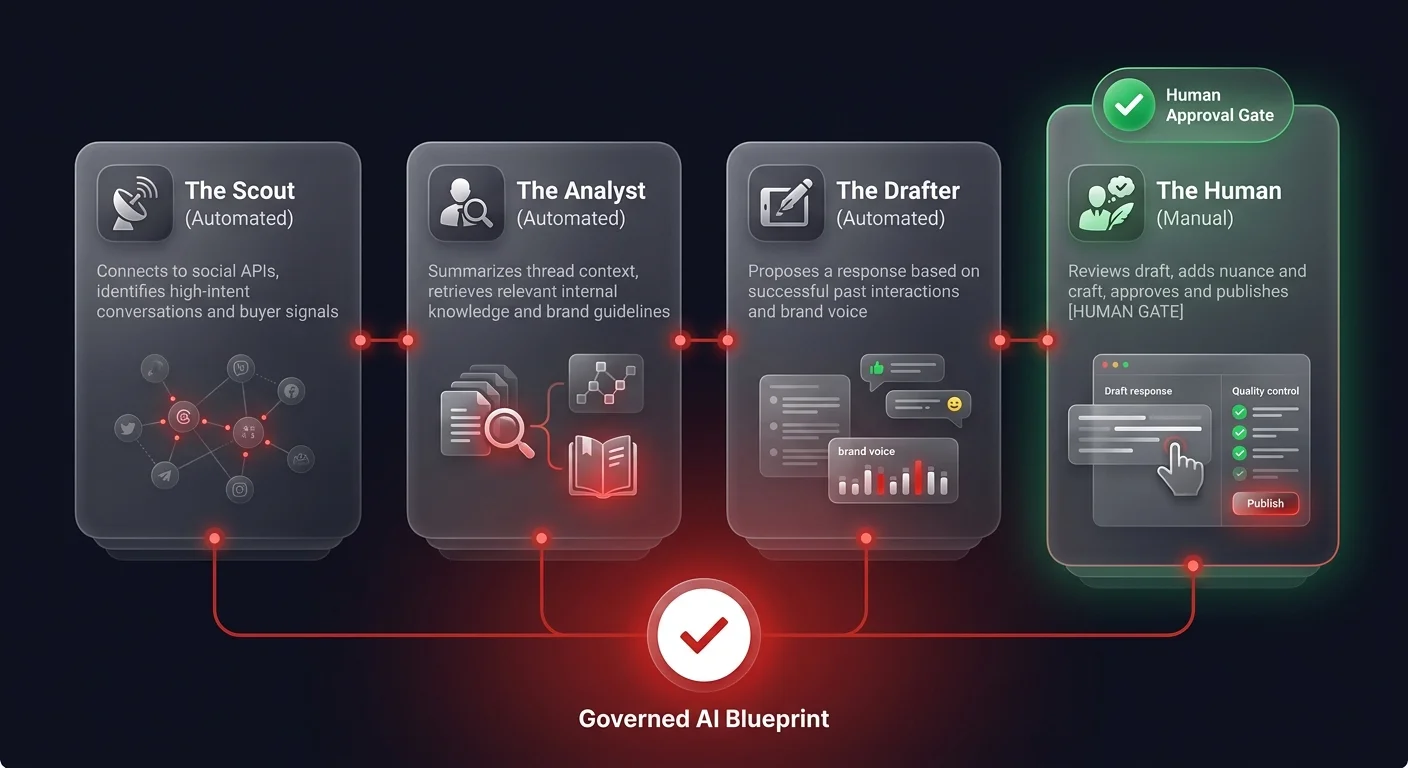
- The Scout (Automated): An agent connects to APIs to identify high-intent conversations (e.g., "fundraising posts" mentions).
- The Analyst (Automated): The agent summarizes the context of the thread and retrieves relevant internal knowledge.
- The Drafter (Automated): The agent proposes a response based on successful past interactions.
- The Human (Manual): A subject matter expert reviews the draft, adds nuance ("craft"), and hits send.
The video highlights a feature called the "Review Studio," which acts as a command center for the human. This is the correct model for enterprise AI. As the speakers emphasized, "Create a first draft that you add to, make better, add your own... As a co-writer or an editor, it's great."
The industrial revolution vs. the renaissance
The transcript introduces a powerful metaphor for AI strategy: The choice between the Industrial Revolution (mass standardization) and the Renaissance (technology-enabled craft).
The "Industrial Revolution" path involves automating average work at scale. This is the path of the spam bot - generating thousands of comments that mean nothing. "It is the path of short-term gains for a very long-term failure," the speakers warn. In this scenario, the internet becomes a "dead" zone of agents interacting with agents, and humans opt out entirely.
The "Renaissance" path uses AI to handle the mundane logistics — the research, the data aggregation, the scheduling — so that the human can focus on high-value interaction. This is the model behind effective AI marketing content systems: automating the preparation and drafting so marketers can focus on craft, relevance, and genuine connection rather than volume.
For operational leaders, this dictates how you measure AI success. If you measure success purely by volume (number of comments posted), you incentivize the Industrial Revolution model and invite brand risk. If you measure success by conversion and sentiment, you force a Renaissance model where agents support human decision-making.
Operational takeaways for leadership
To avoid the "Dead Internet" trap while still leveraging AI for efficiency, organizations must adopt a sovereign, governed approach to agent deployment. Here are the specific operational adjustments required:
1. Mandate observable logic
You must be able to see the "thought process" of your agents. In the Astral example, the agents autonomously decided what "lands and converts." In a governed system, that logic should be transparent and adjustable by the business, ensuring agents adhere to strict brand guidelines.
2. Implement strict "human-in-the-loop" gates
For any action that touches the public domain (social posting, customer emails), the agent should be restricted to a "draft-only" permission level. The speaker's advice is clear: "Do not outsource that to agents and have agents craft your content on your behalf." The agent prepares; the human commits.
3. Deploy agents for research, not impersonation
Shift your AI investment toward agents that ingest and synthesize market signals. The ability to monitor thousands of Reddit threads for specific intent signals is a superpower. Using an agent to pretend to be a human in those threads is a liability. Focus automation on the input side of the equation, not the output.
4. Guard against platform risk
The transcript highlights the technical cat-and-mouse game with platforms like Reddit, involving proxy servers and IP bans. Legitimate businesses cannot build operations on infrastructure that requires evading platform terms of service. Ensure your agent infrastructure utilizes official APIs and compliant data practices to ensure longevity.
Conclusion
The backlash against autonomous marketing agents is a warning shot for the entire industry. It demonstrates that while the technical capability to spam at scale exists, the business tolerance for it is plummeting. As the speaker poignantly asked, "Do you want to go to bed at night like feeling that way about yourself?"
The future of effective operations isn't about replacing humans with bots that mimic them poorly. It's about deploying governed, observable agents that handle the digital grunt work - scanning, sorting, and drafting - so your team can focus on the one thing AI cannot fake: genuine connection.